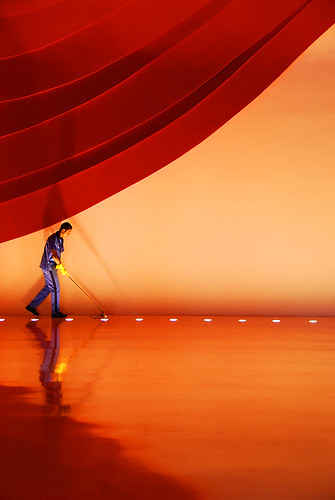
What several designers noted, though, were the crazy-quilt lines of what the publicity materials refer to as the “grand manor roof.” “With most houses, they could be colonial or modern, the roof line is so clear that you can see that underneath there is some kind of rational flow and layout,” said Mr. Hayes, author of “The Tailored Interior.” “With this, they’re unresolved and a bit messed up. You know that what’s underneath is not a lot of clarity.”
Hayes was speaking of Michelle Bachmann's Minnesota home in The Houses of the Hopefuls in today's New York Times.
The article features a run down of the architecture and interior design of the homes of the Republican presidential hopefuls.
UCSD professor of visual arts Ricardo Dominguez cited in an EFE wire story and reported by Fox News Latino »
UCSD professor of visual arts Ricardo Dominguez was speaking about a smartphone application that he created using GPS technology to assist individuals cross the border from Mexico to the US illegally by sharing information about the location of aid stations where water, clothing and blankets are stockpiled.
Domingo spoke to cell phones as part of a "poetic system that can save lives."
In America, the top 1% earn more than $380,000 per year. We are, however, among the richest nations on Earth. How much do you need to earn to be among the top 1% of the world?
$34,000.
That was the finding World Bank economist Branko Milanovic presented in his 2010 book The Haves and the Have-Nots. Going down the distribution ladder may be just as surprising. To be in the top half of the globe, you need to earn just $1,225 a year. For the top 20%, it's $5,000 per year. Enter the top 10% with $12,000 a year. To be included in the top 0.1% requires an annual income of $70,000.
Desire lines generally refer to worn paths
where people naturally walk – the beaten path that trails off the sidewalk,
usually as a shortcut to a destination – but can be applied more broadly to any
signs or traces of user activity in an object or environment. The implicit
claim of desire lines is that they represent an unbiased indication of how an
object or environment is actually used by people.
My grandfather introduced me to desire lines, but he didn’t
call them by name. I can’t be sure that he knew what they were called. We were
crossing the Quad at the University of Washington, cherry trees in bloom, and
he pointed out the gentle ruts in the grass left by renegade feet in oblique
purpose to the University’s imposed paths.
“Those are the paths they should pave,” he said, pointing
out the bald earth. I think of him now whenever I see a transgressive groove
slice through the corners of trim, paved plaza geometries.
Desire lines.
Rem Koolhaas oriented his IIT Student Center around the
desire lines that students wore into the wasteland beneath the El tracks on
their passage to class, long before the building was sited. In the belly of his building there’s a placard that
maps the original paths so you can see at a macro level what you experience when
you walk through the structure: his building breathes with a unique kind of
respiration because it is so well-aligned with the passage of people through
that place. It doesn’t obstruct their passage from point A to B: It shelters
it.
I’m surprised that I’ve only just discovered this name for the
thing. It startled me when I stumbled across it yesterday, and left me to
wonder if maybe I knew it before but didn’t notice it; am noticing it now only because
of these first tentative steps off my trim path; this early attempt
at letting my feet find the way they would prefer to go.
The rabbi addresses the importance of talking to the dead. His premise is that we want to, need to, talk to the dead. It is an important, not a maudlin, thing to do. The rabbi suggests that we have four things to say to them: I'm sorry. Thank you. I forgive you. I love you. This is what makes us human, over time, over distance.
You have to write as much as you can. People have studied these things.
Principal Jay Richard of Oyster River Middle School, speaking on strategies for passing the essay portion of standardized tests in America's schools in today's New York Times.