Showing posts with label books. Show all posts

Tuesday, August 17, 2010

catchword

David Pearson
Great Ideas Vol. 1, Penguin Books

I really struggle with the idea that book covers should have a distinct voice. In many ways I think a book cover should do no more than titillate, leaving the blurb — and reader — to do the rest. I don’t think it should be down to me to reveal what the chief protagonist looks like, nor to imbue a piece of photography with a meaning for which it was never intended. Typographic or pattern-led covers challenge the reader to project meaning onto them, which feels entirely more sympathetic and — luckily for me — the French publishing industry seems to embrace quietly suggestive cover designs.


Text Designer David Pearson, interviewed by Peter Terzian in Print: Design for Curious Minds

It's not clear to me how I missed Penguin's reissue of the Great Ideas series, in four volumes no less with a fifth imminent, designed exquisitely by David Pearson. My only excuse is that, perhaps, the releases with their extraordinary book design didn't make it to the US, and we all know I've had my own difficulties leaving these shores of late.

Although I fear the reason may be that I don't spend enough time in bookstores anymore, browsing the tables with the latest releases; that I rely too much on the Internet for information and insights; that I buy too frequently from Amazon; that I've neglected my first, my truest, my dearest friends: books.

How curious that I would discover what I've missed through a random Flickr photostream encounter.

Whatever the reason, Mr. Pearson's work is exquisite and makes me want to toss off my responsibilities and spend a good solid series of weeks catching up with the great ideas books, and then weeks more discovering new books that his covers tease out for me.

Enjoy.

Great Ideas Vol. 1 »
Great Ideas Vol. 2 »
Great Ideas Vol. 3 »
davidpearsondesign.com

Internally, illustrative endpapers and a decorative title page are joined by a rather unusual text setting method rarely seen in the last hundred years. Each right-hand page sports what is known as a catchword: a hanging word that provides the opening of the following page. We believe that this aids the flow of reading, especially when using a larger, heavy page with a slow turning rate.

From the same interview cited above.

Tuesday, July 13, 2010

like traffic signs


driveby #2. blurred.
Originally uploaded by suttonhoo
Punctuation, he said, was like traffic signs, too much of it distracted you from the road on which you travelled, and if you wondered, Wouldn’t writing be rather confusing without it, he would say No, it was like the constant wash and turn of the sea, sounding even more sibilant in Portuguese than in English, or like a journey taken by a traveller, every step linked to the next and every end to a beginning, or like the press of time, no sooner coming than going, never stopping in the present, which consequently never existed.


From the Economists' obituary for José Saramago, Portugal’s Nobel laureate in literature.

Saturday, June 12, 2010

get lit


get lit
Originally uploaded by suttonhoo
Posting by cameraphone from the Printer's Row Lit Fest née Book Fair.

Charlie Pierce up next »

Sunday, May 23, 2010

julius shulman: chicago mid-century modernism (book signing)

Gary Gand signs the book: Julius Shulman's last book, really. Story to follow soon.

Posting by cameraphone from Rockwell's House on the Bluff in Olympia Fields, Illinois.

Update: Here's the story »

Thursday, May 06, 2010

the comfort of things


George’s flat was disorienting not because of anything that was in it, but precisely because it contained nothing at all, beyond the most basic carpet and furniture. Absence of a degree doesn’t particularly disturb. A place can be minimalist, or there can be a single plant or poster that gathers presence precisely through contrast with the lack of any other resting place for the eye. But there is always something: a little china ornament, a postcard from a trip somewhere, an image of a friend or relative, even an old ticket stub or label. What I can barely ever remember encountering is a habitation entirely devoid of any form of decoration.

There is a violence to such emptiness.

Faced with nothing, one’s gaze is not returned, attention is not circumscribed. There is a loss of shape, discernment and integrity. There is no sense of the person as the other, who defines one’s own boundary and extent. I was trying to concentrate on what he was saying, but I was disturbed by the sheer completeness of this void. I began to feel we simply had to visit the other rooms in his house, his bedroom and his bathroom, in the hope that they would not replicate this chilling absence. But when, during a subsequent visit we did take opportunities to glance around these other rooms, they proved just as empty.


Daniel Miller in The Comfort of Things.

This is the same fellow who wrote Stuff (also loaded with brilliant, tender insights into how we express ourselves and arrive at self through material culture).

Sunday, May 02, 2010

browser


browser
Originally uploaded by suttonhoo
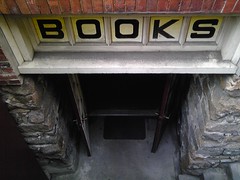
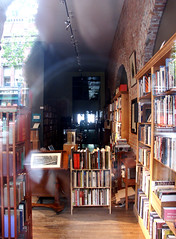
Browsing used bookshops in Boston leaves me wanting nothing more for all the rest of my days than to find a good spot in a quiet corner where I can settle in and read.

Nearly had a fit at Commonwealth Books on 2 Milk Street when I found a copy of the book I've always wanted to read but didn't know existed: Malvina Hoffman's Heads and Tales. First edition. Signed by the author.

And even though I couldn't bluff my way through my excitement well enough to ask the shop clerk (the owner?) to knock the price down a little she did, without my asking, and said how glad she was to see someone excited over a book; said most folks only want to buy what they can plug in.

I'm afraid I'm complicit in, I told her. It's what I do for a living; and she startled before going on, full of hurt and forgiveness, like a grandmother who only receives visits on far distant holidays.

Well, that's all right, she said. At least you stop by when you can.

Posting by cameraphone from Boston.

Friday, April 16, 2010

sufficiency


I have all I want.


Grigory (Grisha) Perelman, "the fearsomely brilliant and notoriously antisocial Russian mathematician," uttered through the closed door of his apartment on March 23rd of this year to the folks who tried to award him the $1M dollar Clay prize for proving the Poincaré Conjecture, according to the New York Review of Books.

Perelman is in the habit of refusing prizes. According to the same piece he turned down the Fields Medal in 2006 for the same proof, saying: “Everybody understood that if the proof is correct then no other recognition is needed," and in 1996 he refused a prize from the European Mathematical Society because "he believed that his work was not complete, that the judges were not qualified to assess it, and that he, not they, should decide when he should receive a prize."


Martha Glesson's book on Perelman, Perfect Rigor: A genius and the mathematical breakthrough of the century was also reviewed by the New Scientist back in November »

Sunday, January 24, 2010

deep into that darkness peering

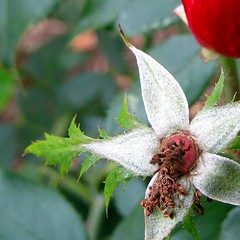
passing rose, detail

Since 1949 ... a black-clad figure has shown up annually early on the morning of Jan. 19, the author’s birthday, to raise a Cognac toast to his grave and deposit three red roses, along with the remnants of the Cognac bottle.

But the visitor — whose identity, or identities, has never been revealed, despite some claims to the contrary over the years — failed to show up this year for the first time, ending a strange crepuscular tradition and disappointing a crowd of more than 30 people who forfeited a good night’s sleep to witness the visitation.

Randy Kennedy in the New York Times over the no-show of the Poe Toaster on the anniversary of Edgar Allan Poe's birthday, January 19th.

In today's paper there is speculation that the toaster "might have just had the flu or car trouble — or that he had died," as people have been known to do.

unhappy in his life


Update: Leslie Miller, she of much cake, commented on Facebook this morning that there was speculation that her friend, the poet David Frank, was the latest Poe Toaster. Mr. Frank passed away on January 14th. This recording of his poem, Alice Gains Plays the Harp, is really quite lovely.

Sunday, January 10, 2010

in search of memory


Please come to a theater near me.

Please.

btw: Eric Kandel's book, In Search of Memory? Brilliant and a pleasure to read.

Saturday, December 19, 2009

take it straight


take it straight
Originally uploaded by suttonhoo
That strange frothy microbrewed substance in the IV bag that looks like a nice small-batch wheat beer? That's my plasma.

This is the second batch; the first batch had already been returned to me, along with saline, in an icy transfusion after the blood center extracted a concentrated dose of red blood cells from what I gave them. How much was that? I got *two* "be kind to me I gave blood stickers" over the usual one. So two pints, but they gave me all the leftovers back. At the end of the hour the phlebotomist handed me a form to sign saying: "sorry I forgot about this before."

The consent form detailed the strange side effects I was already feeling -- weird tingling in my lips; severe chills; nausea -- and states at the very last: "Long term side-effects from the depletion of lymphocytes are unknown." That would be my white blood cells; the ones that fight infection.

Lovely.

Also in the small print: a prohibition against donating blood if you are a man who has had sexual contact with a man anytime since 1977. This question comes up some time after one is queried about sexual contact with an individual who is HIV positive, male or female.

So basically gay men are out, just because they're gay, unless I'm reading that wrong.

It may not be marriage, but it's still discrimination, and it made me even more curious to read Martha Nussbaum's pending release on the politics of revulsion in which she theorizes that much of the antagonism to gay marriage is rooted in homophobic disgust over queer sexuality.

I want to see where she goes with that and whether she draws a parallel between sexual discrimination and our sorry history of racial segregation.

Separate drinking fountains come to mind.

From Disgust to Humanity by Martha Nussbaum

Saturday, December 12, 2009

the black book

Illus: Sunlight Soap Advertisement from The Black Book

Dear Mrs. Morrison,
Someone sent me a copy of The Black Book and if at all possible I would like to have two more. I need one copy to give to a friend, another to throw against the wall over and over and over. The one I already own I want to hold in my hand against my heart.


A letter from a prison inmate to Toni Morrison, editor of the Black Book while she was an editor at Random House, upon the book's initial release in 1974, cited by NPR.

The Black Book has been reissued in commemoration of its 35 year anniversary »

the red book

Illus: Carl Jung, The Red Book

To the superficial observer, it will appear like madness.

Carl Jung in the unfinished epilogue to his Red Book.

Jung's Red Book is on exhibit at the Rubin Museum of Art in Chelsea through mid-February.

The New York Times has posted a slideshow of Red Book folios (registration required) »

Friday, October 23, 2009

some like it hot


He was more dangerous. He did things to Minnie that were not nice. I think what happened was that he became so popular – this is my own theory – they gave his cruelty and his toughness to Donald Duck. And they made Mickey a fat nothing. He's too important for products. They want him to be placid and nice and adorable. He turned into a schmaltzer. I despised him after a point.


Where the Wild Things Are author Maurice Sendak commenting on the changes that came to Mickey Mouse over time in Tuesday's Guardian.

In the article, when he's not telling "parents worried by Wild Things to 'go to hell'", he's recounting how the monsters in his classic children's book were based on relatives who came to his house when he was a child. Immigrants who spoke little English:

They grabbed you and twisted your face, and they thought that was an affectionate thing to do. And I knew that my mother's cooking was pretty terrible, and it also took forever, and there was every possibility that they would eat me, or my sister or my brother. We really had a wicked fantasy that they were capable of that. We couldn't taste any worse than what she was preparing. So that's who the Wild Things are. They're foreigners, lost in America, without a language. And children who are petrified of them, and don't understand that these gestures, these twistings of flesh, are meant to be affectionate.


It's a brief crotchety frightfully endearing piece -- especially the part about how he and his editor battled over whether or not to say that Max's dinner was "still hot" -- as opposed to "warm" -- and less likely to burn a little boy. He won the battle by conveying: "how dopey 'warm' sounded. Unemotional. Undramatic. Everything about that book is 'hot'."

Mr. Sendak, I adore you.

made animate

Photo: Terry Border

The young Joyce was a frequenter of the Dublin Hermetic Society and was intrigued by the notion that things could be endowed with consciousness. You didn't have to be a Theosophist to sense such potentials; writers and artists had similar intuitions.

The painter Cézanne, for example, said that the apples he painted were 'filled with thought'. Other modernist artists were moved by the sight of inanimate objects that had suffered rejection. 'This morning I visited the place where the street cleaners dump the rubbish,' Van Gogh reported. 'My God, it was beautiful.'


From Ulysses and Us by Declan Kiberd, a new release and remarkably good read that is my first step in finally tackling Joyce's Ulysses.

Apparently I'm not alone in giving up early in. According to Kiberd: "Ernest Hemingway worshipped Joyce as the leader of intellectual Paris in the 1920s, yet his copy of Ulysses lies in the John F. Kennedy library with all but the early and final pages uncut."

Those final pages would be the dirty bits.

I mention it now because Terry Border's Bent Objects: The Secret Life of Everyday Things has also just been released to the wild, and his mimetic objects (which you may know from his blog) animate the thoughts that most of us are guilty of -- that these things that populate our lives may well have a life of their own.

Crazy thoughts, maybe, or simply absurd -- and absurdity, we now know, is good for the brain.

So there's the hook: Just like the great Modernists, Bent Objects is good for the brain. Your brain. And whichever brain you may choose to grace with a copy this holiday season.

Plus, it's a whole lot of fun.

<end>Bald pimping from a Bent Object's fan.</end>


Related:
apparition with an appetite »
he revealed himself to me in the cheese »
outlook not good »

Saturday, October 17, 2009

speaking of small trades

waiting for the shop to open

What this does is accentuate the trend towards best sellers dominating the market. You have a choke point where millions of writers are trying to reach millions of readers, but if it all has to go through a narrow funnel where there are only four or five buyers deciding what’s going to get published, the business is in trouble.


William Petrocelli, an owner of Book Passage, an independent company that has stores in San Francisco and suburban Corte Madera, California, commenting in the New York Times on the price wars that emerged yesterday between Amazon and Walmart on upcoming releases.

Friday, October 09, 2009

being ware, part 2.

Video: Chris Ware on making stuff


p.s. Being Ware, part 1 »

Sunday, September 06, 2009

wild thing

Video Trailer: Where the Wild Things Are

Hope.
Fear.
Adventure.

I can get into that.

Plus the kid looks a whole lot like my Portland honey, J-H.

The movie adaptation of Where the Wild Things Are opens October 16th.

Sendak's book terrified me when I was a kid. Not in a nervous Cat in the Hat kind of a way; in a subverting the dominant paradigm I want to do that too kind of way.

Of especial interest is the documentary that director Jonez has also made about Where the Wild Things Are author and illustrator Maurice Sendak, a clip of which is available via the NYTimes website (left side rail) »

The documentary airs Oct 14th on HBO. (Or so says the NYT. Nothing online at HBO about it quite yet.)

Monday, August 24, 2009

souffléd


In a month, I’ve sold almost seven times what I sell, typically, in a year of ‘Mastering,’ and it’s going to get even higher. It’s amazing.


Lee Stern, cookbook buyer for Barnes & Noble, in After 48 Years, Julia Child Has a Big Best Seller, Butter and All in this morning's New York Times.

The New York Times reports that Child's iconic cookbook "will make its debut at No. 1 on the New York Times best-seller list of Aug. 30 in the advice and how-to category," and that the 22,000 copies that sold in the last week tracked were "more copies than were sold in any full year since the book’s appearance."

All good, and Yay, Julia, and yes the movie is a delight. What strikes me about this success however is the contrast to earlier sales figures. Julia Child is an icon. Her kitchen is entombed in the Smithsonian. She changed how Americans cook.

Somehow she did all this without ever before reaching Number One on the New York Times bestseller list.

With those previous sales figures would she have become the icon that she is in today's America? Would her television viewing numbers rank her among the also ran chefs of the Food Network?

Given today's media saturation, would any of us know Julia Child today?

Video: The Omlette Show (The French Chef)

Sunday, August 16, 2009

please make a note of it


People who have recently lost someone have a certain look, recognizable maybe only to those who have seen that look on their own faces. I have noticed it on my face and I notice it now on others.

The look is one of extreme vulnerability, nakedness, openness. It is the look of someone who walks from the ophthalmologist's office into the bright daylight with dilated eyes, or of someone who wears glasses and is suddenly made to take them off.

These people who have lost someone look naked because they think themselves invisible.


From Joan Didion's The Year of Magical Thinking.

I haven't blogged much (at all, not since it happened) about the only thing I'm thinking about, because this blog has been so often crowded with death and dying and grieving and loss and haven't we all had enough already?

But it occupies my every thought, when I'm not chasing it to some dark corner with work or travel or chores (my house? so tidy you wouldn't believe.).

A friend said today "you should tell people that: that she was more than most grandmothers; that she was more to you," and she was. My mother left me and my stepmother didn't like me much. There was no one to mother me.

Except Grama.

She said "tell them" like it would make it hurt less; or maybe make people care more.

But people caring more will not make me feel any less alone.

"That's a lonely feeling," another friend said, when he sent condolences, and they were the truest words I've received.

Which is a long way of saying that reading Joan Didion's The Year of Magical Thinking this weekend is the first time I haven't felt so crazy or so terribly alone since the ceiling caved in.

Highly recommended if you are grieving, or have grieved, or will grieve.

Which pretty much makes it mandatory reading for everyone on the planet.

Friday, August 14, 2009

sign-posts

just another roadside attraction

There are moments in our lives, there are moments in a day, when we seem to see beyond the usual. Such are the moments of our greatest happiness. Such are the moments of our greatest wisdom. If one could but recall his vision by some sort of sign. It was in this hope that the arts were invented. Sign-posts on the way to what may be. Sign-posts toward greater knowledge.


American Artist and Educator Robert Henri in his collection of lectures and thoughts: The Art Spirit.

@karigee is asking for favorite books to stock up her cache. I was reminded of this one and pulled it up on Google Books -- and was startled and reassured to be reminded of why I love it so much.

(I wrote briefly of how I came by it here »)
Related Posts with Thumbnails