Showing posts with label museums. Show all posts

Sunday, April 03, 2011

under glass


The Harvard Museum of Natural History is connected to the Peabody by a causeway on the third floor. I wandered over yesterday after I had my fill of the Peabody's fractured casts of the stelea of Copan and their marvelous Mayan greenstone, which is not entirely theirs at all, of course, but belonged to the good folks of Honduras once, some of whom were pictured beside the booty after it had been wrested from where their ancestors placed it millennia before, just before it was carted up by the folks from Harvard and shipped back to Cambridge for study.

Which got me to thinking about our compulsion to collect. Which is a dangerous thing for a museum junkie to start wondering about.

Without museums would we have as much cause to wonder about the wider world? Would a lack of museums lead us to be insular and inward looking and unconcerned about others beyond our boundaries? This is to be avoided. But what right do we have to uproot the treasures of other cities and peoples and place them under glass?

And then I wandered into the taxidermic galleries of the Natural History Museum. Case after case of collected creatures stuffed and arrayed incongruously on display. Prey beside predator, each soul unmoved by the presence of the other, staring ahead with glassy eyes. Each unrelentingly anxious, as if in answer to my question.


Taxidermic creatures, Harvard Museum of Natural History.

Sunday, August 16, 2009

ophidian

Photo: Museum of Arts and Design

After Saddam Hussein’s press referred to her as a serpent, Secretary Albright wore a golden snake brooch pinned to her suit for her next meeting on Iraq.


The Museum of Arts and Design, promoting Read My Pins, an exhibition of former Secretary of State Madeleine Albright's brooches that "explores jewelry as a diplomatic, political and social tool."

The exhibition runs at New York's Museum of Arts and Design from September 30 through January 31, 2010.

Thursday, June 25, 2009

the persistence of durable objects

English Cigarette Card from the NYPL Collection

Rimbaud (dead)
Lautréamont (dead)
Breton (gone to America)
Marx Brothers (forbidden)
English cigarettes (too expensive)
American cigarettes (see English cigarettes)
Jazz (no phonographs or recordings)
Getting out of here (no papers, too expensive)
Whiskey (too expensive)
Picasso
Cocteau


Text from a postcard from the Belgian poet Christian Dotremont to Paul Éluard written on 26 May 1942 from Nazi occupied Paris detailing what could and could no longer be had in the city under the occupation.

The postcard appears in Between Collaboration and Resistance: French Literary Life Under Nazi Occupation on the first floor of a double decker stack of exhibits regarding liberty -- the loss of it, the pursuit of it -- currently running at the New York Pubic Library.

The ground floor exhibit features artifacts from artists and writers in France under the occupation -- the program from the first production of Anouilh's Antigone is here, as is a pseudonymous review of Sartre's Les Mouches. There are film posters and still shots of films made under the occupation including Marcel Carné's luminous Children of Paradise.


There are letters: one penned by later Marxist critic and then POW Louis Althusser who, en route to his concentration camp wrote of "the train that shakes my pen" before he enfolded his missive into an envelope addressed to his uncle and dropped it through the train's window onto the railroad tracks. It bore no stamp, only a request that it be delivered to his uncle's address in Paris. And it was.

There was another epistolary exchange between Marguerite Duras and her husband Robert Anthelme: his scribbled on a small spare scrap of paper that he has survived the camps; to which her letter replies "You're alive! You're alive!" and in which she writes of her fear that she might not have survived news of his death. Never mind that she had been sleeping with their mutual friend Dionys Mascolo since before the war; never mind that eventually she would throw the former over for the latter. Never mind. He was alive right then when worse was feared.

Photo: Robert Anthelme, Marguerite Duras and Dionys Mascolo


So downstairs there are writers surviving, collaborating and resisting Vichy France, and upstairs, in that lean hallway that runs alongside the Rose Reading Room there's Stonewall. 1967: The Year of Gay Liberation isn't afforded nearly the same real estate as the Vichy show, but like so many of the shows that hang in that hallway it's tightly curated to deliver a full body blow with minimal artifacts, and it's cast in a strong palette of groovy golds that put the yellowing sepias of the Paris show to shame.

Here too there were more print pieces: posters and zines; pamphlets, police reports, newspapers, and letters produced in the aftermath of the Stonewall riots and the Lavender Menace response to Betty Friedan's lesbians-are-a-threat-to-feminism remarks. Ephemera, again. Small voices grasping in the swallowing din for a bullhorn to be heard by; a message in a bottle set upon the sea.

Here I am. Hear me.


I don't know if the NYPL planned these exhibits as complements. It's the first time I've seen such a strong echo between two simultaneously running exhibits in that space. The reverb was made stronger, perhaps, by the shouts coming now from Iran in the wake of the protests following the election of Mahmoud Ahmadinejad. It was impossible to not be keenly conscious of both the magnanimity and the fragility of the small human voice set against the force and will of a State that does not want to hear it.

The voices of the Green Revolution, as some have called it, are being amplified across the Web through retweets and vias and blog posts that trumpet the injustice and argue for the cause. These posts have and will most likely continue to play a potent and powerful role in spreading the word.

The social network Twitter acted as such an important conduit of information while events were unfolding in Iran that the U.S. State Department suggested that perhaps they should put off their scheduled maintenance and downtime in light of the fact that a revolution was underway. According to the New York Times:

This was just a call to say: ‘It appears Twitter is playing an important role at a crucial time in Iran. Could you keep it going?’” said P.J. Crowley, the assistant secretary of state for public affairs.


Viewing the Vichy France and Stonewall exhibits at NYPL I was reminded that the government cannot always be trusted with preserving public freedom of expression, but I'm still alarmed that online there is no place that is truly public. We are having a public conversation across private enterprise channels.

The power and potency of the social graphs that folks are creating across social networks like Twitter and Flickr and Facebook and their blogs on Wordpress and Blogger ride on corporate dollars. That social networks afford individuals influence across the web and through their network neighborhoods is undeniable; the fact that corporations are bankrolling a dialogue that once upon a time unfolded in the public square or through businesses like newspapers where public interest was the core mission, is hardly being discussed.

I'm not ready to make an argument for government intervention in the online space, but it's a concern that has been gnawing on me since the SxSW conference in March where I heard over and over again folks speaking about using the Interweb as a communication tool for furthering human rights and self-expression -- but no one mentioned the fact that we're doing this on the back of big business.

Which brings us too to the question of the ephemera generated online during events like the Green Revolution: How will we recount the voices that spoke up when these events have passed and history has been written by the winners? Where will we display the green swathed avatars and the tweets that spread like a lightening strike in a dry tinder forest?


You couldn't identify anything anymore. The persistence of durable objects had been solidly defeated.


The poet Jean Follain describing Sant-Lô, Normandy, which was decimated by the allied bombing that accompanied D-Day.

Saturday, November 29, 2008

attention must be paid


He represents an extremely subversive vision with his interest in populations that were disdained. He paid careful attention, not touristically but profoundly, to the human beings on the earth who think differently from us. It’s a respect for others, which is very strong and very moving. He knew that cultural diversity is necessary for cultural creativity, for the future.


Landscape designer Gilles Clément speaking of Claude Lévi-Strauss at the anthropologist's 100th birthday party yesterday in Paris. The party was held at the Musée du quai Branly, for which Clément designed the grounds.

Of negligible interest: Clément compared the hundred year old Lévi-Strauss to a tortoise.

Saturday, August 09, 2008

omphalos


I'm pretty sure that's a belly button on that pot.

Just sayin'.

Saturday, August 02, 2008

SAAM


SAAM
Originally uploaded by suttonhoo
Seattle Asian Art Museum

Posting by cameraphone from Volunteer Park, Seattle

Monday, July 21, 2008

Museo Nacional de Antropología


Decided to forgo uploading the dozens of shots that I took in the Museo Nacional de Antropología in Mexico City over five hours, and instead upload just a handful.

But five hours: yeah. It really is that big. It really is that amazing. And the restaurant buffet, on the lower level with an open patio and chattering squirrels running about, isn't bad either -- especially when you need to fortify just so that you can finish wandering through the collections. (Recommend passing on the flan, however.)

Tuesday, June 03, 2008

found.

Photo: Weegee


It rains every day and we can’t find 2 midgets, so it looks like I’ll be here at least 2 more weeks.


The photographer Weegee, from papers which are now part of the collection of the Indianapolis Museum of Art along with a whole trove of photographs recently found at a garage sale in Kentucky -- and nearly tossed away as rubbish. As reported in this morning's New York Times.

Hmmm: Indianapolis isn't all that far from Chicago...

I think I hear a road trip calling.

Although no word (in the article, at least) about if and when the photographs will be on display.

das pintele yud

imaginary boundaries

One of the central purposes of the exhibition is not only to explore the way maps summon national identities but, conversely, to investigate the way they function to force other identities out of locations.

Curator Rhoda Rosen writing in the catalog of the exhibit Imaginary Coordinates showing now at the Spertus Museum through September 7, 2008.


The Spertus Museum wasn’t on the docket for Sunday. The plan was to hit the matinee showing of The Thomashefskys: Music and Memories of a life in Yiddish Theater at the CSO, a show that held a lot of promise if you don’t mind (and lord knows I don’t mind) running in circles that trend twenty to thirty years my senior and concern themselves with things like the Yiddish Theater in America that took root in New York’s Lower East side the last time we got all worked up over the unstoppable tide of immigrants landing on American shores.

That time it was the Irish and the Ukrainians and the Poles and the Russians who were Gilding our Age -- and a fraction of those pouring in from Eastern Europe were Jewish. The story told at the Symphony, as it was patched together by Michael Tilson Thomas, the music director of the San Francisco Symphony, concerned two of those immigrants who also happened to be Thomas’ grandparents and two of the leading lights of that Yiddish Theater: Boris and Bessie Thomashevsky.

It was unexpected that we’d have a couple hours to kill before the show, and the Spertus had been on the list of things to see ever since Blair Kamin mentioned its remarkable architecture in the Trib and we stopped by briefly with half an hour to spare sometime back to see what was doing only to discover that they wanted a good chunk of change to get to the ninth and tenth floors where the exhibition and the collections are.

Time being short we took a pass then, poking around the library instead and digging the amazing video work at the top of the stairs by the cafe (that g*d*it I didn’t take notes on), but on Sunday we circled back with our hour and half, which by the time the guide [1] was ready for us had diminished to 45 minutes. We were the only ones under her charge so she was kind enough to trim it back and gave us the floor show in the time allowed.

What we saw was this: An exhibit which I incorrectly called Imaginary Boundaries in an earlier post -- it’s actually called Imaginary Coordinates -- about mapping the thing that you might expect a Jewish American Museum to put on a show about: The Holy Land.

In a way that you might not expect from a Jewish American Museum: From an attempted non-partisan point of view.

“Attempted” because of course the place itself imposes a point of view, and you could feel the tension in the room. There was a fair amount of heat generated by the couple who we picked up in the elevator, who rode up with us, asked a few barbed questions about what was going on here and then politely excused themselves from our guide’s good graces.

We saw them later taking their seats at the Thomashefsky show. Maybe they were just in a hurry. Maybe they weren’t put off by the fact that artifacts from both sides of the conversation shared equal space; by the fact that a map rendered from the memory and by the hand of a Palestinian man in exile to describe his home village which no longer exists, was provided equal real estate alongside the hand-drawn storyboard that a father bound for Auschwitz (who would never return) drew for the four-month old son whom he tucked away in hiding, the storyboard outlining the life that he hoped for him -- his safe survival, his potty training, education, marriage, and finally, “next year in Jerusalem!” (The storyboard compelled the small boy, grown to man, to move to and settle in Israel.)

Maybe they weren’t put off by any of that -- but they sure were cranky.

Although Imaginary Coordinates is part of the citywide Map Festivus that’s been running for a little while now, the maps themselves -- among them elaborate Dutch maps from the 15th century, British renderings from World War II, a map of the Geneva Initiative from 2003 -- all of them the works by men, are offset in the exhibit by contemporary artworks, all of them the creation of women who have some connection to that same hotly contested piece of land.

Remarkable among them was Shirley Shore’s 2004 Landslide composed of a sandbox arranged to resemble a desert topography over which is projected in real time:

a square grid of blinking color cells generated by a code. Beginning each sequence with a palette of sixteen colors and thousands of color cells, the map gradually transforms as cells appropriate neighboring areas. When two colors ultimately dominate the grid, the program stops and begins anew. Landslide operates on an infinite loop in which each cycle produces a different map and a different visual experience. [2]


I asked the guide what the algorithm was that drove the colors in their consumption of one another -- she was unsure but speculated that it was the larger color blocks that swallowed the smaller ones with which they collided. The impact was remarkable: a strange camouflage that morphed into a topographical map and then began again.

As you might expect it was impossible to experience an exhibit like that, marking as it does the 60th anniversary of the modern state of Israel, without the hovering awareness of who is conquerer and who is conquered in this equation -- even with the careful attention that was given to both sides of the narrative.
intermission


The contrast then, with the Thomashevsky show, was to be reminded of the diaspora, the thing that came before all this by just a few brief years; Jews without a home struggling to make America theirs.

The Thomashevskys were remarkable showmen but they were social activists too, providing theater for the Jewish community (in the Yiddish language, which felt like home) about the trials that they faced in this new place. One of their most popular running conceits was of the “green” immigrant and his and her comedic struggles and ultimate triumphs in their new world.

When their drama-ridden personal lives resulted in a split (but never divorce) Bessie Thomashevsky created a new theater and went to town with treatments of women’s issues like suffrage and birth control that sold out houses -- the Jewish Suffragette was one of her most popular roles.

The show was light spirited and entirely enjoyable (although maybe a little too precious, given that it was a treasure served up by a loving grandson who held his subjects a little too close), but the contrast that it presented to the Spertus exhibit was remarkable. In the CSO show the theme of liberation was unmistakable: It vouched for the freedom to live a creative life and to fiercely claim human rights for oneself and one’s community. One of the more memorable themes that defined one of the Thomashevsky’s biggest blockbuster was Das Pintele Yud (sounds like: "das pintela yee"), which spoke to something ineffable and untranslatable from Yiddish -- a grammatical mark that symbolizes (what the song board attempted to translate as) the “spark of Jewishness”. Working, striving, inexhaustible. Rich, spirited, alive.

Brilliantly uplifting in the context of the immigrants’ underdog story on foreign shores. Wholly unsettling (confronted hard on the heels of the quick sprint we made down Michigan Avenue to bridge the distance between the Spertus and the Symphony Hall) when the underdog has become ubermensch, and a chord change has been sounded.


[1] The Chicago Tribune reported in May that Imaginary Coordinates “closed earlier this month for organizers to re-evaluate content, [and] reopened with the major change being that visitors now must see it on guided tours beginning at the head of every hour. Nearly everything else is unchanged, meaning the show is still the most surprising of the eight with art in Chicago's Festival of Maps as well as a rewardingly unconventional commemoration of the 60th anniversary of Israel's founding.” Coordinates' Rewardingly Unorthodox by Alan G. Artner (May 22, 2008)

[2] Imaginary Coordinates (Spertus Press Chicago)

Monday, May 12, 2008

the important thing is going on

Edward Hopper: New York Movie

What I wanted to do was paint sunlight on the side of a house.
— Edward Hopper


I knew too little of Edward Hopper to know that there was more to him than Nighthawks; more than New York Restaurant, which I love for its perfect ability to conjure that transitory happening dependent on time and place known as “lunch” against a larger stage. More than New York in the 1920s. More than that: Hopper was a traveler. And that I didn’t know.

Caught the the Art Institute’s Edward Hopper / Winslow Homer show in its last few days over the weekend, trapped in the shuffling overflow crowd of zombie art fans plugged into those cursed taped audio tours (what I hate about how art galleries have been transformed by those god awful things? it’s like being surrounded by a crowd on their cellphones. they move in large lumps from frame to frame, as though each was a television set or a department store window decorated for Christmas, and assume that all comers will behave by the same automaton rules. there’s a constant electrical buzzing of ambient voiceovers and the occasional shouter who forgets she has her headphones on and gestures wildly to her companion about fugitive pigments and forgotten color washes. they forget to bend and move; they forget to say “excuse me” and forget to effect the physical courtesy required when thrown into public spaces populated by strangers.)
The Hopper show opens with the note about sunlight on the side of the house, progresses through his architectures and sparsely peopled spaces -- canvases “unspoilt by the impertinent presence of people” as his friend Guy Pene du Bois pointed out.

My viewing of the show, startling the folks in headphones as I dipped into and out of their streaming mass, was disrupted by a coiled stone snake that I had seen earlier that day in the Field Museum on a brief visit with my classmates from a course on the Mayan Collapse.

The Aztec snake, carved for the earth goddess, is exhibited on a raised platform under which has been placed a mirror -- so that the viewer can see that the underside was also immaculately finished with the scales and details of the coiled snake. Why? I asked our teacher. For the earth goddess, I was told. Because she can see the underside.


That information shook up my ideas of representational art -- used to, as I am, the stage with its proscenium arch and its audience beyond. To imagine that the folks who made this snake, compelled to create as we are still today, were perhaps compelled to create for a different audience entirely. Or perhaps more exclusively.

People as viewers are secondary to the primary audience: the Gods.

We make art to be seen -- the object is our intercessor.

Passing through the Hopper show, through the desolate loneliness of his urban spaces, I was acutely aware of how he was telling me this story. How his images reach through the loneliness that he portrays so well and attempt connection.[1] The canvas is his stage, I am his audience, he paints for me false fronts and stage sets and I agree to search out the truth of what he has to tell me.

Or at the very least to try.

In the last room of the Hopper show we see Hopper’s later works, when he’s taken to the road after the disappointing period that followed the success of his Nighthawks. He and his wife travel West, and his Western Motel of 1957 is so perfectly transiently American -- this brief, tidy place of habitation against a western landscape; yurt-like in its purpose, the traveler knows it for only a night before they move on. The terrain occupies as much space as the room itself.

Edward Hopper: Western Motel


To me the important thing is going on. You know how beautiful things are when you're traveling. — Hopper


The last canvas selected for the show is one of the last that Hopper painted before he passed away: a bare room, the walls washed in sunlight. Sun in an Empty Room from 1963 was an intentionally curated counterpoint, I suspect -- the journey from painting sunlight on the side of the house to painting sunlight within.

Illuminating the interior.

The placard on the wall details Hopper’s response when he he was asked what he was trying to get at with his art:

"I'm after ME", he replied.

To which I added my own quiet postscript: And you want us to know.


Edward Hopper: Sun in an Empty Room


[1] I’d argue that Flickr is more than just a place where folks seek self-expression -- it’s a place where folks seek connection through that self-expression. Its true appeal lies in the connectedness that the architecture enables -- the comments where folks thread back and forth; the groups where like minded souls post like minded content.

Monday, March 31, 2008

here. now.


Norton Simon Museum
Pasadena, CA

(baby got a holga.)

Sunday, February 17, 2008

even cowgirls get the blues


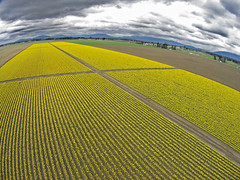
Daffodils from a Kite
Originally uploaded by GoodMolecules.
In the summer of my freshman year my uncle generously gave me a job in the Skagit Valley -- a curvy waistline of landscape that lies halfway between Seattle and Vancouver, about an hour and a half distant from either.

My plan had been to spend the summer in Seattle, stay with my grandparents, and work somewhere nearby, but nobody wanted someone who’d be leaving at summer’s end and I was too lousy at lying to pretend that I’d be sticking around, so my uncle (at my aunt’s gentle suggestion) gave me an administrative job in a cable office that he was just opening up in LaConner. I needed to work: nobody was paying my college tuition but me. So I took it.

The office occupied the first two floors of an old three-story house; I lived that summer in the top floor which had a bathroom of its own, but the kitchen of course was on the main level so I always felt like I was still at the office while I was making my dinner. Or sneaking down in my PJs to make a pot of coffee before everyone else arrived.

I spent the weekends in Seattle, but the weeknights were long and quiet and mostly lonely. The noise and busy friendships of school were subsumed to silence under a single ribbon that I used to tie up the letters, so many letters, that we all wrote back and forth. (Internets being not so big back then.)

But the memories from then are sharp and vivid; loneliness has a way of doing that. After the office closed I’d ride my borrowed bike through the unending fields, that sometimes grew tulips and daffodils and often grew every other kind of wonderful produce. Once I stupidly raced a crop duster that was lowering its poison dust across the field. (yeah. check in on me in another ten years. by then the cancer should have me.)

In the long twilit nights (Pacific Northwest summer nights have a way of stretching on past 10PM) I dutifully read the Englishman Somerset Maugham (wanting to love him. hating him so much.) and guiltily, greedily read LaConner local Tom Robbins.

I was embarrassed to love Robbins as much as I did -- his stuff was so earthy and juicy and vernacular. His proximity was palpable: he lived in town, was one of our cable customers even, calling the office to complain about his service; and, as a contemporary American writer -- not someone dead and dry and removed -- I didn’t know how to squeeze him into my idea of “great literature” as a college freshman who felt like I was already running out of time to read all the “important” stuff.

Thank god for growing up and learning how true it is that even cowgirls get the blues.

Robbins wrote a lovely description of the dawn kissing that valley in one of those books which I have utterly failed to find online (I’m lazy, and I reach my limit after half a dozen misguided queries -- plus I was distracted by a sweet snippet about belly buttons).

But all of this is to say that I received in the mail yesterday a tender view to that valley, a catalog for a exhibition of photography called Harvesting Light: Images of Contemporary Skagit Farm Life, produced by the Skagit County Historical Museum and curated by a friend, Karen Marshall, who is now Director of the museum.


The book catalogs a project that was born of photographer Vince Streano’s idea to have local photographers document a year in the life of Skagit Valley Farms. Eleven photographers participated and 4,000 images were produced; a selection of these were then curated by Marshall for the show.

The results are poetic -- large sweeping landscapes, laboring hands, and the product their labor produces.

But it’s also nearly elegiac -- Skagit County farmland is disappearing, of course. The earth that we need to sustain us is being eaten up by real estate development, like it is across much of America. And without much thought. As David Hedlin, one of the local voices that pepper this volume says: “We’re basically a society whose idea of long-range thinking is buying green bananas.”

I’ll be filing a friendly complaint with Karen regarding the impossibility of buying this volume online -- it doesn’t appear to be listed with Amazon or on the Skagit County Historical Museum’s website. In the meantime I can put you in touch with her for your own copy -- or you can stop by for that cup of tea and take a look at mine while the water boils.


p.s. You can also browse the Skagit County Flickr Pool »

The pool doesn’t include shots from the show, but it will give you a sense of that beautiful place.

Monday, January 28, 2008

green doors


Facade, Virginia Holocaust Museum
Richmond, VA

Museum is well curated, with the exception of their questionable use of mannequins. (Don’t ask.)

Update: I'm a bit embarrassed to admit that, when I posted this this morning, I didn't realize that today is Holocaust Memorial Day »

Monday, January 14, 2008

urban cowboy


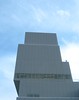
Maybe I would been more deeply moved by the exhibits at the New Museum if they hadn’t been mere punctuation marks in the larger conversation that Rahul and I had over the weekend -- catching up, tossing ideas around, pondering whether some of the “under construction” installations were actually constructed installations -- whether they were messing with us or, really, just working it out.


Either way I have no regrets -- the catching up was the best part. Of the experience the “Hell, Yes” rainbow on the exterior of the building (just me? or so delightfully Japanese?) moved me more than the whole of it, even more than the lovely stacked boxes that made up the structure -- chiefly because the traffic flow through those boxes, which relied heavily on large elevators to transport people between floors and seemed better able to accommodate the ingress over the egress, left me, well, to state the obvious: Unmoved. (And when I’m trying to get from floor to floor I like to be, at the very least, *capable* of motion.)

But I did come away with a treasure: A small chapbook of Minneapolis artist David Rathman’s cowboy sepias. A chapbook that I thought I might hoard for myself but which Rahul, in keeping me honest, has reminded me that I said something like “my dad would love these...” as I was oohing and aahing over the laconic compositions which Rathman creates, according to the book’s preface, by first snapping polaroids of old Westerns which he renders in inky sepia and then, on many, overlays found snippets of dialog.

And you know how much we like the found here at detritus. (With apologies to my brother, AMB, who once stated declaratively during a visit to the AIC, “I don’t like words with my art.”)

The Clementine Gallery has posted a few of Rathman’s pieces online -- but unfortunately their selection doesn’t speak to what this whole little chapbook reveals. The pieces they’ve chosen to post are largely without the dialog, which I suspects makes them more commercially safe.

But I prefer the ones that speak aloud to no one in particular, saying things like: “My vices were magnificent.” “Every day above ground is a good day.”

And: “This used to be a proud town.”

This one’s coming your way, Dad. Just give me a few more days with it.

the new museum

Saturday, January 12, 2008

the new museum

boxed in

boxed in
boxed in
Originally uploaded by suttonhoo.
Spent the afternoon losing my way with** an old friend through the New Museum of Contemporary Art, which really *is* a new museum (designed by architects Sejima & Nishizawa) and is also *called* the New Museum.

The structure and the exhibits were wholly disorienting.

Which is not entirely a bad thing.

The going without my big gun camera? That was kind of a bad thing.

Posting by cameraphone from NYC.

**and catching up and eating lots of good food with too.

Saturday, January 05, 2008

forney-cation


When I was in Denver between Christmas and New Year’s my brother was keen to check out the Forney Museum of Transportation. We had been a few times when we were kids and it was housed downtown in what is now the REI flagship store. The big brick warehouse, to my recollection, was the best part of that visit -- the way the sun spilled through the high windows and lit up the dust that lived everywhere in that place.

The exhibits, as I remembered them, were cool but stale: A lot of big machines. Cars. Trains. Other mechanical stuff. Cool to a point when you’re a girl with a penchant for these things. Unbelievably cool when you’re a boy.

Which is why, I think, my brother was keen to get back there.

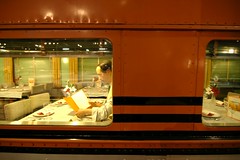
dining car


So we did. With his four kids in tow. And they didn’t even start saying “can we go now?” until we’d been there an hour at least.

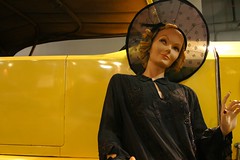
Me? I missed the high windows. The brick. But the electric cars were pretty cool. As were the trains. And I took an especial liking to all the creepy mannequins.

creepy mannequin

Thursday, November 08, 2007

curiosities of the sciences and marvels for the eyes [1]


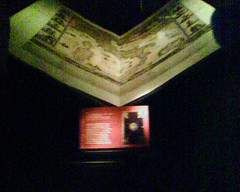
a map as tall as me
Originally uploaded by suttonhoo.[2]
Where am I? Where do I want to go? How do I get there?

—What Maps Tell Us, per the Field Museum


Maps, Finding our Place in the World, which opened up at Chicago’s Field Museum on November 2nd, is a peep show for the schematically inclined.

Caught it last night in a private showing put on by the good folks at the Anthropology Alliance, who also brought in Ryan Williams, one of the show’s curators, to speak on the technologies of mapping. (The buffet, for those who care most about these things, pulled in a meager 3 points out of 5. Full points for the open bar were offset by the unidentifiable Satay, which may or may not have been poultry product. Admittedly the score would have plummeted to 2.5 if the desserts weren’t as solid as they were: mini-carrot cakes, lemon bars and a molten brownie glazed in frosting, sprinkled with jimmies, and vaguely reminiscent of an uptown Hostess ding dong)

But to the exhibit.

All the big guns were there: Lindbergh’s Flight Chart for his historic New York to Paris trek. The first Mercatur projection (I know -- get out!). Cook’s chronograph (although no word on whether it was with him during that unfortunate incident in the Sandwich Islands in which the locals mistook him for Lono -- the second time).

Edmund Halley’s 17-hundred-something map of the magnetic North -- the very first graphical representation of the earth’s magnetic field, bifurcated by the lovely curvilinear “line of no variation” -- also put in an appearance; and Cortes’ map of the Aztec capitol he conquered was also in attendance.

Even a 15th century rendering of Ptolemy’s Geographia was there.

Fans of Edward Tufte will be sure to recognize John Snow’s 1855 Cholera Map of London and Minard’s Figurative Map of the Successive Losses in Men of the French Army in the Russian Campaign 1812-1813.

The freaking cool North/South digital military map of the Civil War conflict from the Lincoln Museum in Springfield, which I wrote about back in August of last year, was there, although it lost some of its impact on the small screen that it was afforded (about twelve inches across -- in Springfield it fills a wall).

Thomas Jefferson and Benjamin Franklin also put an appearance, mapping colonies and the Gulf Stream respectively, but it was the more obscure gems that were ultimately the most interesting.

  • Places Visited by Emperor Yu by an unknown Chinese mapmaker in 1136 was one of the first maps to use uniform scale to represent distance. The map itself is carved in wood -- copies were made via ink rubbings. The image is a strict grid -- solid blocks of black outlined in concave lines of white -- intersected and overrun by the sinuous meanders of what I assumed was the Yangtze, but realize now that I failed to write it down


  • A map of Oaxaca, Mexico, when it was still called Amoltepec -- drawn just like you would expect a Mixtec artist would draw it on paper in 1580 -- hauntingly reminiscent of the few remaining Mayan Codices


  • A map drawn from memory by Wetallok, an Inuit, of the Belcher Islands in Canada, on request for Explorer Robert Flaherty, that in its harsh expressionistic lines appears to be strikingly abstract -- until you compare it with the satellite image of the area that hangs alongside it, and you realize that folks who work the land know the land better than any surveyor ever could


  • A spectacular letterpress map of Venice executed across six panels on that gorgeous stout Italian-made paper, the upper rightmost of which, in all its peripheral abstraction, earned my award for “map I most want to take home to live with me and be my love”


  • The beautiful mystery of seeing first, the 1863 map by John Hanning Speke, on behalf of the Royal Geographic Society expedition, that verifies Lake Victoria as the source of the Nile River and then rounding the corner to find Francesco Roselli’s 1508 map of the world -- the first one post-Columbus’ discovery -- that not only tries to make sense (and does so badly) out of North and South America, but also harbors a sweet little divot cut clean through the paper where the heart should be in Africa that is, in fact, Lake Victoria -- and is fed by all those marvelous rivers, including, yes, why isn’t that the Nile? Hey...waitaminute...


I only got two-thirds of the way through in the hour before we were called away to the lecture, and then again in the brief twenty minutes that we squeaked in after the lecture before we had to hit the road home. So I’ll return soon to finish it, and to circle back to see the rest of the exhibit and to visit my favorites again -- including the sweet little slash of blue turbulence, perfectly tamed, that caught my eye like the crystalline call of an eagle’s cry [3] just as we were heading out the door. A story beautifully told, a man’s plan to tame the Arno and turn Florence into an economic powerhouse to rival its sister city: The Plan to Regulate the Arno River in Florence drawn by the hand of Leonardo da Vinci.


p.s. If you’ve never read Stephen Jay Gould’s explication of da Vinci’s Mona Lisa and the role that, he believes, water as an energy resource plays in that painting -- well, who am I to tell you what to read? But honestly -- you won’t be disappointed.

p.p.s. This map thing is going on all over the city for the next little while -- good times »


[1] Stole the title of this post from a remarkably beautiful Egyptian series of maps -- 13th century copies of 11th century originals by an unidentified mapmaker who turned out strikingly graphic and geometric representations of the European world that looked unlike anything the Europeans were producing at the time

[2] The image is illegal, taken by cameraphone before I saw the “no photography” sign, of an Italian book of maps, c. 1665, that, had it been standing, would have stood as tall as me -- and I’m 5 foot 12.

[3] Have you ever heard anything like it -- that clear blue chime that an eagle makes when it’s calling to its mate? I heard it once on Christmas Day walking through Seward Park in Seattle and it took me several disorienting minutes to realize that what I heard was a living breathing creature.

Saturday, October 27, 2007

shout out

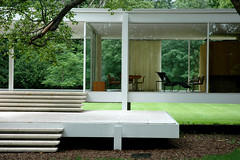
Mies' Farnsworth House

Sending some love to the good folks at Museu Oscar Niemeyer (MON) in Curitiba, Brazil, because they were kind enough to pick up a photo from my Farnsworth House set for publication in an "art educational primer that will be distributed free for the public schools of Parana State, encouraging students to visit the museum frequently."

Don't know which one they picked up just yet, but they were kind enough to promise me a copy.

Yay.

That set's getting a lot of airplay: Heard from some folks in Denmark a while back who made a similar request to use one of the Farnsworth exterior shots for "a children's (educational) book about architecture and air" by "Danish writer/architect Bente Lange", and have also granted permission for its use in The Fundamentals of Architecture by AVA Publishing out of Switzerland.

No word on whether I'll see the ink on either one of those.

Oh. Yeah. And before you think I'm one of those easy girls who gives it all up for nothin': Just sold a shot for real money that will grace the cover of a literary magazine, but they're sending 10 whole copies, so I'm holding back naming names until I have something to show for that one. :)

Double dog yay.

Saturday, September 29, 2007

wiggin' at the walker


wiggin' at the walker
Originally uploaded by suttonhoo.
Freaky video installation at the Walker Art Museum that none of us could figure out.

Hanging with my aunt and her sweetie in Minneapolis, MN.

Posting by cameraphone.
Related Posts with Thumbnails