Showing posts with label archaeology. Show all posts

Friday, December 18, 2009

petraphile


Ghost Hearders
Originally uploaded by TheOdyssey.tv
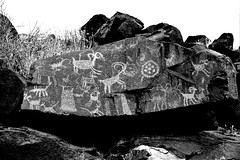
Having visited hundreds of sites all over the world, including Lascaux and Chauvet in France and the Côa Valley in Portugal, [archaeologist David S. Whitley] believes the Coso Petroglyphs to be one of the most important rock art sites on earth.

Mr. Whitley estimated that there may be as many as 100,000 images carved into the dark volcanic canyons above the China Lake basin, some as old as 12,000 to 16,000 years, others as recent as the mid-20th century.

In Rock Art Redefines Ancient in today's New York Times.

The Coso Rock Art District, just off the road between L.A. and Vegas, has defied disturbance because it also operates as a firing range for U.S. Naval air weapons.

Go figure.

It's open for visitors (during which time I'm pretty sure they turn the bombs off). You can arrange a tour through the Maturango Museum »

You can also take a Flickr tour:

Saturday, November 21, 2009

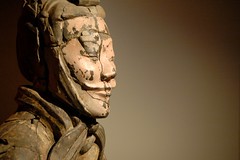
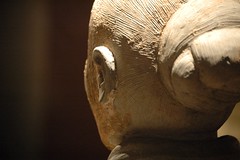
so about those Terra Cotta Warriors

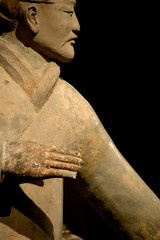
Terra Cotta Warrior


I left for D.C. on Wednesday knowing very little about the Terra Cotta Warriors that I was going to see on display at the National Geographic Museum, and I returned home knowing just a little bit more than that.

The only difference between then and now is that now I have pictures, and having pictures means that I have a responsibility to say something that matters about these guys.


So I went digging and this is what I found -- sources vary and are cited below. I offer them to you now along with an apology if any of this is old news:

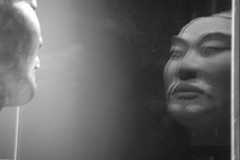
  • Long before the Warriors were “discovered” in Lin Tong in 1974, locals told stories of unfortunate ancestors “who dug too deeply in the earth and saw the face of a ghost, half-hidden in dirt,” and were plagued with bad fortune for their trouble. [1]


  • reflective


  • The farmers who were sinking the well that brought the warriors to light were at first ignored by local officials. The bureaucrat who was called in to examine the torso hauled in to county headquarters by Farmer Yang (which was no mean feat -- each Warrior weighs between 300 and 400 pounds) left it languishing in a back storeroom for some time before he declared that it was maybe 100 years old and not all that interesting. By chance an archaeologist from Xi’an heard about the discovery and recognized its significance.


  • The tomb was sacked and burned by enemies of the state before it was completed. The Warriors were buried in the warehouse where they were awaiting placement. It's believed that this is the reason several rooms of the tomb were found empty.


  • An elaborate river scene within the "entertainment center" of the Necropolis was, however, completed before the attack. According to the exhibit placard: "The longest hall takes the form of a river with a bank on each side, paralleling a river system above ground. Bronze birds, including cranes, swans, and geese were placed along the underground river's length. The 46 birds in the flock are all in naturalistic poses, each one slightly different."


  • Terra Cotta Warrior


  • The Emperor of China, Qin Shi Huang or Shihuangdi, on whose behalf the 8,000+ warriors were interred, was the first emperor China ever had.


  • According to Chinese officials, his burial chamber has yet to be excavated.


  • Under his rule the entire country took on the name of his home state Qin (because all of China had in fact been swallowed by Qin -- pronounced “chin”), and it’s thought that the western name “China” is probably derived from this place name.


  • Historians were largely unkind to Emperor Qin and described him as a hard ass who distrusted scholars and burned books. Some suggest that this description was politically motivated and not entirely true.


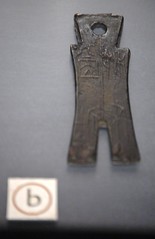
  • funky money


  • Under the first Emperor’s rule weights, measures, language and currencies were standardized -- and coin standards included some crazy shapes like spades and blades, in addition to the traditional circular form which ultimately won out.


  • Emperor Qin started construction on the Great Wall of China. Most of the “pounded earth and stone” that comprised his Wall was later replaced by brick in the Ming Dynasty, but some fragments of the original structure still remain.


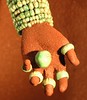
  • His terra cotta soldiers were not, in fact, individualized portraits, but: "an early feat of mass production: a small and quite limited repertoire of body parts were joined together in a multitude of combinations, with details worked by hand afterwards. Then the whole figures were painted. Endless variety of costumes, hairstyles, hand positions or facial features was therefore possible, but in no way were they individual portraits. The clay warriors were stamped with the name and unit of the foreman of a group of workmen, as part of an elaborate system of quality control." [2]


Jane Portal also reports in The first emperor: China's Terracotta Army that:

The First Emperor wanted to live for ever and go on ruling eternally. Following several assassination attempts on his life, he tried to achieve physical immortality with the help of alchemists who prescribed pills and potions featuring large amounts of mercury. He also sent groups of envoys to the mythical isles of the immortals off the east coast to seek elixirs of immortality.


civilian official


Given that, I shouldn’t have been so easily awed by the findings of researchers at Stanford who recently ran a chemical analysis of the Chinese Purple pigment used on the Terra Cotta Warriors -- a rare, synthetically derived pigment that some have speculated was received in a trade with the Egyptians long before the Silk Road became established. Please bear with the lengthy excerpt -- this is fascinating:

In order to address these questions [of provenance], we re-examined the chemistry and the morphology of purple pigments found on one of the Qin Terracotta warriors. By combining our findings of the technology used in the synthesis of Chinese Purple with existing archaeological evidence, we conclude that Taoist alchemists invented this pigment as well as the related pigment Chinese Blue independently from any Egyptian influence.

These chemical maps and maps of the crystallographic orientation suggest that Chinese Purple was synthesized using lead flux melting, a process very similar to that for glass making. Diffusion of heavy elements such as Ba, and even Cu, is very sluggish even at 1000 C and limits the grain sizes in a solid state synthesize to a few microns, as is frequently seen for solid state synthesis of high Tc superconductors which have similar heavy ion composition. However, if the pigment crystallites grew from a melt, as Pb elemental map and the grain growth morphology suggest, then the grain growth kinetics are not governed by diffusivity of individual ions, but by the flow due to thermal convention, which is significantly higher than solid state diffusion. Therefore, the presence of large pigment crystallites (20μm-50μm), in conjunction with the growth morphology suggest that pigment crystals grew in presence of liquid and probably even precipitated from a melt.

top knot

(...)


Historical records suggest that Taoist alchemists are responsible for the making of these barium-lead-containing glasses. It is known that jade holds a special status in Taoism.

Taoist believed that jade, which they considered to be a magical material, not only held the power to preserve a human body and spirit (Needham and Lu 1974) but also was an elixir for achieving physical immortality (Ko 320). In the pursuit to understand and obtain such a precious material, the Taoist monks started to synthesize it themselves. Several records in ancient Chinese texts mentioned Taoist monks making jade (glass) by fusing stones. As recorded in “Lun Heng” (Wang 27-97), “the Taoist monks used to make five-colored jade with five stones....” More importantly, it also mentioned that glass could achieve a certain appearance when different raw materials were added during the process, “Suihou (the duke of Sui) made beads out of several ‘medicines’ which were more shiny and appealing.”

As we know today, the barium glass has a larger refractive index than that of a normal glass. This would give barium glass a certain turbidity and a jade-like appearance. Glass (Jade) makers would have found this by trial and error. Barium minerals, such as Barite (BaSO4) or Witherite (BaCO3), are reasonably common in central China. This mineral is unusually heavy and forms “appealing” crystals, so the Chinese, as careful observers and curious chemists, would no doubt have found and experimented with it. In this process of imitating jade, they discovered the recipe of the barium containing glass. Then, the copper minerals, Malachite (Cu2(CO3)(OH)2) or Azurite (Cu3(CO3)2(OH)2), could be added later to obtain different jade colours. We believe that this experimentation led to the eventual discovery of Chinese Purple. [3]


The researchers report that the Chinese Purple wasn’t used much before this occasion, and was seldom seen afterward, which they suggest is an indication of the declining tide of Taoism.

Before then, however, as Jennifer Oldstone-Moore reports in her book on Taoism: origins, beliefs, practices, holy texts, sacred places, Taoist "individuals knowledgeable in techniques for achieving immortality -- the fang-shih, or ‘gentlemen with recipes’ -- were hired by imperial courts to reveal their secrets.” [4]

And so it would seem that Qin contracted with Taoist fang-shih to act as celestial tailors -- clothing his warriors in immortality to ensure his rule for all eternity.

Terra Cotta Warriors: Guardians of China's First Emperor
National Geographic Museum
1145 17th Street NW, Washington DC
Exhibition open daily from 10AM to 6PM
Hours extended to 9PM on Wednesdays, and the first 200 to line up by 5.30 will receive free entrance at 6PM.


kneeling figure


[1] Seth Faison, South of the Clouds: Exploring the Hidden Realms of China. St. Martin's Press, October 2004.

[2] Jane Portal and Hiromi Kinoshita, The first emperor: China's Terracotta Army. Harvard University Press, 2007.

[3] Influence of Taoism on the Invention of the Purple Pigment Used on the Qin Terracotta Warriors, Z. Liu1,3, A. Mehta1, N. Tamura2, D. Pickard3, B. Rong4, T. Zhou4 and P. Pianetta. Stanford Synchrotron Radiation Lab, Stanford University, Stanford, California 94305
USA

[4] Jennifer Oldstone-Moore, Taoism: origins, beliefs, practices, holy texts, sacred places. Oxford University Press, 2003.

p.s. The invitation to attend the bloggers’ preview of the exhibit was my excuse to have a lovely play day in the middle of the week in Washington D.C., and the excuse came my way only because my Twitter buddy @bobcatrock spotted the open call for bloggers on Flickr and passed the link my way.

Thank you thank you thank you, Mr. Bobcat. As excuses go, it was one of the best.

drum

Wednesday, November 11, 2009

homeless complements

Illus: 1870 Can Opener from Patent Pending Blog

The homeless have a tough time opening cans unless they have openers.


Archaeologist Larry Zimmerman, who conducted an archaeological survey of the homeless with student and colleague Jessica Welch, commenting in November/December 2009 issue of Archaeology on how "donations can simply go to waste if complementary items are not also offered."

Zimmerman and Welch found many cans around homeless sites unopened for want of a can opener and many hotel guest-size shampoo bottles unopened for want of running water. Survey findings indicate that "shoes, food, blankets and clothing can be put to better and more creative use and reuse if they are given with common-sense items such as shoelaces, scissors, rope, glue, and razors."

Tuesday, June 30, 2009

the chaco meridian


This book is not for the faint of heart, or for neophytes. If you are a practicing Southwestern archaeologist with hypertension problems, stop. Read something safe.


The warning that accompanies the The Chaco Meridian: Centers of Political Power in the Ancient Southwest by Steve Lekson, an archaeologist from the University of Colorado, in which Dr. Lekson argues that "for centuries the Anasazi leaders, reckoning by the stars, aligned their principal settlements along this north-south axis — the 108th meridian of longitude," according to today's New York Times.

The New York Times also cites David Phillips, curator of archaeology at the Maxwell Museum of Anthropology at the University of New Mexico, on the controversial Chaco Meridian theory:

Steve is possibly the best writer in Southwest archaeology. Our academic writing has this inherent gift of taking something interesting and making it dull and boring. And Steve doesn’t have that problem. He thinks outside the box, and the rest of us comb through his ideas.

Having said all that, I personally think that the Chaco meridian is a crock.


Archaeology published Amending the Meridian by Lekson in the January/February 2009 issue »

Saturday, May 02, 2009

cosa morta


cosa morta


cosa morta: the idea "that art divorced from its archaeological setting is a 'dead thing'."

Gleaned from Who Should Own the World's Antiquities, an examination of art, antiquity, nationality and provenance, in the 14 May issue of the New York Review of Books.

Wednesday, March 04, 2009

atomic artifact


The plutonium, found in a one-gallon glass jug after a cleanup crew tore open the safe with an excavator, was processed at Hanford in late 1944 from spent uranium fuel from a reactor at Oak Ridge, Tenn. It was the product of test runs of a plant built for separating plutonium for use in the Manhattan Project to build the atomic bomb.


The New York Times reporting on the man-made plutonium (read: nuclear waste) that was discovered in a glass jar in an "old safe buried in a waste trench" at the Hanford Nuclear Reservation in 2004.

The piece continues: "The only earlier sample of man-made plutonium known to exist was produced in 1941 in an accelerator and is stored at the Smithsonian Institution."

The glass jar was labeled: "Wastes for Recovery."

Friday, February 06, 2009

america's first archaeological subdivision


INDIAN CAMP RANCH is a 1200 acre tract of land 2 miles due west of the town of CORTEZ in the southwest corner of Colorado. It is divided into 32 parcels, each a little over 35 acres in size.

What is so unique about our Development is that we have over 210 Anasazi sites in excess of 700 years old. Montezuma County, where we are located, has an estimated 80,000 such sites but our uniqueness comes from not only the fact that we have the highest recorded site density in the state of Colorado but that we recognize the importance of protecting these sites for future generations. More about this later but the basics are these:

Every parcel contains from one to seventeen sites and every owner may excavate his or her sites when he or she agrees to the following guidelines:
  1. Excavate only under the guidance of an approved archaeologist

  2. Protect the finished dig in an open and protected condition

  3. Write an archaeological report upon completion

  4. Agree to donate all artifacts to the Indian Camp Ranch Museum upon their death

From the Indian Camp Ranch website, "America's First Archaeological Subdivision".

I poked around a little online to try to uncover how far Indian Camp Ranch's policies diverge from Colorado State and Federal Laws, because I suspect that the policy of their subdivision is simply state law delivered as marketing spin.

In Colorado, according to the National Association of Tribal Historic Preservation Officers:

Anyone who knowingly disturbs an unmarked human burial commits a Class 1 misdemeanor; any person who has knowledge that an unmarked human burial is being unlawfully disturbed and fails to notify the local law enforcement official commits a Class 2 misdemeanor.


Which is why, of course, you'd want to call in an archaeologist and proceed according to best practices if you stumbled across a possible archaeological site on any tract of land, regardless of whether it was within the boundaries of Indian Camp Ranch.

It appears that it's legal to collect arrowheads on private land, but it's unclear what the explicit considerations regarding the excavation of artifacts on private land are, when they are not associated with human burials. (I suspect there's more information out there -- I'm just short on time to dig around for it.) (Yes, of course, that pun was intended.)

Also important to keep in mind, per the Colorado Historical Society Office of Archaeology and Historic Preservation: What to do when you find those old dinosaur bones?

Contact a paleontologist. Stat.

Saturday, August 09, 2008

omphalos


I'm pretty sure that's a belly button on that pot.

Just sayin'.

Tuesday, July 22, 2008

these bones

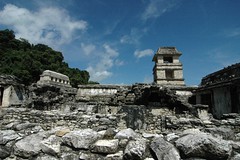
Palenque Tower and Temple


There’s a lot you should know about Palenque, a Mayan site on the Northern edge of the Chiapas highlands, but I’m probably not the one to tell you.
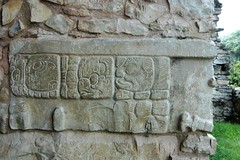
glyphs


Heavy hitters [1] have written books and papers and shared research about the place known to the classic Mayan as B’aakal, or Bone: about its art, its architecture, its friendly terms with Tikal, its antagonistic relations with Calakmul, Tonina and Piedras Negras.

At minimum you should know about K’inich Janaab’ Pakal and his cinnabar saturated jade strewn burial in the heart of the plaza. About how he was found at the bottom of a smooth bending stairway of ochre colored stone 22 meters deep in the Temple of the Inscriptions, barricaded by rubble from the world and connected only by a psychoduct through which his descendants could play telephone with their ancestor. About the marvelous greenstone mosaic that masked his face in death; about the jade sphere that his corpse clutched in his left hand; the jade cube that he clutched in his right.
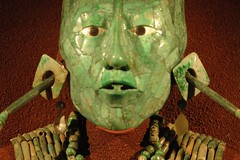
pakal's mask

pakal's cubepakal's sphere


About the marvelous inscription on the lid of his sarcophagus in which he’s resurrected from the underworld, Xibalba (which is wonderfully delicious to say out loud: she-BALL-bah), as a rapturous maize god; about his ancestors who line the sides of the monumental coffin (so tightly pinched into that small tomb that I asked a friend, who knows something about these things, “they carved it in situ? but how? the detail is so fine.” and he suggested that perhaps, instead, the massive temple was built around the stone container only after it had been carved.) who each bear a headdress that aligns them with an important crop -- cacoa (chocolate), nance, guayaba, chicozapote, mamey, and aguacate (avocado) -- crops that are passed from one generation to the next through inheritance. Like kingship. [2] Each gorgeous line etched to tell the story, to assert that I, Pakal, belong here. This was my job to do and I did it magnificently. And baby: I've *still* got your back. I'm an *ancestor* now.

Temple of the Inscriptions


You should know that the tourist traffic down the stairwell since it was excavated by Alberto Ruz Lhuillier in 1952, that the heat and breath and humidity of curious souls, threatened to destroy the treasure, and most folks can only see it now in a poorly rendered reproduction in the site museum at Palenque, or a little bit better reproduction at the Museo Nacional in Mexico City, where too the original jade mask is kept, along with the sphere and the cube and a cache of other precious grave goods.

You might be interested to know that one late night in a rainy December I had a chance to descend the ochre steps and peek into the tomb, and its an experience I’ll never forget. But that I didn’t this time: our host no longer working at Palenque, after a falling out with INAH.
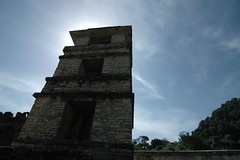
Palenque Tower


You should know too about the beautiful pieces that are still being excavated, some in just the last five years or so: About the jaw dropping details of the thrones from Temples 19 and 21, the figures so individualized, so finely incised, you can almost hear their conversation.
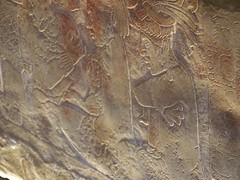
stumpy @ the palenque museo


You should know that in 1973 Merle Greene Robertson, who made magnificent rubbings of the stuccos and bas-relief of Palenque and other sites (preserving many of them before they were diminished by the ash of a nearby volcanic eruption and the relentless worry of acid rain) started the Mesa Redonda, or Palenque Roundtable, in the living room of her home on the street that is now named (and misspelled) in her honor.


How scholars and regular folks with an interest in Mayan glyphs got together to try to crack what they were all about; to uncover the stories; started telling them again. How Linda Schele was there, and her passion for that place sparked a strange and wonderful populist movement that lends a curious slant to Mayan scholarship today -- academics and independent scholars and hobbyists all working through ancient glyphic texts, with variable results, but all working, and adding their decipherings to the pile.
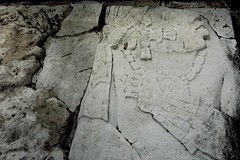
courtyard of the captives


And maybe its peevish of me to mention that ten years after its founding, and ten Roundtables into it, INAH took over the Mesa Redonda and restarted the count back at one, because that’s how INAH does things.
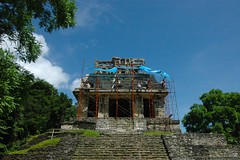
under construction


It might too be of interest to learn that Merle Greene celebrated her 95th birthday at this year’s Roundtable; that our trip was timed to coincide with the conclusion of the festivities so that our host, Nick, could share a few margaritas with the birthday girl.

And for those who have been reading detritus for awhile it might matter to know that the last day of our visit at the historic site we lit a candle in the Cathedral to commemorate the second of anniversary of the night that Kathryn died in Palenque, too young, but in a place she knew as home. In a place she dearly loved.
salvation under wraps


[1] A few heavy hitters worth looking at:
Chronicle of the Maya Kings and Queens: Deciphering the Dynasties of the Ancient Maya, Simon Martin and Nikolai Grube

Maya Cosmos, David Freidel, Linda Schele, and Joy Parker

The Inscriptions from Temple XIX at Palenque, David Stuart

Living with the Ancestors: Kin and Kingship in Ancient Maya Society, Patricia A. Mcanany

[2] Living with the Ancestors, p 43
Sunday, July 20, 2008

cabeza colossal


aka Big Head.

Olmec. These guys were kicking around before the Maya came to town.

Can't really tell from the pic, but this guy's head is about 9 feet high.

Museo Nacional de Antropología
Mexico City, MX

Monday, January 07, 2008

freedom to pillage


Something you probably already know: The Chicago Tribune Tower contains, in its stone facade, some 136 fragments from historical sites around the world. From the Wikipedia entry on the Tower:

Prior to the building of the Tribune Tower, correspondents for the Chicago Tribune brought back rocks and bricks from a variety of historically important sites throughout the world at the request of Colonel McCormick. Many of these reliefs have been incorporated into the lowest levels of the building and are labeled with their location of origin. Stones included in the wall are from such sites as the Trondheim Cathedral, Taj Mahal, the Parthenon, the Great Pyramid, The Alamo, Notre-Dame, Abraham Lincoln’s Tomb, the Great Wall of China, the Berlin Wall among others.

In all, there are 136 fragments in the building. More recently a rock returned from the moon was displayed in a window in the Tribune giftstore (it could not be added to the wall as NASA owns all moon rocks, and it is merely on loan to the Tribune), and a piece of steel recovered from the World Trade Center has been added to the wall.

It's not clear whether the correspondents had permission to lift these artifacts: What is known is that they had mandate from their boss, McCormick, to do so.

Tuesday, November 13, 2007

narwhals with picnickers & pepsi

Field Museum, Lower Level
Chicago, IL

Scarfing some vending action before seeing George & David Stuart (father & son Mayanists) speak at a National Geographic event on Palenque. (What's Palenque? Search my Flickr stream. ;)

Foraging upshot: Hostess Ding Dongs, 11 days past their expiration date.

Posting by cameraphone from seat #D22.

Saturday, August 04, 2007

moxie


rinaldi
Originally uploaded by suttonhoo.

a found poem

My earliest exposure
to gardens and grounds
came [at] my grandparents' home

Among prodigious beds
of black-eyed susans
and hydrangeas

While planting tomatoes there
when I was eight
I uncovered a Moxie pop bottle
tilled under
40 years earlier

It was my first brush
with landscape archaeology
the field of remembrance
and conservation

I could scarcely ignore
the residue of history


Found in Charles A. Birnbaum's piece Cultivating Appreciation in the Summer 2007 issue of Dwell

Wednesday, July 18, 2007

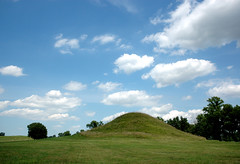
cahokia

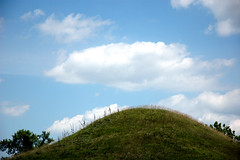
Cahokia mound

Cahokia was one of the target destinations for our trip down south this last weekend – it may be the largest North American UNESCO World Heritage site you’ve never heard of.

Once the largest pre-conquest settlement north of Mexico City, covering 2,200 acres today and sheltering anywhere from 20,000 to 40,000 people, the remains of Cahokia are today surrounded by Collinsville, a sleepy little town just east of St. Louis, whose scraggly little highway bisects the site.


Main attractions? Mounds. And plazas. And a well-intentioned interpretive center that went to town on their wide entry doors, devising a impenetrable bas-relief tableau in some kind of heavy metal that’s difficult to move, intended I’m sure, to rival Rodin’s Gates of Hell (doesn’t, but you’ve gotta appreciate the intent), and must be hell on the wheelchair bound (I had trouble moving them, and didn’t see an easy open switch, although there must have been one in the vicinity. There was a ramp out the back way – let’s hope that’s not the only accessible entrance.)

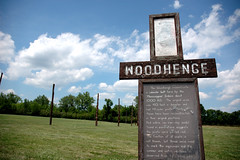
Woodhenge


And let’s not forget the Woodhenge: “You know: like Stonehenge” said the sweet matron who oriented us to the site. Circular, yes; oriented to sun’s path through the sky, yes; massive and monumental like Stonehenge? Well, no. Lovely slim posts where the stones might otherwise be. But sweet. And close to home. 10 points.

And evidence of human sacrifice in some of the excavated mounds: that’s worth about 25 points. (Here’s a tip for you when you go: the round mounds? Contain bodies and stuff. The squared off mounds? Platforms mostly, for strutting and alpha-dog purposes.)

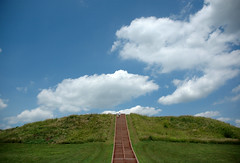
Monk's Mound


Monk’s Mound is the star attraction and it’s immense – a thigh aching climb, it exceeds El Castillo of Chichen Itza in Mexico at 100 feet high. But unlike the Mayan pyramids, which are built of stone and plastered over, this is a dirt mound, which requires a big broad base and makes the whole thing seem squatter than the pyramids down south.

Until you start climbing, of course. Ouch.

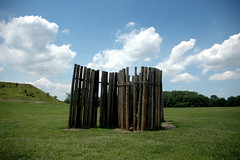
Cahokia pallisade (reconstruction)


Also of interest: the wooden palisade that once skirted the perimeter of the site, and has been reconstructed in bits and pieces to demonstrate its girth and construction. While we were there some folks were excavating what they believed was one of the far corners, just turning the bend. The students were friendly and informative and pulled back plastic tarps to show us the soil stains (those dark impressions left behind by what once was) where the palisade once stood.

All good. Although my evaluation may be biased by my fondness for things pyramidal and plaza-like. There’s a sense of space and proportionality at Cahokia that is not unlike Maya site configurations and seems to suggest a kinship with the Central American sites. All in all a fine place for a picnic.

And all those mounds – an artificial mountain each, built up by the careful attentions of so many hands – made me feel a little less lonely, as a transplanted Rocky Mountain girl, to know that I’m not only one on these wide open flatlands who aches for the embrace that only altitude can give.

Cahokia Mound

Tuesday, July 10, 2007

dust to dust


dust to dust
Originally uploaded by suttonhoo.
I don't think I've ever met an archaeologist who wasn't happy.

Solid happy like out in the sun messing with the dirt, happy; happy like a gardener who's just hoed a row; happy like a kid playing hard in mud puddles, important work kind of playing with the sun on your back and dust in your mouth and dirt under your nails to let you know you're alive, kind of happy.

(I want that kind of happy.)

Spent the evening with two happy folk who dig around Oaxaca and work for Chicago's Field Museum hearing about their recent discoveries at El Palmillo. Excavated residences, mostly, and funerary urns; strange distributions of ancestral burials and legends of the powerful presence of mountains.

Good stuff.

Buffet rocked four stars out of five – there was a white fish in a chile sauce and a tasty mole-topped tostadas (Oaxacan-style) that especially stood out. Whole thing might have hit five stars if we hadn't arrived late to find the quesadillas congealed.


Posting by cameraphone on the way home from Chicago's Field Museum. T.Rex is from one of those funky little mold-your-plastic-while-you-wait machines. (If you close your eyes you can just. smell it.)

Sunday, April 29, 2007

getcher rock on


I've been away -- playing mostly, thinking some. Scrambling on rock faces and seeing what's over the next ridge.

Here's a quickie slideshow of ~ 5,000 year old rock art from a spot called Grapevine Canyon on a little spurt of Nevada Highway 163. The turn-off is a dirt road called Christmas Tree Pass (why it's called Christmas Tree Pass I have no idea -- this isn't evergreen country). Keep your eyes peeled because it's easy to miss.

As are so many things that are worthwhile.

Wednesday, March 07, 2007

rite of spring

estella 12 top

Heading to Austin tomorrow to check in with the folks at the Maya Meetings. This has become a fairly regular rite of spring for us, although we missed the last couple of years because I was giving it all to the Man, and waited too long to book a room in town – a fatal error in the days surrounding the SXSW festival, which has morphed from Music into Interactive and Film, too.

Thought about trying to catch some of the Interactive while I was down there; then thought better of it. Days at home lately have become too precious and few. Do hope to catch a little spillover music while we’re in town, if we get lucky.

This will be the second year that they’re “doing things differently” at the meetings – Nikolai Grube left the seat that he inherited from Linda Schele a few years back. He was pretty much a traditionalist, and the meetings ran Linda’s way while he occupied the chair: Two days of papers (Thursday and Friday), followed by two days of collective decipherment (Saturday and Sunday) – which meant the rock stars of Mayan Studies armed with Sharpies hovering around an overhead projector, outlining and highlighting glyphs and their assorted and sundry parts, and making strange guttural utterances to the approval and/or dismay of the peanut gallery.

estella 12 detail

Worth noting: the peanut gallery is one of the best parts of these meetings, being a mash of notables and nobodys – Justin Kerr, Simon Martin, Michael Coe, Merle Greene, you get the picture… -- surrounded by young Turks and aging groupies (my sweetie and I fall into the aging set) who share little in common outside a prurient interest in the things folks etched in stone down South many, many years ago.

The initial four days used to be followed by a whole week of breakout workshops, in which folks sat down with notebooks full of inscriptions and Mayan grammars and went to town. I never did manage to make the time to stay for the follow up week, and regret now that I never will, because it's been tightened into a considerably more brief few days.

David Stuart is running the show now, having inherited the seat from Grube, and the event as a whole has been compressed. Jury’s still out on whether it’s for the good or the bad – I haven’t experienced it myself, and when I press folks who have for details all I get is a tight-lipped “it’s different”. So we’ll see.

Was pleased to hear that we’ll be taking on Piedras Negras inscriptions, along with a few of its Usumacinta neighbors: Yaxchilan and Pomona. One of my all time fave stellas hails from Piedras Negras, a now inaccessible site along the river because it’s largely occupied by drug lords who have made the monuments their home.

estella 12 4 captives

Estella 12 lives in the National Gallery in Guatemala City now, tucked away in a corner of the partially open patio in the heart of the galleries.

It’s stunning.

It portrays mortified captives under the thrall of their conquerors, and I’ve read none of the formal scholarship so I can no longer sort out what I heard from someone who knew something and what I made up on my own, but to the best of my knowledge the estella was carved by the captives it depicts. And it shows.

The captives (from Copan, I think -- the "Paris of the Mayan World" -- one of the captives is branded with the Copan emblem glyph) are wholly human, distinct, unique, and their suffering is palatable. Their captors are stiff and brutish – the weathering probably has something to do with the fact that they lack the humanity that’s conveyed so vividly in the folks whom they’ve enslaved under their feet – but I suspect it has something to do with the artist’s perspective as well.

So with any luck I’ll come away from the weekend understanding, finally, what the stone says. I’ll let you know how it turns out.

Piedras Negras Estella 12, detail

Tuesday, March 06, 2007

another free meal courtesy of the Field


Field Museum opening with all the trimmings tonight: the new Ancient Americas hall debuted with a 3 ½-out-of-5 star buffet (for me, when I hit the door at 6, it’s all about the buffet. After I eat I’m ready to think about the artifacts.) attended by the requisite mix of anthro-types, ethnically diverse hipsters and bankrolling doyennes (one of whom --I suppose not inexplicably but still surprisingly -- came clad in what appeared to be a baby harp seal fur coat).

The new hall turned out to be indigenous-Americans-lite, of course, because increasingly that’s what a museum installation needs to be if it’s going to work across its chief demographic – kids on field trips.

But I don’t mean to detract from the accomplishment: it’s a terrific addition to the museum's permanent collections, a story well told, and its focus on the indigenous people of the Plains before it travels in a straight swipe down to Central and South America was the right call, I think, for the Field, given its Midwestern provenance. (The Northwestern tribes get theirs in a hall of their own, newly refurbished, right outside the Ancient Americas' exit. I didn't spot any representatives from the Five Nations, but I'll betcha they're in there somewhere.)

The signage and placards are insightful and easy to understand, and the pieces selected from the Field’s collection are, of course, stunning. If Clovis spearheads and eccentric flints rock your world, you’ll do just fine here. (There I go again, revealing too much about my predilections.)

For whatever reason I got giddy stepping into the entry, where vertical video screens feature a diversity of indigenous Americans who appropriately introduce “their grandparents” – the ancestors -- in their native tongues.

From the entry the visitor moves into an antechamber where a moody CGI of the Illinois plains 10,000 years previous plays in ceiling-high surround screens, and the occasional mastodon scampers by in the distance. The experience comes across as a little black light and velvety, and is not as successful as the Cambrian animation that plays in Evolving Planet, because the landscape isn't as varied and diverse (of course it could be that I missed all the action because one of the doyennes was poking me in the kidneys to move along).


For me, the natural fibers and textiles were the panty wreckers of the evening (to borrow an anniemcq-ism) – I get weak all over when I spot indigenous fibers and threads, even more so when they’re really, really old -- and the new installation has three tremendously ancient and surprisingly vibrant and lovely textiles from the Americas on display -- plus a few 500 year old (intact!) Andean spindles and whorls to boot. Sweet.


The crowds were too thick and the timing too tight to take it all in -- and besides that there was dessert to be had (another three and a half stars) -- so we skipped out after 2 hours, with the implicit promise to take the rest in, in another round.

Not to worry: I’ll spare you the next trip.

p.s. The Hall of the Ancient Americas opens for real this coming weekend »

p.p.s. Relive the glory that was the sneak preview last November »

Tuesday, February 27, 2007

a little bit freaky


a little bit freaky
Originally uploaded by suttonhoo.
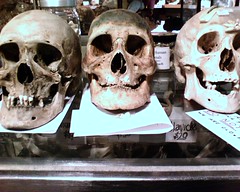
The Bone Room.
Berkeley, California

Okay -- a LOT freaky. The teeth in the center skull had implants characteristic of ancient Mayan remains -- and, I suspect, other ancient peoples of the Americas. The skull to the left had incisions in the front teeth. Ditto on the suspected provenance.

Gotta wonder why no one's shown up to repatriate these folks.

Tuesday, January 30, 2007

under our feet


Ninety-five percent of Mexico remains essentially unexplored.

David Grove, a professor emeritus of anthropology at the University of Illinois at Urbana-Champaign, who has worked in central Mexico for more than 40 years, as reported by National Geographic in Ancient City Found in Mexico; Shows Olmec Influence

And that which has been found is being eaten by acid rain.
Related Posts with Thumbnails