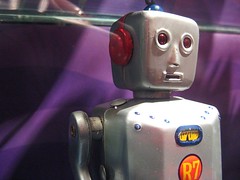
First, make sure all computers and robots are never in a position where they must make a decision in which all the consequences cannot be predicted in advance. The likelihood of this strategy being widely deployed is highly unlikely however, as engineers are already building computers and robotic systems for use in environments where actions cannot always be predicted.The ACM's summary of the The New Scientist's review of Moral Machines: Teaching Robots Right from Wrong by Yale University ethicist Wendell Wallach and historian and philosopher of cognitive science Colin Allen, at Indiana University.
Second, do not give robots and computerized systems weapons. Semi-autonomous robotic weapons already exist, in the form of cruise missiles and Predator drones, and military planners are very interested in developing robotic soldiers as a way to reduce the deaths of human soldiers.
Third, install robots with Isaac Asimov's "Three Laws of Robotics," which state that robots should not harm humans or allow them to come to harm through inaction, robots should always obey humans, and that robotic-self preservation is the lowest priority.
Fourth, program robots with principles for behavior that are more general than simplistic rules.
Fifth, educate robots like children. Machines that learn as they go through new experiences could develop a sensitivity to the actions that people consider to be right or wrong.
Finally, create machines capable of mastering emotions such as empathy, and give robots the ability to read non-verbal social cues.
Showing posts with label ethics. Show all posts
Showing posts with label ethics. Show all posts
Wednesday, December 03, 2008
how to housebreak your robot


Thursday, November 15, 2007
speaking of absence
Humans are meaning making machines.
Professor Tyler Curtain, wrapping up an interview with WUNC in Chapel Hill re a lecture he'll be delivering this Friday on Evolution and Ethics. Extinction is the core idea that runs through the interview. With a welcome peppering of comics.
Long time ago I shared a pizza with Tyler and his then sweetie, a biology grad student, and there was moment in which the conversation wrapped around to global warming and extinction and the biologist said something like: "Oh the planet will always be here: it's humans that won't be."
That was long before Al became Oscar Nobel and things like that simply weren't said in polite society. But it stuck with me, vividly, because it rang so true.
Give the interview a listen »
Subscribe to:
Posts (Atom)