Showing posts with label crete. Show all posts

Sunday, April 11, 2010

serve warm

This will never be
the same simple pie

one gets
for about a thousand drachmas
in Kikitsa's little stone taverna
in Monodendri

up in the Zagohoria
the northwest reaches of Epirus

The flour is different;
the cheese, homemade,
certainly is different;

and the result here
is my humble attempt
to reproduce

perfection.


Diane Kochilas, prefacing her recipe for Tiganopitta Epirou, or Skillet Pie from Epirus, in her cookbook: The Food and Wine of Greece.

I had a pie like the one Kochilas describes, but it was on Crete, not in Epirus, in a little hard-scrabble mountain town called Kato Afrata, a short drive from Chania, which is where it had been recommended to me and my traveling companions.


Or rather: where She had been recommended to us. "She" was Roxani, and she was reputed to make the best cheese pies on the island of Crete.

They were delicious, and fresh, and hot from the skillet. There were spinach pies too, but the cheese were exemplary.

But what I remember about the stop in that little out of the way place where it surprised me anyone could make a living at all running a restaurant, was her Alexander, who ran the restaurant with her. The kindness that coursed between them as they conducted their business and welcomed these American travelers (the only guests just then) and fed them well and smiled to be recommended by their friend in Chania.

The way they endearingly and enduringly (in a way that made me ache) loved one another.


Here's Kochilas' recipe for that cheese pie:

1 cup sifted all-purpose flour
1/2 teaspoon salt
1/4 cup warm water
1/4 cup plus 2 tablespoons olive oil
1/2 cup grated feta cheese


1. In a medium-sized bowl, sift together flour and salt. Make a well in center and add warm water and 2 tablespoons olive oil. Mix until a dough forms and knead in bowl for 5 to 7 minutes, or slightly longer, until dough is smooth and silky to the touch.

2. Divide dough into several balls, and roll out each on a lightly floured surface to a 1/2-inch-thick circle a little smaller than the base of the skillet. Dot with feta, fold into a crescent, and flatten with rolling pin or fingertips to a circle about as large as the base of the skillet. Heat remaining 1/4 cup olive oil in a large heavy skillet. Fry until golden brown, flipping to cook on both sides. Repeat with remaining dough.

3. Serve warm.

Thursday, November 22, 2007

asbestos gelos

asbestos gelos: A term used by Homer actually. It literally means “Fireproof laughter.”

Unquenchable laughter. Invincible laughter.

And the Cretans say that he who laughs, lasts.

And they have been around a long, long time.


Robert Fulghum in Sketches of Crete, an online excerpt of his new book What on Earth Have I Done? in which he tells a great story about jogging nearly naked and unwittingly making an ass of himself in a small town on Crete.

I understand Mr. Fulghum wrote a book about Kindergarten or something a while back. Heard it sold pretty well. I don’t know much about that, but I do know I’m a fan now that I know he feels for Crete the way I do -- that there’s something about the folks who populate that island in the Mediterranean that makes it unlike many other places in the world.

I’ve only visited Crete once, and then too briefly, but every day of the journey I was met with unexpected acts of generousity -- pitchers of rosé sent to my table by smiling waving strangers in tavernas, candy bars handed to me in a firm handshake and a “welcome to Crete” from the owner behind the shop counter; good company and conversation long into the night with new friends. A little while back I was swapping stories via email with a friend of mine, and I sent him this one, about just one example of the way people operate on Crete:

so about that car on crete -- we went to crete to research a tv pilot project (never did get sold [project dried up during the divorce], but I still think it was a good idea: all about how the myths and stories of a culture are tied to the landscape. we were thinking about spinning it with a food angle too -- food of the place where the stories were told; how food guest stars in many of the stories); anyway, we were traveling with another gal, a producer, who shared my interest in Arthur Evans and the dig at Knossos -- unfortunately B had an interest in the gal -- and I was stupid enough not to figure it out until much later. (idiot.)

we rented a car in Chania with the idea that we'd cross the island -- we had the Lassithi plains in our sights because of the Diktian cave (zeus, baby-popping chronos, the whole nine yards). on one of these mornings we stopped for an early lunch at a little slip of a town, and parked the car in what, we later found out, was a no parking zone. but really: the signs were in some kind of funky greek iconography -- and if I remember it right the sign in question was orange or blue, not red like you might expect. I suppose if any of us had read up on greek road signs we would have been in a little bit better shape -- but none of us had.

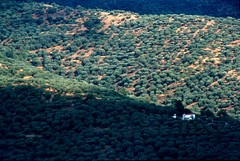
landscape with church


when we got back to the car after having our "toast" (the ubiquitous croque monsieur of greece -- a grilled cheese and ham sandwich) there was a ticket on the windshield, from which we figured out we were probably parked somewhere we shouldn't be.

no biggie: we figured we would just mail the fee in (or maybe just forget it ever happened <sheAdmitsSheepishly/>), and we started to get into the car to go. a couple of guys hanging out at a sidewalk café waved us down at that point, and managed to explain to us -- through gestures and exclamations -- that our license plates were missing.

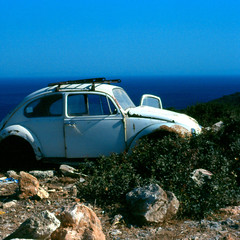
hellas blue #4


clearly the police were used to dealing with tourists with rental cars, and they had figured out a way to make sure the ticket was paid sooner than later. something else was becoming clear at this point: the odds of finding someone who spoke english in this little town were pretty slim.

later I would learn a little greek, but at that time all I knew was how to say "thank you", "cheese pie", and "come here, come here!" -- which I had learned just the day before from a sweet old guy who invited us into his home and showed us the scrap book of all the folks whom he had led up to this little local acropolis -- which was our destination when he called out to us: "ella, ella!" from the doorway of his home. he couldn't lead us up there because he was too old, and too lame, and it was clear that it was breaking his heart. but that's another story.

the thing about crete is that the folks are a little bit different than they are everywhere else that I've been to in greece. they think of themselves as a people apart -- they're not entirely greek; the whole Minoan ancestry influences this way of thinking, and there are also a cool ancient ties to the Balkans, and an occupation by the Venetians and then the Turks -- all of which ties together to make them a fierce little band who are ready to fight at the drop of a hat -- but it also seems to contribute to the fact that they are hugely compassionate, kind and generous. (I could back this point up with hours worth of stories; I'll save you the digression.)

all of these characteristics would soon become very important in the incident with the license plates. before long we were surrounded by a press of people who were concerned with our predicament. there was one among them who spoke some english. a young guy, without a whole lot of get up and go of his own, but who became an important liason between us and the key player -- a wirey old grandfather who pushed his way to the center of the circle and demanded to know what was going on.

the guy who spoke english explained that we were in a bit of a bind -- we certainly needed to go the police station, but he expected that no one would be there to help us out. the town was small, with only a few officers, and he expected they would be out patrolling. besides: it was nearly lunch time.

my heart sank. I had seen greek men do lunch. they start around 10, at one of the tavernas, and they wrap up around 2.30, 3 o'clock. often in groups of 5 or 6, never fewer than groups of 3. The dishes are served tapas style -- so they'll munch on a plate of little fried fish for awhile, then some calamari, then some spanokopita, maybe a little moussaka; ouzo or a rosé is an important accompaniment. in athens, for several days running, I saw a group of older guys spend the whole day at the same taverna, downing plate after plate and glass after glass. nice work if you can get it.

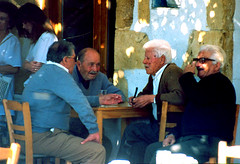
(just remembered I have an illustration handy -- these aren't the same guys, but they'll do:)

The Life.


well, the wirey old guy figured out that we weren't about to wait -- neither did he think we should have to. he exchanged some animated words with the young guy who tried to argue with him before he finally gave up, turned to me resignedly, and said: "he'll take you".

so we loaded the guy into the car -- he got into the back seat and I can still see him leaning forward animatedly, gesturing to me where to go, where to turn, leaning out the window and shouting with exasperation to other drivers "ella, ella!" -- which I now realized had the double meaning of "get off the road, asshole!"

we parked at the police station and he took me into the station, where we found out that we were lucky -- the policeman who had our plates were there -- but they were not about to do a thing about it. they had a schedule in mind -- and they'd get back to us tomorrow. well the wirey old guy wasn't going to allow that, and he ripped them a new one, all in greek of course. I just stood there smiling, batting my eyes, and trying to look like the kind of silly american girl who they might take pity on. we were at it for a good 45 minutes. there were discussions behind closed doors. and this old guy just kept swinging for us.

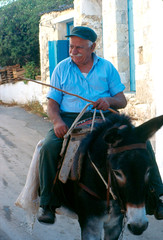
generous stranger


finally, he prevailed. I paid a fee and the officer handed over the plates. he managed to scare up enough english to explain to me that this was highly unusual. the old guy was really pleased with himself, but also thanked the officers with a dignity and courtesy that ensured no one lost face. down on the street, after the whole thing wrapped up, I showered him with thanks and tried to offer him some money -- which he waved off -- he wouldn't even take a ride back to spot where we picked him up. he shook my hand, bowed graciously and waved goodbye. he was such a gentleman; so regal; so kind.

passing time, crete

Thursday, February 08, 2007

the old man and the sea


Here's to swimmin' with bowlegged women.

The crazy old shark guy in Jaws as he raises his glass. (Watching a re-run tonight.)

That line is second among crazy old men of the sea quotes only to, in my estimation, Anthony Quinn as Zorba the Greek when he wants to know: What kind of a man are you? Don't you even like dolphins?

And now, perhaps, you know too much about me.


btw: I've been on this beach, where they filmed Zorba the Greek. It's a little slip of nothing outside of Chania on the island of Crete. When I was there there weren't a lot of folks around -- although I'm willing to guess that most days there are, since they promote its cinematic virtues to anyone who will listen.

But does anyone really know about Zorba the Greek anymore? Does anybody care? (What kind of a man are you...)

There's a small cave on the hillside overlooking this cove, and if you take the time to hike the hill you're surrounded by the fragrance of rosemary, thyme, and oregano growing wild and baking in the sun. The cave itself is a treat, if you can overlook the goat droppings that carpet the floor. There's a small shrine to a saint -- as there are in so many caves around the hillsides of Greece -- that was previously dedicated to a pagan god or goddess.

The same holds true in Guatemala, where holy caves are frequently dedicated to John the Baptist -- although folks who know will tell you that John and Don Juan, the Earth Lord, are one in the same.

I imagine the cave thing holds true wherever you find pockets of populations who have been around for ages, and who all felt, for some reason, the compulsion to whisper their petitions to the deep crevices of the earth.
Related Posts with Thumbnails