Awkward transliteration aside, Luca Guadagnino's I Am Love (Io Sono L'amore) beautifully sates the foreign film trinity of food, sex and death and makes for a lovely Lady Chatterley-dodge from the swelter of a summer afternoon.
Swinton is brilliant, of course, as are the others.
There’s so much that is not quite right about the Wizard of Oz.
The farm girl whose aunt chides her to stay out of the way because she’s worthless on the farm and yet knows instinctively how to vamp when the Twister hits or the camera strays to her sparkly heels.
The middle-aged men who cozy up to our 12 year old heroine and accompany her on her travels in a way that the creep factor would prohibit in any film made today.
And finally this: the idea that a girl who longs to be anywhere besides Kansas, and then finds herself at last over the rainbow in a “real truly live place” where “most of it was beautiful” would spend the whole of her marvelous adventure wanting only to be home, like some ugly American, and to decide after all that wonder, once she returns again to Kansas, that “I’m not going to leave here ever ever again.”
Really? That’s our moral lesson? Not: Travel has opened my eyes and expanded my mind to make room for new people and new experiences entirely foreign to my own?
(Maybe my bafflement is especially keen because of the unhappy hours I spent in Kansas this last week.)
And yet: It’s a magnificent film, which I was reminded of on Friday when I saw it on the big screen, digitally remastered with the full orchestration of the Chicago Symphony Orchestra behind it and cried -- yes cried -- when Dorothy sang of melting lemon drops away above the chimney tops.
That’s where you’ll find me.
Bonus material, aka "Only bad witches are ugly." -- Glinda the Good Witch
Video: Dog Day Afternoon Trailer (film editing for Dog Day Afternoon earned Dede Allen an Oscar Nomination in 1976)
Miss Allen, though she read Eisenstein on a Los Angeles streetcar, is not a theorizer and will generalize only to the extent of suggesting that film editing is both a talent and a craft. She talks in terms of specific films and specific personalities.
Robert Wise, whose “Odds Against Tomorrow” was her first major assignment, she credits with having given her confidence to experiment, to work with her own interpretations of a scene. She remembers once reversing an optical so that, in the Wise film, Gloria Grahame, instead of lowering her eyes in a doorway flirtation with Robert Ryan, raised them to give a quite different meaning to the scene.
She recalls Wise saying delightedly: “It is different working with a woman!” To which Miss Allen answered: “I should hope so.”
Craig McKay spoke to her influence on his work yesterday on NPR:
I can remember one of the first things she ever said to me. She says, you have to cut with your gut. And what that meant, I came to discover over the years, was that this process is not really so much a thinking process as it is an intuitive process. She was an intuitive editor. And I think she passed that along to me, along with so many other great editors that she's single-handedly responsible for creating.
From the Black Dynamite movie trailer, which will be in theaters this Friday.
This is either going to be really good -- or super bad.
According to Michael Jai White, the actor and filmmaker who plays Black Dynamite, the character for a "Ninja-slaying, lady-melting, blaxploitation-style hero" came to him while listening to James Brown's Super Bad on repeat.
The New York Times notes that "a boom mike makes a cameo early on," and the movie "features a climactic kung-fu showdown at the White House between Black Dynamite and Richard Nixon."
I learned of the letterpress work of Amos Paul Kennedy Jr. in the tired hours of the late afternoon yesterday, as the result of a random conversation with @lzinger at the grocery store about how rutabagas are a little like turnips and a little sweet potatoes. And how they are not. By the end we were talking about Twitter, which is how the acquaintance led to this.
On November 24th Christie's of London will auction the 22-inch armature used in the 1933 film 'King Kong' to allow the animated ape to scale the Empire State Building in the final scenes, according to the Associated Press.
"Christie's said it hopes to get up to 150,000 pounds (about $240,000) from the figure's sale."
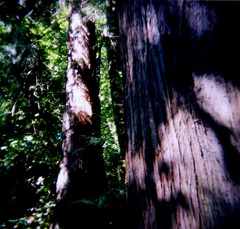
This is the image that remains with me after watching Kurosawa’s Rashômon (yeah for only the first time -- I'm catching up on my greats): A woodsman walking alone through the forest, the camera moving fluidly, magically, through the treetops at a distance, and everywhere the strength of the soaring cedar.
We learn later, watching the DVD special bits, that the dolly is rooted on a rail on the ground and so it must be that we’re looking down and long across a slope, but that reasoning comes later. Just now there is pure magic in how the camera glides through the trees, and I’m reminded of the airy distance that breathed between the oaks of the savanna at dusk, when walking I heard the sonorous hoot of an owl just a little bit distant, stopped and held still to see (after a beat, then three) the giant bird break his bluff and wing his massive bulk through the trees.
It’s all around us in this masterpiece of a movie, the cedar. The manic thief knows his one calm moment as he naps in the lap of one fragrant giant, warmed by the sun, the celluloid nearly redolent with the perfume of its baking wood. He peers skyward under the influence of the breeze and captures a glimpse of the woman he will blame for his motives (whom he blames, pardon me, for his woody) and she too is stalwart and cedar like. Miyagawa’s masterful camera pans her heel to head just as he panned the stewards of the forest, from burl to overstory.
The cedars will be witness to the crimes the camera spares us -- the assault on the wife; the murder (the suicide?) of the husband. This none-of-us-knowing is what, of course, provides Rashomon with its potency as each player unwinds the narrative of the grove’s events in his or her own telling in which he or she is (as it always is) the hero of the story.
There's a quiet scene in the movie Julie & Julia where Julia Child travels to Boston from Paris with the co-author of her momentous cookbook to meet a friend who is in publishing.
We've heard about this friend all the way through the movie, and it only becomes clear when they arrive at the train station that Julia has never actually laid eyes on her.
They're pen pals. They've been pen pals for many years.
Meryl Streep plays the bit brilliantly: a little dismissive in a "don't you worry about it" way when her colleague appears alarmed that she's never actually met this important contact. Because so much depends upon this friendship now -- it will be the bridge that gets the cookbook published, and they both seem to know it.
At last the friend arrives and they know each other instantly. The clip isn't easily found online which isn't surprising because it contains no pots or pans; there is no food in the frame, or ecstatic eating. There are only the words, at least as I remember them -- "my dear friend"-- spoken low as the small woman arrives in a rush and takes both of Julia's hands in her own, welcoming her from far way, knowing her from old.
It's my favorite scene of the movie.
I'm firming up plans for a long weekend in London and afield where, among other lovely things, I'll be meeting up with some of my pen pals.
Sendak's book terrified me when I was a kid. Not in a nervous Cat in the Hat kind of a way; in a subverting the dominant paradigm I want to do that too kind of way.
The New York Times reports that Child's iconic cookbook "will make its debut at No. 1 on the New York Times best-seller list of Aug. 30 in the advice and how-to category," and that the 22,000 copies that sold in the last week tracked were "more copies than were sold in any full year since the book’s appearance."
All good, and Yay, Julia, and yes the movie is a delight. What strikes me about this success however is the contrast to earlier sales figures. Julia Child is an icon. Her kitchen is entombed in the Smithsonian. She changed how Americans cook.
Somehow she did all this without ever before reaching Number One on the New York Times bestseller list.
With those previous sales figures would she have become the icon that she is in today's America? Would her television viewing numbers rank her among the also ran chefs of the Food Network?
Given today's media saturation, would any of us know Julia Child today?
Saw In the Heat of the Night, the 1967 Academy Award Winner for Best Motion Picture, for the first time tonight. Am embarrassed to admit that it took me this long, but somehow I managed to miss the memo that it may be one of the best movies ever made.
Pitch perfect every step of the way.
Each shot is so luscious in its composition that I couldn't bear to take my eyes off the screen. Each plot point is essential, of course, in the unraveling of the mystery, which the script unravels so brilliantly, but it's the performance of the actors that makes the movie unforgettable. The intensity of their engagement, the depth of their character portrayals. Sweet god in heaven why don't they make movies like this anymore?
If you've never seen it, see it soon. If you've already seen it, see it again.
And if you don't want to know anything about it before you watch it DON'T WATCH THE TRAILER.
Although I really must share with you that it's true what they say: They call him Mr. Tibbs.
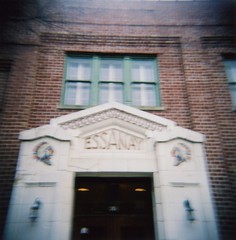
We interrupt this Wright-o-Rama weekend to bring you a holga shot of the Essanay Film Manufacturing Company in Uptown. According to Wikipedia:
The Essanay Film Manufacturing Company was an American motion picture studio founded on August 10, 1907 in the neighborhood of Uptown, Chicago, Illinois by George K. Spoor and Broncho Billy Anderson under the name Essanay ("S and A"). It is best known today for its series of Charlie Chaplin comedies of 1915.
Apparently Essanay produced 450 films before 1913 -- "at a time when four out of every five U.S. movies were produced in Chicago" [1]. Charlie Chaplin endured Essanay for a year, made them a great deal of money, and then left over disputes regarding creative control. Louella Parsons worked here as a screenwriter before she got into gossip.
Ultimately, Chicago's ass-kicking weather persuaded the Essanay folks to move to California where, over time, film manufacturers became filmmakers.
[1] This is noted with the caveat: "citation needed".
There is a huge problem with being in love with a public object. The issue of intimacy – or rather lack of it – is forever present.
Erika La Tour Eiffel, as cited by The Independent, who last May married the Eiffel Tower, and is featured in the documentary Married to the Eiffel Tower: Strangelove (also shown as: Landmark Sex: Married to the Eiffel Tower), which also features ardent relationships with the Berlin Wall, The Golden Gate Bridge, and the Empire State Building.
Erika is also a "world champion in archery – propelled to success, she believes, by her love for Lance, a bow," and she was "discharged from the Armed Forces for refusing to stop sleeping with a ceremonial sword." (From The Times Online)
Many thanks to Flickr contact worldwide.projects who brought my attention to the documentary -- perhaps in an effort to provide a diagnosis for my condition.
Frankly, I find the love for highly public structures like the Eiffel Tower and the Golden Gate Bridge a little like crushing on an overplayed movie star like Tom Cruise.
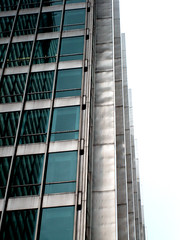
But that's not to say that I wouldn't take an hour alone with the Inland Steel Building, so long as the Chagall mosaic across the street agreed to join us for a three-way.