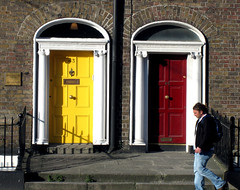
Closing a door on an option is experienced as a loss, and people are willing to pay a price to avoid the emotion of loss.
Dr. Dan Ariely, author of Predictably Irrational, as quoted in this morning's New York Times.
Ariely's research concludes that closing doors -- limiting your options to focus your energies on what remains (just as Cortes did when he burned his ships on the shores of the New World and set off one of the most horrifyingly productive genocides in the colonialization of the Americas) -- is a good thing, but that human nature resists what's best for us, because it feels too much like the parts that suck.
You can play Ariely's door game to see how you fair »
(The site serves up a lot of cool visual illusions, too.)
Once upon a time I was faced with a whopper of a decision to make. I found myself in San Francisco and decided to take the time to walk their Labyrinth -- I'd heard it was a good meditation device, and I thought maybe it would help me figure things out.
Right.
Walked the one in the cathedral twice. Then walked the one outside.
Nothing. I still didn't know what I was going to do.
I decided to hit the gift shop on the way out -- the back of the shop was packed to the rafters with racks and racks of cards and I pushed my way through to a rack in the very far corner, picked up a single card (it had a couple of doors on the front) and opened it. It read: "Whatever decision you make will be the right one."
Later, I shared this story with my friend Enyasi. She said: "You know, my mother would have said: Whatever choice you make, make it the right one."
'Nuff said.