Showing posts with label science. Show all posts

Tuesday, May 18, 2010

empirical

"Lightning Fields 013" (2006).
Gelatin silver print, 59 x 47 in.
Hiroshi Sugimoto

In 1831, Michael Faraday’s formulation of the law of electromagnetic induction led to the invention of electric generators and transformers, which dramatically changed the quality of human life.

Far less well-known is that Faraday’s colleague, William Fox Talbot, was the father of calotype photography. Fox Talbot’s momentous discovery of the photosensitive properties of silver alloys led to the development of positive-negative photographic imaging.

The idea of observing the effects of electrical discharges on photographic dry plates reflects my desire to re-create the major discoveries of these scientific pioneers in the darkroom and verify them with my own eyes.


From Hiroshi Sugimoto's artist statement regarding his Lightening Fields.

Related: hiroshi sugimoto at sydney art biennale 2010 »

Sunday, March 28, 2010

speaking of lumbering apes

Film: Eadweard Muybridge

There’s a brief piece in Science this week about bouncy legs -- how the calculus predicts that locomotion on stiff legs is most efficient and yet all of us -- and small critters especially -- bounce about when we move.

A new computer model nails the reason why:

Integrative physiologist Monica Daley of the Royal Veterinary College (RVC) in Hatfield, U.K., had observed how adeptly the guinea fowl, an African bird known for its running skill, negotiated sudden drops and other obstacles. She wondered how the shape of an animal's body and the nature of the terrain -- details left out of earlier simulations because they're difficult to model -- would alter the models' predictions.

So she and RVC colleague James Usherwood devised a computer model that didn't sidestep the complexities of animal motion. Instead of attaching legs to an idealized point with a certain mass, the new model linked them to a bouncing body -- the seesawing guts and other tissue an animal carries as it moves -- and set them on an uneven course.

As Daley expected, the less-idealized runners fared better on compliant legs. The spring in their step offset the bounce of their bodies, resulting in a smaller energy cost. "That's interesting and quite novel," says biomechanist Manoj Srinivasan of OhioStateUniversity in Columbus, who was not involved with the research. [1]


This is a lovely nod to the impact of terrain on our evolutionary development and only adds fuel to my long simmering theory that we are born and made and shaped by place; that each of us carries our own terroir and inherits some from those who came before us.

That, like wine, we are seasoned by our soil.

It also reminds me of a conversation I had with my dad when I was small and we were navigating the precarious paths of Mesa Verde. I was terrified. “Walk like an Indian,” he told me. “Bounce a little bit.”

I don’t know where he received this intelligence (it well could have been while he was rambling through the desert with Native American friends in search of peyote buds; it may have come to him after they were consumed; it was probably from the pages of a book) but it turns out it works. I deployed it at Mesa Verde -- with success -- and I've found whenever I’m uncertain about my footing on rough trails that exaggerating the spring in my step gets me through the worst of it (with some adjustments in the presence of scree).

Works on mountain bikes, too.

It’s counter intuitive, because when fear settles in while walking the cliff’s edge the instinct is to go rigid and inch your way along in terror. But it's also old news, isn't it: like the drunk who emerges unscathed from the crash with the upright toppled and dying around him, or the reed that bends in the wind.

It's the pliable who survive.


[1] Gisela Telis, Why Bouncy Legs Work Better, Science 23 March 2010

p.s. the apes are still lumbering for a little while longer yet »

Saturday, February 20, 2010

smashed

super conducting magnet


Received a tour of Fermi Lab this morning from a generous friend who works on the supercollider and is part of the team trying to track down the Higgs Boson particle -- both here and over at Cern. I’ve made the mistake of posting this two glasses of wine into my evening, so I won’t try to salvage all that I learned today about the acceleration and wanton smashing of particles, one against the next, and the ways and means by which physicists detect their errant behaviors.

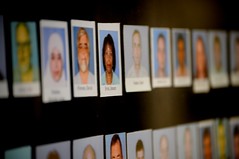
physicists


There were magnets involved (super ones) and attenuated copper wires. Cosmic rays figured large in the explication of the whats, the whys and the wherefores of the protons that shower the earth in the aftermath of super nova explosions, and mention was made of their baked-fresh-daily kin -- anti-protons -- that Fermi generates each day to the tune of trillions before sending them off to the slaughter in the big ring.

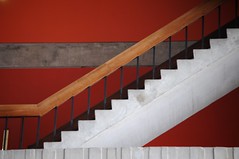
stairwell


I learned that the big bang was infinitesimally small -- more like a quiet burp that escapes during an animated dinner party (when the laughter is raucous and no one can hear it) -- and I began to suspect, as the talk veered to stars, that for all of their elaborate plumbing these folks really are in the business of simply (simply?) emulating brilliant star bursts and then piping their meteoric messages through fiber optic wires that extend from the campus like so many pneumatic tubes conveying cylinders to far bureaucracies, as if shuttling intergalactic gossip at the speed of light.


Fermi Lab
Batavia, IL

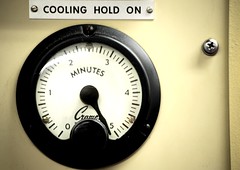
cooling hold on

Sunday, January 24, 2010

the slime mold that transgressed Tokyo


Researchers in the UK have discovered that, when tempted by oat flakes, "the slime mold Physarum polycephalum forms networks with comparable efficiency, fault tolerance, and cost to those of real-world infrastructure networks—in this case, the Tokyo rail system."

As reported in ScienceNOW.


I wonder how the slime mold would fare against Rahul, the public transportation savant of NYC.

Tuesday, January 19, 2010

mach it up


A solid object impacting on liquid creates a liquid jet due to the collapse of the impact cavity. Using visualization experiments with smoke particles and multiscale simulations we show that in addition a high-speed air-jet is pushed out of the cavity. Despite an impact velocity of only 1 m/s, this air-jet attains supersonic speeds.

The cavity pressure nonetheless is merely 1.02 atmospheres and thus much lower than the pressures required for supersonic flow through a rigid nozzle. The high air speeds are shown to result from the "nozzle" being a liquid cavity shrinking rapidly in time.

Stephan Gekle, Ivo Peters, Jose Manuel Gordillo, Devaraj van der Meer and Detlef Lohse in their paper: Supersonic Air Flow due to Solid-Liquid Impact via Slashdot.

Does that mean the deeply satisfying "bloop" that a stone makes as it hits the water is actually a sonic boom?

Sunday, January 10, 2010

harmonic convergence

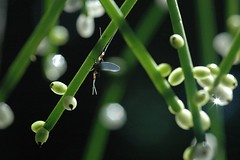
strange fruit

It's very sweet. When they're doing this singing thing, they're reaching their legs across to the other one, trying to do footsies.

Medical entomologist Gabriella Gibson of the University of Sussex and the Natural Resources Institute of the University of Greenwich commenting on her mosquito research in Science.

Gibson found that two variant mosquito types -- which are visually indistinguishable -- find others of their type through the music they make:

Gibson and colleagues collected larvae of the two forms in Burkina Faso and raised them in the lab. Then they stuck a short piece of wire to their backs with beeswax and brought them within a few centimeters of another bound mosquito of the opposite sex. The pair flapped in place while a microphone recorded their "music"; mosquitoes sing by speeding up or slowing down their wing beats, which changes the frequency of their high-pitched whines.

The mosquitoes harmonized--but only with mosquitoes of the same form. A pair of two M or two S mosquitoes aligned their wing beats so that the female beat her wings twice for every three beats of the male's wings. Like a bowed violin string, the beating wings also created higher frequencies, which match when males and females are harmonizing. "If they're of the same form, they'll stick with each other with this harmonizing just for seconds on end," says Gibson. "If they're the two opposite types, they really won't come together."

A mating pair of mosquitoes in harmony (audio) »
Not »

Wednesday, December 23, 2009

daydream believer

self-portrait as embryo

we feel pain and pleasure
we yearn

and in order to find out how
to minimize pain

and maximize pleasure

we think


Found in The 20 W sleep-walkers by Ladislav Kováč1 of Comenius University, Bratislava, Slovakia in the current issue of EMBO Reports.

Also found in Kováč1's piece, as directly quoted:
  • The energy output of the resting adult human body is equal to the power of a 100 W electrical light bulb.

  • The brain alone consumes 20% of the body's chemical energy, even though it accounts for only 2% of the body's mass. Metaphorically speaking, we all have a 20 W light bulb burning in our head, even when we lie still in complete darkness doing physically nothing.

  • The brain as a whole shows no difference in the energy budget between ‘resting’ and ‘busy’ states.

  • The brain guzzles up—per unit weight—as much energy as the heart muscle, about 16 times more energy than the skeletal muscle at rest, or as much as the leg muscles during a marathon race.


And:
When the brain receives no signals from the environment, a considerable part of its energy is used in daydreaming: the human mind may be spending as much as half of its wakeful time daydreaming (Klinger, 1990). This comprises not only the creation of fanciful stories similar to those we dream during the night, but also the rehashing of all possible and impossible alternatives of the past, present and future activities.

This interior universe of daydreaming creates a continuous series of fictional rewards and punishments, which steadily builds up the unique and idiosyncratic personality of every human individual by conditioning. This may explain our capability to work for years on our career, tenaciously, with self-restraint and self-denial, as if we were motivated by the mirage of an ultimate reward.

Apparently, it is not the latter in the remote future, but our present fancies of it that provide immediate, positive rewards and function to reinforce our deeds.

Friday, October 16, 2009

magnifiedcent


Looks like a Paul Klee to me -- but it's actually doxorubin in methanol and dimethylbenzenesulfonic acid magnified 80x as shot in polarized light by Lars BechNaarden of the Netherlands.

Cited by Wired Magazine in 35 Years of the World’s Best Microscope Photography, via boing boing and @timoreilly.


Paul Klee, Red Balloon via artsmarttalk

Saturday, October 03, 2009

a plurality of facemasks


A garment device convertible to one or more facemasks wherein the garment device has a plurality of detachable cup sections. Each of the cup sections has a filter device, an inner portion positionable adjacent to the inner area of the user’s chest, and an outer portion positionable adjacent to the outer area of the user’s chest. The garment device has at least one securing device detachably coupling the inner portions of the cup sections to one another, and the garment device has at least one other securing device attached to the outer portion of at least one of the cut sections. This other securing device is operable to: (a) detachably couple the outer portions of the cup regions to one another; and (b) for each one of the cup sections, attach the outer portion of said cup region to the inner portion of said cup region after said cup region is detached from the other cup region, thereby converting the garment device to a plurality of facemasks.


Abstract for Patent Number 7255627, aka Garment device convertible to one or more facemasks, by Elena N. Bodnar.

Bodnar's invention for a brassiere that converts into a plurality of facemasks is worth mentioning because 1) on account of it, she was awarded an Ig Noble Prize on 1 October and 2) this may well be the only opportunity any of us will ever have to see the esteemed Nobel Laureate Paul Krugman, and two of his Nobel peers, wearing what appear to be C-cups in a very public way.

Photo: Ig Noble Winner Elena N. Bodnar with Nobel Laureates (from left to right) Wolfgang Ketterle, Orhan Pamuk and Paul Krugman

Saturday, June 27, 2009

it's a marvelous day for a moonbounce


It’s the equivalent of climbing Mount Everest in amateur radio. It’s possible, but only barely possible.


Nobel Prize winner and retired Princeton physics professor Joseph H. Taylor Jr. commenting in today's New York Times on the ability for amateur radio ham operators to bounce a signal off the moon.

Giant parabolic antenna radio telescopes have been assembled worldwide to facilitate a global moonbounce today in honor the 40th anniversary of the Apollo 11 moon landing on July 20.

You can listen in here »

I think. (I haven't been able to hear anything yet.)

@robertbrand seems to know something about all this -- but he's not tweeting all that much. You can, however, hear him in a fragment from a recent radio show on many things, including the moonbounce »

Updates (including a live webcam) are promised at echoesofapollo.com »

Wednesday, May 06, 2009

on the market


Tesla's Wardenclyffe Lab: $1,650,000

LONG ISLAND: 5 Randall Road, Shoreham, N.Y., between Tesla Court and Randall Road SIZE: 15.69 acres

ZONING: Two-acre residential

PROS: Complex of 14 industrial buildings, including historic Tesla laboratory. Property can be delivered fully cleared and level.

CONS: Property was a New York State Superfund cleanup site, with the main concerns being silver and cadmium. Remediation was completed last year, but the site still requires semiannual groundwater monitoring as well as periodic inspections of two soil areas of concern, to ensure that they undergo no disturbance.


Listing in Tuesday's New York Times, which also details concerns that Tesla's Wardenclyffe Lab outside of Manhattan, which doesn't have National Heritage protection, might be leveled if the property is sold »

Also worth noting: the lab was bankrolled in part by J. Pierpont Morgan and designed by the architect Stanford White, the fellow who was shot by the millionaire Harry Kendall Thaw after fooling around with Thaw's wife on a red velvet swing.

The ill-fated tower, unfortunately, was scraped for its metal not too long back.

And did everyone know about Tesla's Colorado Springs lab except me?

Tuesday, April 21, 2009

the visual perception of slants


Last year, researchers studied 34 students at the University of Virginia, taking them to the base of a steep hill and fitting them with a weighted backpack. They were then asked to estimate the steepness of the hill. Some participants stood next to friends during the exercise, while others were alone.

The students who stood with friends gave lower estimates of the steepness of the hill. And the longer the friends had known each other, the less steep the hill appeared.


The New York Times synopsis of the research recounted in Social support and the perception of the geographical slant (PDF) by researchers Schnall, Harber, Stefanucci and Proffit of the University of Virginia.

So if Sisyphus had friends, he wouldn't have been so screwed. (Or at least he wouldn't have thought he was.)

Saturday, April 18, 2009

einstein's brain

Photo: Phillippe Halsman


a found haiku

until age seven
he repeated sentences
to himself softly


Found in New Information about Albert Einstein's Brain by Professor Dean Falk of Florida State University, published in Frontiers of Evolutionary Neuroscience. [1]

In his paper, which ScienceNOW did a lovely job of distilling, Falk suggests that "despite the fact that a large portion of Einstein’s cerebral cortex was superficially unremarkable, regions in and near his primary somatosensory and motor cortices were highly unusual, and it is tentatively suggested that these may have contributed to the neuroanatomical substrates for some of his remarkable abilities" -- including his musical ability, his "superior ability to conceptualize physics problems," and his habit of thinking in images and sensations instead of words.


Falk hypothesizes that these anomalies may have been responsible for Einstein's atypical way of thinking:

As an adult, Einstein famously observed that “the words or the language, as they are written or spoken, do not seem to play any role in my mechanism of thought. The psychical entities which seem to serve as elements in thought are certain signs and more or less clear images which can be ‘voluntarily’ reproduced and combined”. Einstein laughed when informed that many people always think in words, and emphasized that concepts became meaningful for him “only through their connection with sense-experiences”.

He was a synthetic thinker. Family members and friends have documented that, when stuck on a physics problem, Einstein would play the violin until, suddenly, he would announce excitedly, “I’ve got it!”.

It is interesting to contemplate that such synthesizing may have contributed to Einstein’s insights, and that his extraordinary abilities may, to some degree, have been associated with the unusual gross anatomy of his cerebral cortex in and around the primary somatosensory and motor cortices.

Also of interest (if you get off on this kind of thing) are the paleoanthropological techniques that Falk applied to reassemble Einstein's brain for study, which had long ago been thin sliced, mounted on slides, and distributed scattershot by its original custodian.


Video: Admiral Freebee - Einstein Brain


[1] If you're looking for it, the complete PDF of Prof. Falk's paper is to the right of the abstract, and available without charge, which is exceedingly cool.

Wednesday, March 18, 2009

kids these days


DSCN2191
Originally uploaded by meteotek08
When we launched at 9.10am on that morning the critical point for the experiment was to see if the balloon would make it past 10,000m, or 30,000ft, which is the altitude that commercial airliners fly at.

We took readings as the balloon rose and mapped its progress using Google Earth and the onboard radio receiver. At over 100,000ft the balloon lost its inflation and the equipment was returned to the earth.

We travelled 10km to find the sensors and photographic card, which was still emitting its signal, even though it had been exposed to the most extreme conditions.


Eighteen-year old Gerard Marull Paretas whose science project, conducted with his pals Sergi Saballs Vila, Marta­ Gasull Morcillo and Jaume Puigmiquel Casamort, went really really well -- as reported in Teens capture images of space with £56 camera and balloon in the Telegraph.

Boys after my own heart -- they've posted a Flickr slideshow of the project »

Saturday, March 07, 2009

coffee stains


Ivan Vakarelski at the Institute of Chemical and Engineering Sciences in Singapore was inspired by the rings left behind by spilled coffee to create a new way to make ultrathin coatings for LCD and plasma flat-screens.

In LCDs, transparent conductive coatings are used to form an electrode on the surface of the screen, while in plasma TVs they provide a shield that prevents electromagnetic fields from straying.

Traditionally to make such coatings it’s necessary to sputter a fine layer of highly conductive and transparent indium tin oxide onto the surface. This takes place in cost-intensive clean rooms and vacuum chambers.

Vakearelsk noted that when coffee is spilled, the evaporating liquid drives coffee particles to the edges of the spill -- which ultimately produces the circular stain. The coffee granules are being "assembled" by the varying evaporation and convection rates in the fluid.

Vakarelski and his colleagues figured that if they could mimic the process in a controlled fashion, they could create a pattern of granules of other materials to form a nanoscale conductive coating.

Instead of coffee they used a suspension of gold particles »


Shamelessly plagiarized and paraphrased from Anil Ananthaswamy’s Future TV screens seen in coffee stains in the 1 March issue of NewScientist.

Wednesday, March 04, 2009

atomic artifact


The plutonium, found in a one-gallon glass jug after a cleanup crew tore open the safe with an excavator, was processed at Hanford in late 1944 from spent uranium fuel from a reactor at Oak Ridge, Tenn. It was the product of test runs of a plant built for separating plutonium for use in the Manhattan Project to build the atomic bomb.


The New York Times reporting on the man-made plutonium (read: nuclear waste) that was discovered in a glass jar in an "old safe buried in a waste trench" at the Hanford Nuclear Reservation in 2004.

The piece continues: "The only earlier sample of man-made plutonium known to exist was produced in 1941 in an accelerator and is stored at the Smithsonian Institution."

The glass jar was labeled: "Wastes for Recovery."

Thursday, February 05, 2009

big blue


You’ve done a great job with the dirt. But what about the water?


Former NOAA chief scientist Dr. Sylvia Earle to John Hanke, co-creator of Google Earth, at an awards ceremony hosted by the Geographical Society of Spain, as cited in Google Earth Fills Its Watery Gaps in the New York Times.

Earle's question to Hanke resulted in the Google Earth initiative to map the oceans of the world. At this writing 5% have been mapped in detail and are now available (I believe) via download of the Google Earth client-side application.

Sunday, September 28, 2008

when super smart nerds who have changed our world vote


During the administration of George W. Bush, vital parts of our country's scientific enterprise have been damaged by stagnant or declining federal support. The government's scientific advisory process has been distorted by political considerations. As a result, our once dominant position in the scientific world has been shaken and our prosperity has been placed at risk. We have lost time critical for the development of new ways to provide energy, treat disease, reverse climate change, strengthen our security, and improve our economy.

We have watched Senator Obama's approach to these issues with admiration. We especially applaud his emphasis during the campaign on the power of science and technology to enhance our nation's competitiveness. In particular, we support the measures he plans to take – through new initiatives in education and training, expanded research funding, an unbiased process for obtaining scientific advice, and an appropriate balance of basic and applied research – to meet the nation's and the world's most urgent needs.


Excerpted from a letter of support issued on 25 September and signed by 61 Nobel Prize winning scientists endorsing Senator Barack Obama for President of the United States of America because he is "a visionary leader who can ensure the future of our traditional strengths in science and technology ... who can harness those strengths to address many of our greatest problems: energy, disease, climate change, security, and economic competitiveness."

Here's the whole letter with the complete list of Nobelists »

Friday, September 26, 2008

alice's adventures in microscopic wonderland


Illustrator Colleen Champ used micrographs of natural objects created by Dennis Kunkel and arranged them into a picture of three beetles enjoying tea at a table of butterfly wings, surrounded by a field of crystallized vitamin C.


National Geographic's write up of Colleen Champ's illustrations for Alice's Adventures in Microscopic Wonderland, a winner in the 2008 International Science & Engineering Visualization Challenge.

p.s. First person to find two copies of this book available for sale online wins a free copy from me -- 'cause I can't find it anywhere.

Saturday, May 10, 2008

fold it good

Long-term, I'm hoping that we can get a significant fraction of the world's population engaged in solving critical problems in world health, and doing it collaboratively and successfully through the game.

We're trying to use the brain power of people all around the world to advance biomedical research.


David Baker, a UW professor of biochemistry, commenting in the University of Washington News on the beta release of FoldIt -- which puts gamers to work folding proteins.

According to the UW News FoldIt is “a new game [that] turns protein folding into a competitive sport. Introductory levels teach the rules, which are the same laws of physics by which protein strands curl and twist into three-dimensional shapes -- key for biological mysteries ranging from Alzheimer's to vaccines.”

Or more to the point, from fold.it:
What big problems is this game tackling?
Knowing the structure of a protein is key to understanding how it works and to targeting it with drugs. A small proteins can consist of 100 amino acids, while some human proteins can be huge (1000 amino acids). The number of different ways even a small protein can fold is astronomical because there are so many degrees of freedom.

Figuring out which of the many, many possible structures is the best one is regarded as one of the hardest problems in biology today and current methods take a lot of money and time, even for computers. Foldit attempts to predict the structure of a protein by taking advantage of humans' puzzle-solving intuitions and having people play competitively to fold the best proteins.

(+ I love that fold.it registered an Italian domain so that they could get the .it extension...)

Game on »
Related Posts with Thumbnails