Showing posts with label mies. Show all posts

Tuesday, March 25, 2008

my brazilian: let me show you it


The package was a puzzle: Brazilian Post. Museu Oscar Niemeyer. A Flickr friend? But who’s in Br...

And then I remembered. Took a few pictures of the packaging. Tore it wide open.

Already bragged on this a bit back when it happened at detritus, but I figure I’m due a Flickr strut too. (And yeah, of course I’ll double post. I’m only human.)

Best part about receiving the unexpected package was remembering: Right. I used to take a lot of pictures and stuff. I need to get back to doing that.

the spread


So may I present: A Casa Farnsworth (1950), projetada por Mies van der Rohe. (Foto de Dayna Bateman)

Page 47 in O Espetaculo Arquitetural, a series on architecture for children produced by the Museu Oscar Niemeyer in Curitiba, Brazil. In Portuguese.

Green values are a little too high on the Farnsworth image, but the book itself -- the way it’s laid out and bound and presented -- is really lovely.

Now if I only read Portuguese.

my brazilian: let me show you it

Sunday, June 10, 2007

the relentless grid

the Fed


Rolf Achilles is a man who knows not only what the city of Chicago has been, could have been, and is -- but also what the city ought to be. All of that spilled over on our walk down Dearborn yesterday with around a dozen good folk who signed on through docomomo.

The walk originated at Mies’s Federal Plaza at the Adams intersection and terminated at Goldberg’s Marina Towers on the Chicago River. It was organized to raise awareness of Modernist buildings under threat – not yet old enough to earn landmark status, important enough that they should before someone decides to do something other than preserve them.

rolf achilles


Achilles -- who is, among other things, an Adjunct Profession of the Art Institute, preservation adviser for Frank Lloyd Wright’s Unity Temple, and curator of the Smith Museum of Stained Glass Windows –- has one of those minds that skeins up anecdotes and insights, so each stop was loaded with story. Some of the tidbits that he served up included:

What did the glass manufacturer say when Mies asked for smoky glass panes? We’ve been trying to perfect clear glass for 2,000 years, and now you want us to muck it up? (This conversation spelled the beginning of the end for clear glass panes in the American skyscraper.)

the picasso


The guy who designed the unremarkable skyscraper that faces Daley Plaza, opposite the Picasso? He did the math for Christo when he went through his wrapping stage.

Why did the name “New Bauhaus” not take in Chicago? Because Mies owned the copyright, and sued the guy who was trying to apply it here.

shimmer and shine


Where did the office cubicle debut in America? In the jewel box Inland Steel building. The cubicle was modeled after a German predecessor.

Total shrinkage when the terracotta facade was first installed on the Marquette Building? 1/8 of an inch. Total shrinkage when they went back and replaced some panels during restoration years later? 1 ½ inches. (Drove them crazy. Nobody knew how to do it right anymore.)


block 37


One of the more enjoyable stories of the walk was summoned out of the long dormant Block 37 in the heart of the Theatre District, which is just now starting to stir again with the construction of the new CBS building -- after the landmark buildings that occupied it were leveled and it lay as an empty lot for years and years. Come to find out this old strip of Dearborn, where the Goodman Theatre now sits, once housed more movie houses than Broadway, and was also the home to United Artists.

According to Achilles, David Wallerstein owned the movie distribution house UA, and while there made one of the lasting contributions to American cinema: selling exorbitantly priced popcorn and soft drinks to movie goers, effectively upping the average expense of going to the movies.

The businessman made two other essential, although questionably laudable, contributions to the American landscape: he backed both Ray Kroc and Walt Disney as they were just getting started, and he sat on the McDonald’s board where, according to the New York Times, he introduced the “supersize” product concept – a kissing cousin to the popcorn up-sell, which only just recently met its demise as the result of, interestingly enough, the pressure applied by a movie.

Saturday, June 09, 2007

calder's curve


calder's curve
Originally uploaded by suttonhoo.
Posting by cameraphone from Mies' Federal Plaza in Chicago's downtown Loop.

Tuesday, December 19, 2006

Mies' Farnsworth House


Mies' Farnsworth House
Originally uploaded by suttonhoo.
I suspect, but can't confirm, that Flickr has been a bonanza as a free source of imagery for the publishers of architectural books.

I was approached by a Swiss publisher for permission to use one of my Farnsworth pics in a book on the Foundations of Architecture. My payment is like before: a copy of the book.

God I'm easy.

Saturday, June 17, 2006

beinahe nichts – almost nothing


floating terrace
Originally uploaded by suttonhoo.
I’ve been working up to this all week, and I still don’t know how to write about Plano and what I saw there.

Like Crown Hall, Mies’ Farnsworth House made a tremendous emotional impact. But this one didn’t leave me giddy.

The spare rectilinear form of Farnsworth has been likened to a Zen temple – but I think it’s more Shinto than Zen, more deeply connected to the landscape and the spirits that dwell within it -- and completely unafraid to want something more.

That same spark of desire that hit me at Crown Hall visited me at Farnsworth: But I wanted something different here. Crown Hall is about doing, making, and achieving. Farnsworth filled me with a desire to be still. A desire to be simple. A desire to move carefully and pay attention to each living thing that shared that moment with me.

It is beautifully and completely what it was designed to be: a place for one individual to get away on the weekend. I can’t imagine that it could be occupied more fully than that. It can be visited, of course, and there’s room to share a meal and drink on the patio with dear friends. To talk long into the night, to stoke the fire and share stories on that boundary-less travertine that stretches like a far horizon into the landscape that surrounds it.

But then the guests must go, and the single occupant will bed down in the far corner, which really isn’t far from anything, the house is so compact – to fall asleep under the trees and wake again, with the sunrise. (There could be no escaping the sunrise in a house where the walls are all glass.)

I’ve never slept so deeply and completely as I have on extended camping or sailing trips, in large part because my body soon acclimates to the rhythms of the sun, waking with the sunrise. Sleeping in a tent, of course, the sun finds you regardless of the tent walls. Sleeping on a boat I’ve always been miserable in the close confines of a cabin, so I usually manage to find my way up to the deck and the stars. And of course the sun finds you there too – but that’s as it should be. I imagine sleeping at Farnsworth would be something like that.

The stories about Farnsworth’s commission and Mies’ execution vary according to who serves them up. One of the rumors is that Farnsworth, a kidney specialist from Chicago and a single woman, took a liking to Mies and he took a liking to her – for the duration of the project. Then, as costs ran high – he used only the finest travertine, the most exceptional Primavera wood, and spent many, many hours of design and fabrication time on the doorknob for the front door (just one example) – they grew tired of one another, and then irascible. They wound up in court before all was said and done. Mies won and Farnsworth wound up paying more than double the original $40K that she had budgeted for the expense.

She called the house her Mies-conception (her journals about the experience are online at the Farnsworth house site) – but can you blame her? She wanted a weekend getaway – she wound up with a masterpiece.

A masterpiece without central air, only one working window and no mosquito screens – which anyone who’s spent any time in Illinois in the summertime will explain to you borders on inhumane.

She had to bully Mies into building her a storage cabinet to house her stereo equipment and, on the reverse, a few pieces of clothing. (Mies had offered her only a hook in the bathroom for her clothes – because who could want more, for a weekend, than what would fit on a single hook?)

She was surrounded by a structure that – while being almost nothing (Mies’ beinahe nichts), enforced a rigorous simplicity – and simplicity is something you have to want.

Ascetics want simplicity because they expect to be transformed by it. If transformation isn’t on your shopping list, simplicity is penal. Deprivation dominates.
The architecture of the Farnsworth House celebrates technology – at least the technology of the late 1940s, when it was designed – and yet it seems even more to honor the impulses of softness and peaceful coexistence. Modernity and technology, it tells us, are not inconsistent with modesty, serenity, and the most humane aspects of civilization. It is difficult to describe the sense of peace that you feel when inside the house, in part because it is somewhat unexpected.

We think of Mies’architecture as rigid. It is certainly not casual, but neither is it controlling. His clean, clear lines and planes are not there to make us straight and pure as they are. Yes, they enforce a certain discipline – no one in a Miesian space feels right giving in to the chaos – but you feel that the precision, far from confining, is what liberates you. Every person who enters becomes a natural foil for the rational structure, conscious of the fact that your body, like the great maple tree out front, is itself a piece of nature.

Paul Goldberger writing in Farnsworth: The Lightness of Being in the July | August 2004 issue of Preservation

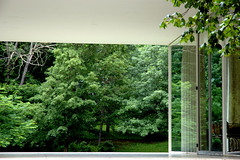
It was impossible to capture the house in photography, but I tried anyway. Here’s a brief slideshow for the brave and the forgiving »

And here's the address to the house. (Just go.):

The Farnsworth House
14520 River Road
Plano, IL 60545
Tel (630) 552-0052
farnsworthhouse.com

Monday, June 12, 2006

miesian tease


miesian tease
Originally uploaded by suttonhoo.
The 20th Century produced a handful of houses that deserve to be ranked with the greatest buildings of all time, and the Farnsworth House is one of them. In this small pavilion Ludwig Mies van der Rohe created a sublime architectural experience of extraordinary power, as exhilarating as a skyscraper and as profound as a cathedral.

Mies teases us with the pretense of simplicity –- you could think this is nothing but a glass box with a white frame –- but this house is about as simple as a Zen garden: utterly spare, perfectly composed.

Paul Goldberger, Farnsworth: The Lightness of Being in the July | August 2004 issue of Preservation
Made a pilgrimage out to Farnsworth yesterday –- and yep, it lives up to all the hype. Need some time to sort through and upload some of the images that I took away. (None of them do it justice, of course.) Stay tuned.

Friday, June 09, 2006

more mies


Farnsworth House Front
Originally uploaded by fueledbycoffee.
So much for slacking off this weekend -- just heard from my favorite CAF docent -- he's taking a group down to Farnsworth this Sunday. Box lunch included.

I'm so there.

(I'm a sucker for a box lunch.)


[Photo credit: fueledbycoffee]

Tuesday, June 06, 2006

mies, mies baby

messin' around with mies #1
Originally uploaded by suttonhoo.
Not too many years back (just under one, to be exact) I was firmly convinced that I wasn’t into Mies and the kind of Modernism that he served up. Of course, I arrived at this conclusion without the advantage of having visited a Mies building, but all the same: it was a conviction. (His chairs were kind of nice, but DWR was where I drew the line.)

And then, last September, I went ahead and visited a Mies. The Chicago Architecture Foundation runs a periodic Mies and Modernism tour on the IIT campus – my sweetie and I signed up for one Saturday last September.

I’ll spare you the details of wandering through Rem and Jahn’s structures (I would rhapsodize and you might yawn), and the slow meander through Mies’ God Box and the Admissions building. Let’s just say I was slowly warming to the man, to his long lines and suspended steel girders, and I didn’t entirely know why.

crown hallBut it wasn’t until we hit Crown Hall that I crossed over.

It was the middle of the afternoon, and the day was overcast – an innocent enough moment to encounter the structure that’s better known for a being a beautiful box of light that beams across the campus at night. The hall was packed with first year architecture students assembled around drafting tables and chalk boards, buzzing with new beginnings.

I don’t understand what happened next, but all I know was: I got giddy.

Something about that building made me high.

The only experience that comes close to what I felt that first time in Mies’ Crown Hall takes a minute to explain: I was 12 and visiting friends; he was 16 and a cousin of theirs.

We were all horsing around in the swimming pool and he picked me up and hurled me across the water – but before he tossed me, he held me just long enough to make me wish he would hold me some more.

That’s all there was too it – a brief, bare moment of experience – I was too young to understand where it could lead, or how messy that would all get – I just wanted that feeling of being held against his chest to last forever. It was pure intoxication without the complications of consummation. Nothing hidden. Every ounce of desire was in plain sight.

crown hallThat’s Crown Hall.

Suspended from the girders that support the building, it’s largely one big room, divided gratuitously by human-sized partitions. The walls are all windows, of course; the base panels are scrim-like; the top panels are pellucid and transparent. A largely iron-free glass makes these panes extraordinarily clear.

I returned to Crown Hall over the weekend as part of an architecture class with Blair Kamin, the architecture critic for the Chicago Tribune. It was the first time I had been back since September, and I suspected that I would be a little more restrained this time.

But I was wrong. The students were gone and the sun was out and the vastness of the hall was even more pronounced.

crown hallNo cold old man of Modernism here. Mies is shockingly transparent in his intentions.

Hold me, Mies. Hold me.


See more shots of Mies »

Saturday, April 15, 2006

the god box


Carr Chapel detail
Originally uploaded by suttonhoo.
I suspect Mies had nothing to do with this detail, but it did seem that this little decal (on the window panes that skirt the front of the building) had been around as long as his minimalist chapel, known to the students on the IIT campus as "The God Box". Light was terribly low inside so, given my aversion to using a flash, I came away with only one other usable shot.

Carr Chapel, aka "The God Box"
Mies van der Rohe at IIT
Chicago, IL
Related Posts with Thumbnails