Showing posts with label sociology. Show all posts

Saturday, January 29, 2011

3-second rule

The Hug
Photo by nicky.reynolds

What we have is very broad research showing that we experience the world in about these 3-second time frames.

Developmental psychologist Emese Nagy of the University of Dundee in the United Kingdom, commenting on her study: Sharing the moment: the duration of embraces in humans, in which she determines that the average Olympic gymnasts' hug lasts about three seconds.

Nagy's research stems from older studies that have observed this 3-second rule in human nature, as reported by the Journal Science:
Crosscultural studies dating back to 1911 have shown that people tend to operate in 3-second bursts. Goodbye waves, musical phrases, and infants' bouts of babbling and gesturing all last about 3 seconds. Many basic physiological events, such as relaxed breathing and certain nervous system functions do, too. And several other species of mammals and birds follow the general rule in their body-movement patterns. A 1994 study of giraffes, okapis, roe deer, raccoons, pandas, and kangaroos living in zoos, for example, found that although the duration of the animals' every move, from chewing to defecating, varied considerably, the average was, you guessed it, 3 seconds.

Sunday, April 12, 2009

subtext

Easter in Atitlan

I’ve written before of the ways and habits of the Atitecos of Atitlan, or rather, related what others have observed about the people who live around the lake rimmed by three volcanoes in the Guatemalan Highlands. The contemporary Easter practices of these Maya who managed under Spanish conquest and the persistent presence of the Catholic Church to preserve their old stories and practices is no less interesting -- and perhaps it’s no accident that it brings us back to belly buttons and to the renewal of Spring:

her majesty

Just as the three volcanoes conceptually grew out of the waters of Lake Atitlan, the three church altarpieces rise above the floor of the church. The space beneath this floor contains a number of burials which Atitecos associate with sacrificial offerings, semideified ancestors, and indigenous kings. Tz’utujils also believe that the floor of their church constitutes a thing barrier separating them from the underworld, where all the creative and destructive elements inherent in nature gather together.


The most sacred opening into the underworld realm is a small hole called the pa ruchi’ jay xibalba (“at the doorway of the underworld”) or r’muxux ruchiliew (“navel of the face of the earth”) located 3m. west of the raised altar in the center of the nave’s floor. It is approximately a meter deep and 35cm. across and is normally covered with a removable flagstone. Among traditionalists, this hole is the principal access point leading to the underworld and the symbolic center of creation.


...


The navel hole at Santiago Atitlan is only uncovered once a year, at midnight prior to Holy Thursday during Easter Week. On the following day, Holy Friday, a great throng of Atitecos gather in the church to watch a massive wooden cross, on which the life-size sculpture of Christ with moveable arms has been nailed, being lowered into the hole.

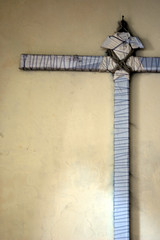
bound cross


The placement of the cross of Christ in the ground signifies not only his entrance into the underworld of death, but also represents the means by which the resurrected God reemerges to new life from the center point of creation. One of the sacristans who participated in the ceremony told me that the cross is “planted” in the ground just as a seed is planted. Christ on the cross is thus reborn “just like new maize plants.”

From Allen J. Christenson's Art and Society in a Highland Maya Community.

Wednesday, October 31, 2007

txt me


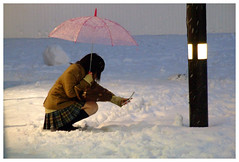
picture of snowman
Originally uploaded by glowingstar.
The fixed line phone "is a collective channel, a shared organisational tool, with most calls made 'in public' because they are relevant to the other members of the household."

Mobile calls are for last-minute planning or to co-ordinate travel and meetings.

Texting is for "intimacy, emotions and efficiency".

E-mail is for administration and to exchange pictures, documents and music.

Instant messaging and voice-over-internet calls are "continuous channels", open in the background while people do other things.


Conclusions reached by Stefana Broadbent, an anthropologist who leads the User Adoption Lab at Swisscom, Switzerland's largest telecoms operator as reported way back in June the Economist's 2007 Technology Quarterly. The study was based on observation, interviews, surveys of users' homes and asking people to keep logbooks of their communications usage across several European countries.

Also reported in the piece, entitled Home truths about telecoms:

• 80% of an individual's mobile communications are with the same four people

• 60% of men carry their cellphones in their pocket; 61% of women carry their phone in their handbags -- and women tend to miss 50% of their calls because of the difficulty of retrieving the phone from those dark depths

• Not surprisingly, the frequency with which belt-pouches are used for carrying phones diminishes according to city's fashion sense: 31% of men used them in Ji Lin City; 19% use them in Beijing; 4% use them in Milan; and they're practically non-existent in Tokyo.

Of her research Broadbent commented: "The most fascinating discovery I've made this year is the flattening in voice communications and an increase in written channels."

Thursday, May 03, 2007

diagram of a blog


Missed this when it ran in the NYT on 5 April -- stumbled across is yesterday on Pentagram's Blog.
Related Posts with Thumbnails