Showing posts with label mayan studies. Show all posts

Monday, September 21, 2009

as cited


Attended the Saturday afternoon sessions of NIU’s conference on Crafting a Maya Identity. (The link appears to have expired or else the server died, so apologies for the lack of reference.) The afternoon sessions were concerned with “Indigenous Kitsch” -- tourist art in the Yucatan that has no historical antecedent outside the tourist trade, although in recent years the handicrafts have drawn from Classic Maya bas-relief for much of its subject matter.

The conference was accompanied by a lovely exhibit of artists’ works, and many of the Mayan artists were in attendance.

The usual questions about “is it art” were asked, as were questions of cultural identity. Not mentioned (unless it was covered in the morning sessions) were textiles as art and/or kitsch. Witness: I have in my possession some lovely table runners and pillow cases from Mexico and Guatemala, and although they were created on traditional Mayan backstrap looms and borrow from traditional patterns, I’m pretty sure the Classic Maya didn’t have a lot of call for pillow cases like these.

Mary Katherine Scott, who curated the exhibition and in part organized the conference, presented her paper on “Representing the Maya: When is it Appropriate to Call ‘Appropriations’ Art”. She drew extensively on referential imagery to explicate her subject matter -- Andy Warhol’s works put in an appearance as did Roy Lichtenstein. An extensive scattering of classic Mayan and Olmec artifacts were also visually referenced.

When she didn’t reference her own photographs to M.K. Scott, she referenced the imagery, almost universally, to Google Images.

I had hoped to ask her about it during Q&A but there was none following her presentation, and the panel discussion led to more interesting topics, and I had no interest in derailing it with this small matter.

But is it a small matter? To cite a reference engine that has no agency of its own as a source for imagery? Google Images only points to images created by others, and the actual citations could easily have been obtained by clicking through to the destination page and culling the reference from the parent source. Something, certainly, that this scholar had to do, because she used large images, not the small thumbnails that are rendered for Google Image search.

In each case she would have found a human being or an institution responsible for the making of that image. In each case it is that person or organization that should have been cited.

Not only was it horribly ironic that in presenting her criticism of historical appropriations she would have inappropriately appropriated imagery without proper attribution (say *that* three times fast); but I found it especially troubling, as someone whose trade depends upon architecting websites so that they may be found via Google and other channels of discovery, that she would have referenced a transitory source. Google Image search results may well change from day to day, depending upon the availability of the site serving the image and its competition with other images. There is no promise or contract in place that will ensure an image found there yesterday can be found again today. Perhaps if M.K. Scott had cited the keyword used to trigger the query the citation would be more complete and have a better chance of being reproduced, but really? Has the Chicago Manual of Style approved citing a search engine as an appropriate citation?

Please tell me no.


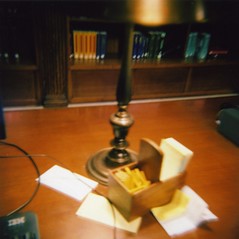
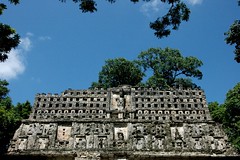
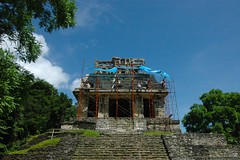
p.s. The image above is a holga shot from the Epcot Center sometime back when I was in Orlando for a conference. It’s Disney’s version of a Mayan pyramid, and it’s all kinds of wrong. If you care to reference it elsewhere please go with “Photo by: Dayna Bateman who posts to Flickr as suttonhoo.” Even though the image may sometimes be found in Google Images.

Sunday, April 12, 2009

subtext

Easter in Atitlan

I’ve written before of the ways and habits of the Atitecos of Atitlan, or rather, related what others have observed about the people who live around the lake rimmed by three volcanoes in the Guatemalan Highlands. The contemporary Easter practices of these Maya who managed under Spanish conquest and the persistent presence of the Catholic Church to preserve their old stories and practices is no less interesting -- and perhaps it’s no accident that it brings us back to belly buttons and to the renewal of Spring:

her majesty

Just as the three volcanoes conceptually grew out of the waters of Lake Atitlan, the three church altarpieces rise above the floor of the church. The space beneath this floor contains a number of burials which Atitecos associate with sacrificial offerings, semideified ancestors, and indigenous kings. Tz’utujils also believe that the floor of their church constitutes a thing barrier separating them from the underworld, where all the creative and destructive elements inherent in nature gather together.


The most sacred opening into the underworld realm is a small hole called the pa ruchi’ jay xibalba (“at the doorway of the underworld”) or r’muxux ruchiliew (“navel of the face of the earth”) located 3m. west of the raised altar in the center of the nave’s floor. It is approximately a meter deep and 35cm. across and is normally covered with a removable flagstone. Among traditionalists, this hole is the principal access point leading to the underworld and the symbolic center of creation.


...


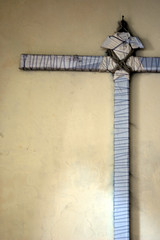
The navel hole at Santiago Atitlan is only uncovered once a year, at midnight prior to Holy Thursday during Easter Week. On the following day, Holy Friday, a great throng of Atitecos gather in the church to watch a massive wooden cross, on which the life-size sculpture of Christ with moveable arms has been nailed, being lowered into the hole.

bound cross


The placement of the cross of Christ in the ground signifies not only his entrance into the underworld of death, but also represents the means by which the resurrected God reemerges to new life from the center point of creation. One of the sacristans who participated in the ceremony told me that the cross is “planted” in the ground just as a seed is planted. Christ on the cross is thus reborn “just like new maize plants.”

From Allen J. Christenson's Art and Society in a Highland Maya Community.

Monday, April 06, 2009

locavore

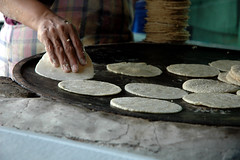
comal

That’s why I haven’t had a cheese steak.


My brother, who’s been living in Philly for the last eight months and will most likely leave as soon as he wraps up his graduate program, when I saw him over the weekend and related to him something I had just heard from Allen Christiansen at the U Penn Maya Weekend.

Namely that, tangled up within contemporary Mayan conceptions of ancestry, is the very potent possibility that we come to know the things that matter -- histories, remedies, right ways of being -- because the blood of the ancestors resides in our blood and helps us remember these things.

But unlike the euro-centric idea of ancestry which is top heavy with begats and begottens, in the Mayan world view one isn’t born into ancestry -- ancestry is tethered to place.

Nine months is usually what it takes to make the ancestors of a place your own: a period of gestation in which you live there, eat the local food[1] and contribute to the community.

After that you are of that place and the ancestors are your ancestors -- and once the ancestors have got your back, baby: you're golden. (Provided, of course, you do your part with the prayers and the flowers and the offerings and stuff.)


[1] Corn tortilla is the food that matters most to the Maya -- it bears a powerful resemblance to the Catholic Host in their world view.

Friday, April 03, 2009

awkward moment

please make a note of it

Last night I was reminded what a complete nerd I am when my drinking companions looked at me through the din of the pub with fixed and glazed expressions while I explained I would have to leave pretty early so that I could pack for Philly where my sweetie and I would be taking in U Penn’s annual Maya Weekend.

Of course I had to persist, hoping to spark the fire in their eyes, explaining what a hottie Simon Martin is, and how I was pretty sure Karen Bassie would be presenting the Popol Vuh geo-specificity theory that she had cooked up with Google Earth and some crazy road tripping with our buddy Nick.

Polite nods were followed shortly by car bombs (Guinness + Bailey’s + Whiskey) and I can only hope that they’ve since forgotten how I like to spend my weekends.

Sunday, October 26, 2008

Thursday, October 09, 2008

camina y pasa tambien


toda luna, todo año

todo dia, todo viento
camina y pasa tambien.
tambien toda sangre llega
al lugar de su quietud.

—chilam-balam


Jean-Marie Gustave Le Clézio, translator of the Chilam-Balam texts (among other things), has won the Nobel Prize for Literature.

Photo from the National Museum of Anthropology in Mexico City.

Friday, September 12, 2008

black stones, reprised

I wrote of Piedras Negras a little while ago: that remote Mayan site along the Usumacinta River where so many Mayanists did so much important work.

This is a reprise: Piedras Negras by holga.

landmark


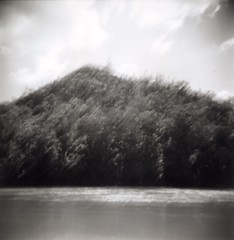
Memorize this mound of a mountain. It's just opposite the riverbank where you'll put in to climb the steep sandy bank to access the site. It's one of very few landmarks. There are no signs marking Piedras Negras.


temple steps
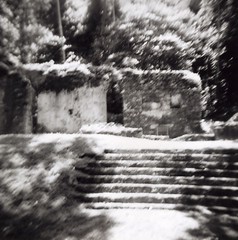
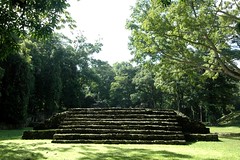
Temple steps.


mayan temple
Temple.


where Tatiana sleeps
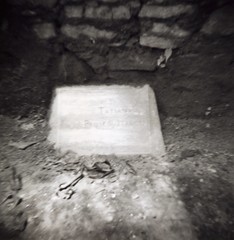
Where Tatiana sleeps at the top of the temple steps.

Sunday, August 10, 2008

más ruinas

ruinas

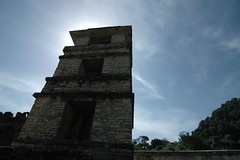
There's something strangely sexy about the Mayan site of Yaxchilan, forgetting that when you're there you're dripping with sweat and constantly swatting at mosquitoes.
I blame Lady Xoc.

Shield Jaguar's Queen is depicted in Lintel 24 on her knees before her King, threading a rope spiked with thorns through her tongue in the female version of penis perforation. She captures her blood on a paper offering that will be burned to invoke a crazy serpent vision like the one depicted on Lintel 25. [1]

Lady Xoc’s sultry spirit is all over this place.

lintel


The site is considerably more groomed than Piedras Negras, but has none of the tightly trimmed pathways of Palenque. It's somewhat remote and requires that you put in by boat, but still brings in a respectable tourist trade -- enough traffic that when our friend and guide Alfonso set up a picnic for us all and was mashing up a bucket of guacamole to top the banana leaf wrapped tamales that he hauled in from afar, the tide of tourists would stop to ask him ¿cuánto? (Fortunately he didn't relent and we had more than enough to wash down with a cane sugar Coca -- one of the best meals ever.)

At Yaxchilan there's a deep dark labyrinth of passageways that meander through an interlocking series of excavated structures. The ceilings frequently peak in that classic attenuated Mayan triangle, and are studded with a concentration of sleeping bats -- blind sleeping bats, you remind yourself fervently, as you sweep your flashlight over them.
dance platform


Stepping around the dark corners and up unexpected steps soon you find yourself in a colonnade that spills into a wide open grassy plaza studded with a dance platform and a ball court and an abundance of free standing structures -- many of them with carved lintels, still intact in their door frames, and an occasional stucco.

I’ve never received a satisfactory answer to my question: Why did the Maya exert so much effort into carving a surface that no one saw? Lintels are installed in that place in the door jamb just over head -- to see them at all requires the indignity of cranking your neck back hard; to shoot them requires lying flat on your back in something of a sprawl. I shot almost a dozen lintels on this last trip and each time I felt like perv peeking up a girl’s skirt.

lintel


I’ve been told by several scholars that the subjected saw them when they were lying prostrate before the king, but I’m not buying it: prostrate implies nose to the dirt, and lintel requires some serious head twisting to look up and absorb the intricate stories that they tell.

Something else is going on with the lintels, and I’m reminded of the Thai belief that spirits live in door jambs (which is why you never want to step on the wood that frames the bottom of a door in a Thai house) and wonder whether it was thought that something sleeps here too; something that looks after the stories and ensures they’re remembered.

It's a complete bullshit theory, but it's mine.


Stairways vie with lintels for predominance at Yaxchilan. The central feature of the site is a big ass stairway that ascends to remarkable Temple 33 that’s graced with an estella carved from a stalactite.

Temple 33, roof comb


Arriving, huffing, at the top you realize you still haven't gone far enough -- there are two more acropolis that lie behind a slippery hike through twisted trails, over rock faces and thick roots.

Three of us hiked it together in silence. It was a little like hiking one of the steeper trails at Yosemite, back in the wilderness areas during the early spring when it's misty and wet. But ratch up the heat and humidity by about 95%, and then drop a 3,000 year old structure on the summit. Better yet: drop three structures. And populate them with cryptic carvings.

It was something like that.

acropolis


And then like jimmies on ice cream the monkeys stopped by -- at least half a dozen howlers with a baby among them, taking their time over lunch, swinging through the trees.

dear sidereal: I brought you a monkey


p.s. There was a furry tarantula too, who, near the end of the day as we ascended what would be our last temple steps of the trip, ducked into his hidey-hole just as my foot found its grip on his step, three of his eight legs protruding as he sat perfectly still, pretending to be invisible, waiting for me to move on.


[1] Both lintels -- two of the most extraordinary examples of Mayan art -- now hang in the British Museum.

Friday, August 08, 2008

black stones

altar

Had hoped to write something compelling and endlessly fascinating about Piedras Negras, because the Mayan site on the Usamacinta River was, after all, the whole reason I soaked myself in deet and took cloroquin only to be bitten ANYWAY by disease bearing mosquitoes (although bearing something else probably, because the malaria smear turned up negative. west nile’s the head runner, followed by dengue fever. still waiting for results on those.)

But because my brain is taking odd holidays at random moments I’ll stick to the basics and simply upload a handful of shots and prattle on a bit.

ik' window


Piedras Negras doesn’t see a lot of visitors -- it’s not like the well-groomed sites of Tikal and Palenque or even the mildly groomed jungle site of Yaxchilan (pics from there to follow soon) -- Piedras Negras today is only a few narrow trails cut into a series of steep slopes.

piedras glyphs


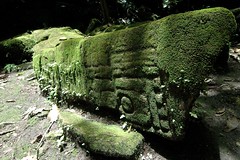
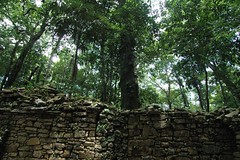
Very few of the ruins are revealed to what little light makes it through the thick rainforest canopy: much has never been excavated and the little that has has been overtaken again by the jungle in the time it lay fallow between excavations and when it was home to guerillas and drug runners.

The real treasures (and they’re astonishing, the estella and thrones and other bas-relief of Piedras) have been spirited away to the National Gallery in Guatemala City (Piedras lies on the Guatemalan side of the river). What’s left on the site has mostly been overtaken by moss.

steps


Piedras Negras matters because Tatiana Proskouriakoff did some of her most important work here -- as an artist developing reconstructive drawings of what the site looked like in its prime she puzzled out the obvious: that the estella -- stone monuments erected in front of the temples and structures of the site -- recorded histories. Not mythologies, as previously believed. Actual chronicles of the kings.

Her insight led to the subsequent rapid tumble decipherment of Mayan hieroglyphics. Well, maybe not that rapid, but something of a tumble, and still underway today.

structure wall


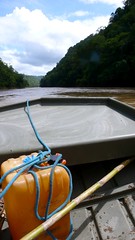
The approach to Piedras Negras isn’t easy. For us it was an hour and half in the bed of a pick up truck, a slick descent down a muddy bank (well traveled by pollo -- the Usumacinta is a main thoroughfare on the underground highway into the U.S.) into metal skiffs that would ferry us for the next 45 minutes along the river, and then a sandy ascent up another steep bank to the site.

skiff to Piedras


All of which contributed to the wholly giddy feeling that I had on the approach, and the scramble through the bush, through the green soaked sunlight and the thick under story and the muddled mossy edifices. Yeah. Could hardly see a thing. And it was heaven.

Even the indignity of squatting in the woods (there are no port-a-potties at Piedras) couldn’t shake off the feeling that comes from finally touching down at a place where so much history happened.

the ascent to the acropolis


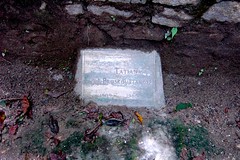
Tatiana’s ashes are interred on the acropolis -- a steep ascent up yet another mound that’s part hillside part structure part city beneath your feet. She’s surrounded by the whirring sounds of the jungle -- howler monkeys and tiny cicadas that sound like weed whackers and add a surreal edge that makes being in the middle of nowhere sound a little like being in the middle of the suburbs.

where Tatiana sleeps


Wednesday, July 23, 2008

Ik'

I'k

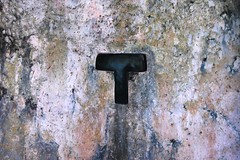
This is a window at the Mayan site of Palenque. It's also an Ik', a glyph that means wind, but really something closer to the Chinese concept of Chi.

There's more spirit in it; more life force; more vital energy.

These windows are scattered all through the palace at Palenque. They also appear in the ruins at Piedras Negras, and other sites in the Mayan world.

Pakal, Palenque's heavy hitter, was buried in a jade mask that had an Ik' between his lips.

I've written a little bit about the Ik' before »

Tuesday, July 22, 2008

these bones

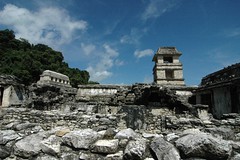
Palenque Tower and Temple


There’s a lot you should know about Palenque, a Mayan site on the Northern edge of the Chiapas highlands, but I’m probably not the one to tell you.

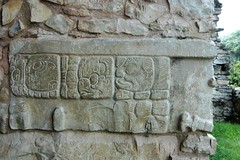
glyphs


Heavy hitters [1] have written books and papers and shared research about the place known to the classic Mayan as B’aakal, or Bone: about its art, its architecture, its friendly terms with Tikal, its antagonistic relations with Calakmul, Tonina and Piedras Negras.

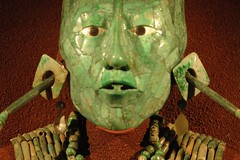
At minimum you should know about K’inich Janaab’ Pakal and his cinnabar saturated jade strewn burial in the heart of the plaza. About how he was found at the bottom of a smooth bending stairway of ochre colored stone 22 meters deep in the Temple of the Inscriptions, barricaded by rubble from the world and connected only by a psychoduct through which his descendants could play telephone with their ancestor. About the marvelous greenstone mosaic that masked his face in death; about the jade sphere that his corpse clutched in his left hand; the jade cube that he clutched in his right.

pakal's mask

pakal's cubepakal's sphere


About the marvelous inscription on the lid of his sarcophagus in which he’s resurrected from the underworld, Xibalba (which is wonderfully delicious to say out loud: she-BALL-bah), as a rapturous maize god; about his ancestors who line the sides of the monumental coffin (so tightly pinched into that small tomb that I asked a friend, who knows something about these things, “they carved it in situ? but how? the detail is so fine.” and he suggested that perhaps, instead, the massive temple was built around the stone container only after it had been carved.) who each bear a headdress that aligns them with an important crop -- cacoa (chocolate), nance, guayaba, chicozapote, mamey, and aguacate (avocado) -- crops that are passed from one generation to the next through inheritance. Like kingship. [2] Each gorgeous line etched to tell the story, to assert that I, Pakal, belong here. This was my job to do and I did it magnificently. And baby: I've *still* got your back. I'm an *ancestor* now.

Temple of the Inscriptions


You should know that the tourist traffic down the stairwell since it was excavated by Alberto Ruz Lhuillier in 1952, that the heat and breath and humidity of curious souls, threatened to destroy the treasure, and most folks can only see it now in a poorly rendered reproduction in the site museum at Palenque, or a little bit better reproduction at the Museo Nacional in Mexico City, where too the original jade mask is kept, along with the sphere and the cube and a cache of other precious grave goods.

You might be interested to know that one late night in a rainy December I had a chance to descend the ochre steps and peek into the tomb, and its an experience I’ll never forget. But that I didn’t this time: our host no longer working at Palenque, after a falling out with INAH.

Palenque Tower


You should know too about the beautiful pieces that are still being excavated, some in just the last five years or so: About the jaw dropping details of the thrones from Temples 19 and 21, the figures so individualized, so finely incised, you can almost hear their conversation.

stumpy @ the palenque museo


You should know that in 1973 Merle Greene Robertson, who made magnificent rubbings of the stuccos and bas-relief of Palenque and other sites (preserving many of them before they were diminished by the ash of a nearby volcanic eruption and the relentless worry of acid rain) started the Mesa Redonda, or Palenque Roundtable, in the living room of her home on the street that is now named (and misspelled) in her honor.


How scholars and regular folks with an interest in Mayan glyphs got together to try to crack what they were all about; to uncover the stories; started telling them again. How Linda Schele was there, and her passion for that place sparked a strange and wonderful populist movement that lends a curious slant to Mayan scholarship today -- academics and independent scholars and hobbyists all working through ancient glyphic texts, with variable results, but all working, and adding their decipherings to the pile.

courtyard of the captives


And maybe its peevish of me to mention that ten years after its founding, and ten Roundtables into it, INAH took over the Mesa Redonda and restarted the count back at one, because that’s how INAH does things.

under construction


It might too be of interest to learn that Merle Greene celebrated her 95th birthday at this year’s Roundtable; that our trip was timed to coincide with the conclusion of the festivities so that our host, Nick, could share a few margaritas with the birthday girl.

And for those who have been reading detritus for awhile it might matter to know that the last day of our visit at the historic site we lit a candle in the Cathedral to commemorate the second of anniversary of the night that Kathryn died in Palenque, too young, but in a place she knew as home. In a place she dearly loved.

salvation under wraps


[1] A few heavy hitters worth looking at:
Chronicle of the Maya Kings and Queens: Deciphering the Dynasties of the Ancient Maya, Simon Martin and Nikolai Grube

Maya Cosmos, David Freidel, Linda Schele, and Joy Parker

The Inscriptions from Temple XIX at Palenque, David Stuart

Living with the Ancestors: Kin and Kingship in Ancient Maya Society, Patricia A. Mcanany

[2] Living with the Ancestors, p 43

Friday, November 16, 2007

No. 9


No. 9
Originally uploaded by suttonhoo.
Snapped this earlier this week in Detroit.

Posting by cameraphone from
Edwards Hospital.

Random FYI: In Mayan Cosmology 9 is the number of the underworld. (Per George Stuart at the Field Museum earlier in the week.)

Tuesday, November 13, 2007

narwhals with picnickers & pepsi

Field Museum, Lower Level
Chicago, IL

Scarfing some vending action before seeing George & David Stuart (father & son Mayanists) speak at a National Geographic event on Palenque. (What's Palenque? Search my Flickr stream. ;)

Foraging upshot: Hostess Ding Dongs, 11 days past their expiration date.

Posting by cameraphone from seat #D22.

Saturday, August 04, 2007

underscore


Heading home this afternoon from Evanston, after a wonderful conversation with a friend, my mind strayed randomly to something I read once about Chagall's Self-portrait with Seven Fingers. It was this:

The mysterious extra fingers on his left hand can be explained by a Yiddish saying, whereby to do things with seven fingers means doing something really well and with all one's heart. [1]

Not so random, I guess, because the conversation of the morning was about exactly that: deciding to do a thing and then pouring your whole heart into it. Owning it. Giving it your full talent.

Because to do less it to set yourself up for later regret.

And then tonight, a Flickrite commented randomly on a photo that I posted a couple years back (July of 2005 -- it's rare that photos that deep in the stream receive attention) with a question about provenance. I pulled up the image to answer his question, and realized that here, in the impression of hands left by a Mayan artist around about 1000 B.C.E. -- were seven fingers.


Who knows if the artist intended the seven fingered impression, or if his hand just slipped. But for me, this night -- with Jung as my witness -- I took it to heart as a telling punctuation mark.


[1] From Phaidon's biography: Chagall

Above: Self-portrait with Seven Fingers by Chagall; Mayan artist unknown.

Wednesday, March 07, 2007

rite of spring

estella 12 top

Heading to Austin tomorrow to check in with the folks at the Maya Meetings. This has become a fairly regular rite of spring for us, although we missed the last couple of years because I was giving it all to the Man, and waited too long to book a room in town – a fatal error in the days surrounding the SXSW festival, which has morphed from Music into Interactive and Film, too.

Thought about trying to catch some of the Interactive while I was down there; then thought better of it. Days at home lately have become too precious and few. Do hope to catch a little spillover music while we’re in town, if we get lucky.

This will be the second year that they’re “doing things differently” at the meetings – Nikolai Grube left the seat that he inherited from Linda Schele a few years back. He was pretty much a traditionalist, and the meetings ran Linda’s way while he occupied the chair: Two days of papers (Thursday and Friday), followed by two days of collective decipherment (Saturday and Sunday) – which meant the rock stars of Mayan Studies armed with Sharpies hovering around an overhead projector, outlining and highlighting glyphs and their assorted and sundry parts, and making strange guttural utterances to the approval and/or dismay of the peanut gallery.

estella 12 detail

Worth noting: the peanut gallery is one of the best parts of these meetings, being a mash of notables and nobodys – Justin Kerr, Simon Martin, Michael Coe, Merle Greene, you get the picture… -- surrounded by young Turks and aging groupies (my sweetie and I fall into the aging set) who share little in common outside a prurient interest in the things folks etched in stone down South many, many years ago.

The initial four days used to be followed by a whole week of breakout workshops, in which folks sat down with notebooks full of inscriptions and Mayan grammars and went to town. I never did manage to make the time to stay for the follow up week, and regret now that I never will, because it's been tightened into a considerably more brief few days.

David Stuart is running the show now, having inherited the seat from Grube, and the event as a whole has been compressed. Jury’s still out on whether it’s for the good or the bad – I haven’t experienced it myself, and when I press folks who have for details all I get is a tight-lipped “it’s different”. So we’ll see.

Was pleased to hear that we’ll be taking on Piedras Negras inscriptions, along with a few of its Usumacinta neighbors: Yaxchilan and Pomona. One of my all time fave stellas hails from Piedras Negras, a now inaccessible site along the river because it’s largely occupied by drug lords who have made the monuments their home.

estella 12 4 captives

Estella 12 lives in the National Gallery in Guatemala City now, tucked away in a corner of the partially open patio in the heart of the galleries.

It’s stunning.

It portrays mortified captives under the thrall of their conquerors, and I’ve read none of the formal scholarship so I can no longer sort out what I heard from someone who knew something and what I made up on my own, but to the best of my knowledge the estella was carved by the captives it depicts. And it shows.

The captives (from Copan, I think -- the "Paris of the Mayan World" -- one of the captives is branded with the Copan emblem glyph) are wholly human, distinct, unique, and their suffering is palatable. Their captors are stiff and brutish – the weathering probably has something to do with the fact that they lack the humanity that’s conveyed so vividly in the folks whom they’ve enslaved under their feet – but I suspect it has something to do with the artist’s perspective as well.

So with any luck I’ll come away from the weekend understanding, finally, what the stone says. I’ll let you know how it turns out.

Piedras Negras Estella 12, detail
Related Posts with Thumbnails