Showing posts with label war. Show all posts

Wednesday, April 20, 2011

final dispatch

Diary (2010) from Tim Hetherington on Vimeo.



Photographer Tim Hetherington, the maker of this short film and the director of Restrepo, was killed today in Misrata.

Thursday, January 14, 2010

poppies

one more for the road

a found poem

Other wars have happened since.

Only when they passed 100
under gentle nudging
did they break their silence

The words tumbled out then

Mr. Allingham misstepped
into the vile hole
where he could feel
against his groping hands
the floating carcasses
of rats and parts
of human bodies

Mr. Patch in his nursing home
saw the linen cupboard light
flash on

and cried out

He thought it was the shell
that killed three of his mates
leaving nothing to find
and had sent into his abdomen
a jagged chunk of shrapnel

cut out
without anaesthetic
four men holding him down

Both men remembered the mud

sticky gluey mud
mud crusted with blood

in which men and horses drowned

In old age he visited the battlefield
now tided and grassed over
staring out from his wheelchair
he murmured

Mud. Mud. Mud.


Found in From Memory to History in the 17 December 2009 issue of the Economist, concerning the deaths of the last two surviving veterans of WWI.

Tuesday, November 17, 2009

what is it good for

Illus: Joe Kubert Star Spangled War Stories #137 "War That Time Forgot" Page 4 Original Art (DC, 1968)


Last Sunday our Unitarian minister wrapped up a Veteran's Day service about homelessness among our Vets by admonishing the congregation to create a world in which we never go to war again.

With some discomfort I realized I don't believe such a thing is possible.

I once I did.

In part, I've been spoiled by stories. Good stories, true stories, real stories all have conflict at their heart. The best stories portray the transformation that occurs when that conflict is conquered and resolved.

Conflict originates in the struggle for power, something that, frankly, all of us should grasp for. Owning our own strength, claiming our will to power, is what makes us human and gives us the courage to find the capacity to fulfill the dreams that drive us forward.

But of course, conflict occurs when the will to power of an individual or an entity treads on the autonomy of others.

Conflict cannot be entirely prevented in world that honors democracy and freedom, because preventing conflict means squelching free will and freedom of expression.

War, of course, is conflict out of control; conflict that requires severe remediation; and is often driven by individuals who have exerted their will to power at the expense of others' right to live. War should be the last measure, always, but can we really imagine a world in which it falls out of our lexicon? Falls off our list of options?

What matters more, I realized with a start, having been raised to believe that a conflict-free world of peace is possible, having felt always that soldiers are doing something inherently distasteful, something ultimately shameful; what matters in a way that is more real to me now than dreams of an abiding peace ever were, is to ensure that when the fight comes -- because I'm sure now that it will come -- what matters is that it's a fair fight. [1]

A curious side effect of this realization is that my conflicted feelings toward soldiers -- the career guys who serve honorably and take their duties seriously, several of whom I'm proud to call my friends -- has been transformed into one of greater respect and deeper gratitude.

This idea that war will always be with us is old news to a lot of folks; it's a curious revelation to me because it contradicts my usual posture, and maybe it will shift again as I grow older and greyer and long for pastoral landscapes and quiet places full of courtesy.

As I write this, such a place seems hard to come by.


Speaking of fair fights: The original comic art of Joe Kubert, who inked Tor, Tarzan, and Seven Soldiers of Victory for DC Comics is on auction through Friday »

Also related: How a soldier is working for peace by fighting poverty (see The End (Jake's Story) at the top of the pile) »


[1] Granted: Given the current constructs of war -- in which the poor and disenfranchised are the most likely to die and the multi-national corporations are the most likely to profit -- there is much work to be done to ensure the fight is fair.

Monday, June 29, 2009

study war no more


The model starts by assuming that everyone cares about two dimensions on any policy issue: getting an outcome as close to what they want as possible, and getting credit for being essential in putting a deal together -- or preventing a deal.

The model estimates the way in which individual decision-makers trade off between credit and policy outcomes. Some are prepared to go down in a blaze of glory seeking the outcome they want, knowing they will lose. Others have their finger in the wind, trying to figure out what position is likely to win and then attach themselves to that position in the hope of getting credit for promoting the final agreement.


Bruce Bueno de Mesquita, the Julius Silver Professor of Politics at New York University and a senior fellow at the Hoover Institution at Stanford University, explaining the computer model he's created, based on game theory, that can predict the outcomes of international conflicts. His interview with Sara Forrest appears in the 22 June issue of Computer World.

Thursday, January 08, 2009

779 dead

ØØØØØØØØØØØØØØØØØØØØØØØØØØØØØØØØØØØØØØØ
ØØØØØØØØØØØØØØØØØØØØØØØØ
+
ØØØØØØØØØØØØØØ

Thirteen days of fighting between Israel and Hamas have left an estimated 765 Palestinians and 14 Israelis dead.*

Sunday, January 04, 2009

Z is for Zion


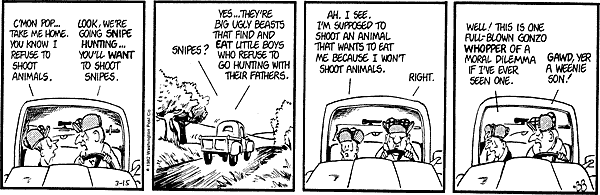
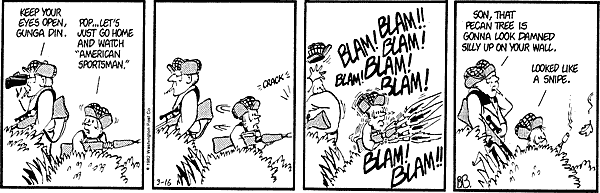
Lolabola kindly posted a series of comic strips that she found who-the-heck-knows-where after I referred to them when commenting on her blog. She wanted to know how could remember them from so long ago.

What I told her was true: Some girls remember first kisses; I remember when I first learned a new word. [1]

Those Bloom County comic strips taught me the word “snipe”.

I learned the word “happenstance” from a televised documentary. I don't remember the content of the show but I do remember spinning around to ask my dad: “is that a real word?” It seemed too wonderful to be true, a circumstance filled with chance and synchronicity.

I learned the word “Zion” when my stepmom laid it down on the Scrabble board and won a hefty triple letter score for the Z. She was cheating of course: Zion is a proper noun, which isn’t allowed in Scrabble play. But I was still in Elementary school and she was still bigger than me, plus she’d just unlocked a wonderful redolent word that meant, she told us, the Promised Land. So we let it lie.

I knew from Passover, a holiday that we celebrated in our curiously hybrid household, that the Promised Land meant Israel, that next year that’s where we’d be and that there was something wonderful about it – a kind of homecoming after much suffering.

I didn’t know that it meant someone else had to leave. I didn’t know it meant someone else had to suffer. I didn’t know it would lead to this »

p.s. Protect the Human »

[1] (Which isn't to say I don't remember the kisses, but they deserve their own post.)

you must remember this

Video Trailer: Waltz with Bashir

Animation functions on the border between reality and the subconscious.


Director Ari Folman, cited in Rolling Stone, on why he animated his documentary Waltz with Bashir.

Peter Travers' synopsis of the movie:

Folman, a former Israeli soldier who served during the 1982 Israeli-Lebanese war, has repressed his memories of the invasion of Beirut — more specifically, the massacre of Palestinian civilians at the Sabra and Shatila refugee camps. Though the killings were committed by the Christian Phalangist militia as payback for the murder of their leader, Bashir, the Israeli army stood by and reportedly sent up flares to aid the slaughter of men, women and children. In the years since, Folman cut off ties to the men he served with. The movie is his attempt to make some kind of sense of what happened by interviewing those involved.

Here's A.O. Scott's review in the New York Times »

Waltz with Bashir is in theaters now. Catch it post-protest.
Related Posts with Thumbnails