Showing posts sorted by date for query palenque. Sort by relevance Show all posts

Sunday, August 10, 2008

más ruinas

ruinas

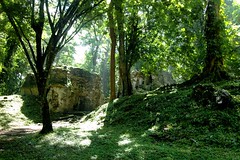
There's something strangely sexy about the Mayan site of Yaxchilan, forgetting that when you're there you're dripping with sweat and constantly swatting at mosquitoes.

I blame Lady Xoc.

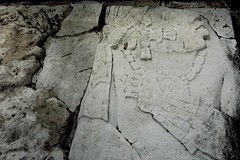
Shield Jaguar's Queen is depicted in Lintel 24 on her knees before her King, threading a rope spiked with thorns through her tongue in the female version of penis perforation. She captures her blood on a paper offering that will be burned to invoke a crazy serpent vision like the one depicted on Lintel 25. [1]

Lady Xoc’s sultry spirit is all over this place.
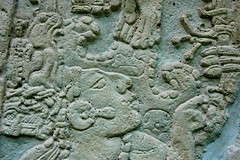
lintel


The site is considerably more groomed than Piedras Negras, but has none of the tightly trimmed pathways of Palenque. It's somewhat remote and requires that you put in by boat, but still brings in a respectable tourist trade -- enough traffic that when our friend and guide Alfonso set up a picnic for us all and was mashing up a bucket of guacamole to top the banana leaf wrapped tamales that he hauled in from afar, the tide of tourists would stop to ask him ¿cuánto? (Fortunately he didn't relent and we had more than enough to wash down with a cane sugar Coca -- one of the best meals ever.)

At Yaxchilan there's a deep dark labyrinth of passageways that meander through an interlocking series of excavated structures. The ceilings frequently peak in that classic attenuated Mayan triangle, and are studded with a concentration of sleeping bats -- blind sleeping bats, you remind yourself fervently, as you sweep your flashlight over them.
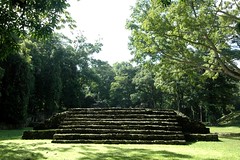
dance platform


Stepping around the dark corners and up unexpected steps soon you find yourself in a colonnade that spills into a wide open grassy plaza studded with a dance platform and a ball court and an abundance of free standing structures -- many of them with carved lintels, still intact in their door frames, and an occasional stucco.

I’ve never received a satisfactory answer to my question: Why did the Maya exert so much effort into carving a surface that no one saw? Lintels are installed in that place in the door jamb just over head -- to see them at all requires the indignity of cranking your neck back hard; to shoot them requires lying flat on your back in something of a sprawl. I shot almost a dozen lintels on this last trip and each time I felt like perv peeking up a girl’s skirt.
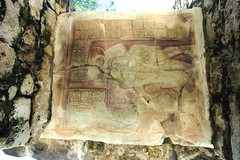
lintel


I’ve been told by several scholars that the subjected saw them when they were lying prostrate before the king, but I’m not buying it: prostrate implies nose to the dirt, and lintel requires some serious head twisting to look up and absorb the intricate stories that they tell.

Something else is going on with the lintels, and I’m reminded of the Thai belief that spirits live in door jambs (which is why you never want to step on the wood that frames the bottom of a door in a Thai house) and wonder whether it was thought that something sleeps here too; something that looks after the stories and ensures they’re remembered.

It's a complete bullshit theory, but it's mine.


Stairways vie with lintels for predominance at Yaxchilan. The central feature of the site is a big ass stairway that ascends to remarkable Temple 33 that’s graced with an estella carved from a stalactite.
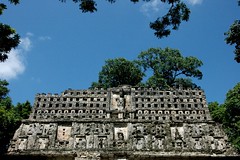
Temple 33, roof comb


Arriving, huffing, at the top you realize you still haven't gone far enough -- there are two more acropolis that lie behind a slippery hike through twisted trails, over rock faces and thick roots.

Three of us hiked it together in silence. It was a little like hiking one of the steeper trails at Yosemite, back in the wilderness areas during the early spring when it's misty and wet. But ratch up the heat and humidity by about 95%, and then drop a 3,000 year old structure on the summit. Better yet: drop three structures. And populate them with cryptic carvings.

It was something like that.
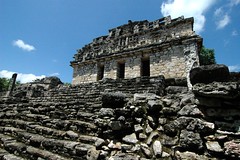
acropolis


And then like jimmies on ice cream the monkeys stopped by -- at least half a dozen howlers with a baby among them, taking their time over lunch, swinging through the trees.
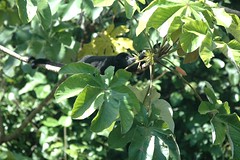
dear sidereal: I brought you a monkey


p.s. There was a furry tarantula too, who, near the end of the day as we ascended what would be our last temple steps of the trip, ducked into his hidey-hole just as my foot found its grip on his step, three of his eight legs protruding as he sat perfectly still, pretending to be invisible, waiting for me to move on.


[1] Both lintels -- two of the most extraordinary examples of Mayan art -- now hang in the British Museum.

Friday, August 08, 2008

black stones

altar

Had hoped to write something compelling and endlessly fascinating about Piedras Negras, because the Mayan site on the Usamacinta River was, after all, the whole reason I soaked myself in deet and took cloroquin only to be bitten ANYWAY by disease bearing mosquitoes (although bearing something else probably, because the malaria smear turned up negative. west nile’s the head runner, followed by dengue fever. still waiting for results on those.)

But because my brain is taking odd holidays at random moments I’ll stick to the basics and simply upload a handful of shots and prattle on a bit.

ik' window


Piedras Negras doesn’t see a lot of visitors -- it’s not like the well-groomed sites of Tikal and Palenque or even the mildly groomed jungle site of Yaxchilan (pics from there to follow soon) -- Piedras Negras today is only a few narrow trails cut into a series of steep slopes.

piedras glyphs


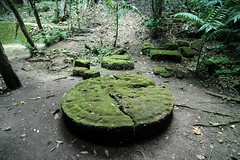
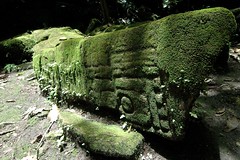
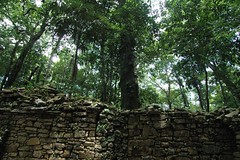
Very few of the ruins are revealed to what little light makes it through the thick rainforest canopy: much has never been excavated and the little that has has been overtaken again by the jungle in the time it lay fallow between excavations and when it was home to guerillas and drug runners.

The real treasures (and they’re astonishing, the estella and thrones and other bas-relief of Piedras) have been spirited away to the National Gallery in Guatemala City (Piedras lies on the Guatemalan side of the river). What’s left on the site has mostly been overtaken by moss.

steps


Piedras Negras matters because Tatiana Proskouriakoff did some of her most important work here -- as an artist developing reconstructive drawings of what the site looked like in its prime she puzzled out the obvious: that the estella -- stone monuments erected in front of the temples and structures of the site -- recorded histories. Not mythologies, as previously believed. Actual chronicles of the kings.

Her insight led to the subsequent rapid tumble decipherment of Mayan hieroglyphics. Well, maybe not that rapid, but something of a tumble, and still underway today.

structure wall


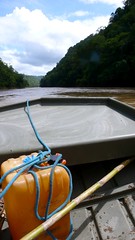
The approach to Piedras Negras isn’t easy. For us it was an hour and half in the bed of a pick up truck, a slick descent down a muddy bank (well traveled by pollo -- the Usumacinta is a main thoroughfare on the underground highway into the U.S.) into metal skiffs that would ferry us for the next 45 minutes along the river, and then a sandy ascent up another steep bank to the site.

skiff to Piedras


All of which contributed to the wholly giddy feeling that I had on the approach, and the scramble through the bush, through the green soaked sunlight and the thick under story and the muddled mossy edifices. Yeah. Could hardly see a thing. And it was heaven.

Even the indignity of squatting in the woods (there are no port-a-potties at Piedras) couldn’t shake off the feeling that comes from finally touching down at a place where so much history happened.

the ascent to the acropolis


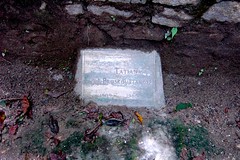
Tatiana’s ashes are interred on the acropolis -- a steep ascent up yet another mound that’s part hillside part structure part city beneath your feet. She’s surrounded by the whirring sounds of the jungle -- howler monkeys and tiny cicadas that sound like weed whackers and add a surreal edge that makes being in the middle of nowhere sound a little like being in the middle of the suburbs.

where Tatiana sleeps


Wednesday, July 23, 2008

Ik'

I'k

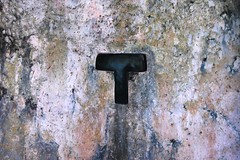
This is a window at the Mayan site of Palenque. It's also an Ik', a glyph that means wind, but really something closer to the Chinese concept of Chi.

There's more spirit in it; more life force; more vital energy.

These windows are scattered all through the palace at Palenque. They also appear in the ruins at Piedras Negras, and other sites in the Mayan world.

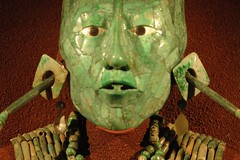
Pakal, Palenque's heavy hitter, was buried in a jade mask that had an Ik' between his lips.

I've written a little bit about the Ik' before »

Tuesday, July 22, 2008

these bones

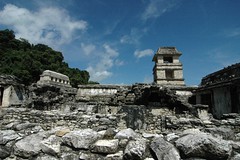
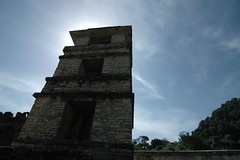
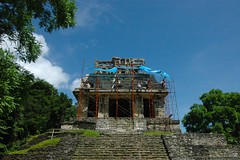
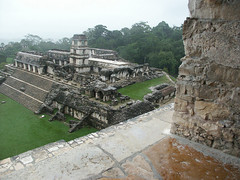
Palenque Tower and Temple


There’s a lot you should know about Palenque, a Mayan site on the Northern edge of the Chiapas highlands, but I’m probably not the one to tell you.

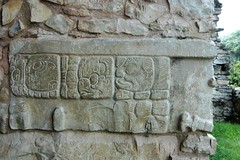
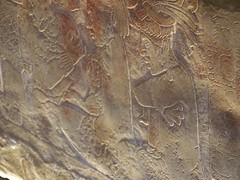
glyphs


Heavy hitters [1] have written books and papers and shared research about the place known to the classic Mayan as B’aakal, or Bone: about its art, its architecture, its friendly terms with Tikal, its antagonistic relations with Calakmul, Tonina and Piedras Negras.

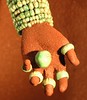
At minimum you should know about K’inich Janaab’ Pakal and his cinnabar saturated jade strewn burial in the heart of the plaza. About how he was found at the bottom of a smooth bending stairway of ochre colored stone 22 meters deep in the Temple of the Inscriptions, barricaded by rubble from the world and connected only by a psychoduct through which his descendants could play telephone with their ancestor. About the marvelous greenstone mosaic that masked his face in death; about the jade sphere that his corpse clutched in his left hand; the jade cube that he clutched in his right.

pakal's mask

pakal's cubepakal's sphere


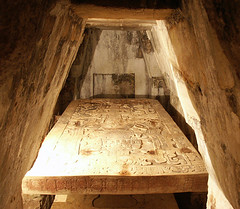
About the marvelous inscription on the lid of his sarcophagus in which he’s resurrected from the underworld, Xibalba (which is wonderfully delicious to say out loud: she-BALL-bah), as a rapturous maize god; about his ancestors who line the sides of the monumental coffin (so tightly pinched into that small tomb that I asked a friend, who knows something about these things, “they carved it in situ? but how? the detail is so fine.” and he suggested that perhaps, instead, the massive temple was built around the stone container only after it had been carved.) who each bear a headdress that aligns them with an important crop -- cacoa (chocolate), nance, guayaba, chicozapote, mamey, and aguacate (avocado) -- crops that are passed from one generation to the next through inheritance. Like kingship. [2] Each gorgeous line etched to tell the story, to assert that I, Pakal, belong here. This was my job to do and I did it magnificently. And baby: I've *still* got your back. I'm an *ancestor* now.

Temple of the Inscriptions


You should know that the tourist traffic down the stairwell since it was excavated by Alberto Ruz Lhuillier in 1952, that the heat and breath and humidity of curious souls, threatened to destroy the treasure, and most folks can only see it now in a poorly rendered reproduction in the site museum at Palenque, or a little bit better reproduction at the Museo Nacional in Mexico City, where too the original jade mask is kept, along with the sphere and the cube and a cache of other precious grave goods.

You might be interested to know that one late night in a rainy December I had a chance to descend the ochre steps and peek into the tomb, and its an experience I’ll never forget. But that I didn’t this time: our host no longer working at Palenque, after a falling out with INAH.

Palenque Tower


You should know too about the beautiful pieces that are still being excavated, some in just the last five years or so: About the jaw dropping details of the thrones from Temples 19 and 21, the figures so individualized, so finely incised, you can almost hear their conversation.

stumpy @ the palenque museo


You should know that in 1973 Merle Greene Robertson, who made magnificent rubbings of the stuccos and bas-relief of Palenque and other sites (preserving many of them before they were diminished by the ash of a nearby volcanic eruption and the relentless worry of acid rain) started the Mesa Redonda, or Palenque Roundtable, in the living room of her home on the street that is now named (and misspelled) in her honor.


How scholars and regular folks with an interest in Mayan glyphs got together to try to crack what they were all about; to uncover the stories; started telling them again. How Linda Schele was there, and her passion for that place sparked a strange and wonderful populist movement that lends a curious slant to Mayan scholarship today -- academics and independent scholars and hobbyists all working through ancient glyphic texts, with variable results, but all working, and adding their decipherings to the pile.

courtyard of the captives


And maybe its peevish of me to mention that ten years after its founding, and ten Roundtables into it, INAH took over the Mesa Redonda and restarted the count back at one, because that’s how INAH does things.

under construction


It might too be of interest to learn that Merle Greene celebrated her 95th birthday at this year’s Roundtable; that our trip was timed to coincide with the conclusion of the festivities so that our host, Nick, could share a few margaritas with the birthday girl.

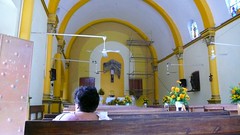
And for those who have been reading detritus for awhile it might matter to know that the last day of our visit at the historic site we lit a candle in the Cathedral to commemorate the second of anniversary of the night that Kathryn died in Palenque, too young, but in a place she knew as home. In a place she dearly loved.

salvation under wraps


[1] A few heavy hitters worth looking at:
Chronicle of the Maya Kings and Queens: Deciphering the Dynasties of the Ancient Maya, Simon Martin and Nikolai Grube

Maya Cosmos, David Freidel, Linda Schele, and Joy Parker

The Inscriptions from Temple XIX at Palenque, David Stuart

Living with the Ancestors: Kin and Kingship in Ancient Maya Society, Patricia A. Mcanany

[2] Living with the Ancestors, p 43

Friday, July 18, 2008

palenque

One last day in Palenque -- because honestly, can a girl ever get enough of Palenque?

This post was queued up and scheduled on 4 July.

Sunday, July 13, 2008

palenque via villahermosa

Will spend the next couple of days in Palenque, home of Pacal and his golden tomb.

This post was queued up and scheduled on 4 July.

Tuesday, November 13, 2007

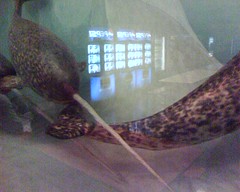
narwhals with picnickers & pepsi

Field Museum, Lower Level
Chicago, IL

Scarfing some vending action before seeing George & David Stuart (father & son Mayanists) speak at a National Geographic event on Palenque. (What's Palenque? Search my Flickr stream. ;)
Foraging upshot: Hostess Ding Dongs, 11 days past their expiration date.

Posting by cameraphone from seat #D22.

Thursday, November 30, 2006

Trudy Blom

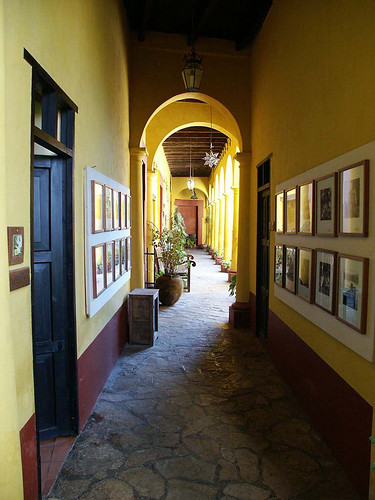
casanabolom_hallway


I've been trading comments on Chiapas with Lassë of The Big Thoughts, and Franz Blom came up -- the Dane who worked at Palenque and set up La Casa Na Bolom in San Cristóbol de las Casas, in Chiapas, Mexico. Blom’s wife Trudy is of particular interest to me – a quick google turns up nada on her work, so I thought I’d post this to at least create a point of reference in the great google-sphere – because her work really should receive more attention.

I come by what I know of Gertrude Blom through Nick Hopkins and Kathryn Josserand, both Mayanists, who I’ve written about here before, and Chip Morris, the MacArthur Genius Grantee and author of the Living Maya, who lived near the Bloms in San Cristóbol, and knew them well.

La Casa Na Bolom


Nick studied under Trudy’s husband Franz, and Nick and Kathryn stayed with Trudy at La Casa Na Bolom frequently after Franz passed away. They have some great stories to tell about Trudy and her regal ways, but I’ll stick to the ones that matter here: Franz and Trudy worked closely with the Lacandon Maya, and established La Casa Na Bolom as a research center for better understanding their language and culture – and also, as I understand it, to try to elevate the standing of the Lacandon within the Mexican context in which they live -- a culture which by and large treats them very poorly, as an indigenous people. (An ongoing trend here in the Americas.)

bridal suite
view large


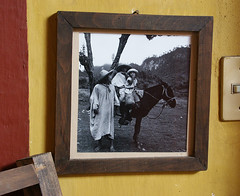
Trudy’s photographs of the Lacandon are startling and endlessly appealing for their warmth and humanity. They’re also notable, of course, because they show the Lacandon within their cultural context – something that’s not readily available to outsiders (although is more so now, given the work that the Blom’s did). Trudy shot with a box camera, and some folks say that it was this – the fact that her face was not concealed when she was shooting – that made it possible for her to establish such a warm and trusting connection with her subjects. I suspect it had more to do with Trudy herself.

Lacandon Maya
view large


Not too long ago I visited the home of Bob Goldberg[1], a Chicago schoolteacher who has amassed an extraordinary collection of Mexican art over the years – every school vacation he would take his station wagon south and pile it high with goods. It’s so extraordinary that he recently donated it all to the Field Museum, which responded with the appropriate gleeful enthusiasm to have it all.

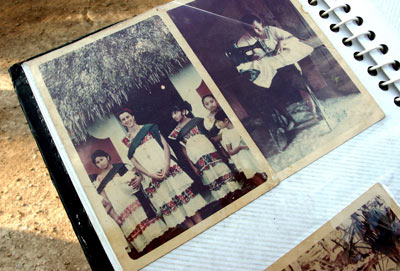
Before it was received and cataloged by the Field he invited small groups into his home to see the collection – a traditional Chicago greystone, overflowing with the colors and textures and art of Mexico – it was on one of these visits that I saw, in a small hallway, what looked like Trudy’s photography. I asked Bob if they were. His face changed immediately – melting from one of the warm, if carefully distant host, to one of recognition, excitement, and loss. (Trudy, of course, passed away in 1993.)

“You know Trudy? You know her work?” And I told him how. He took me into the bedroom and showed me where more of her work was hanging, and then he pulled out several photo albums, sharing stories all the while, of his friend, Trudy, and her wonderful photographs.

Library, La Casa Na Bolom


The only place I know where you can view Trudy Blom's photography is at the La Casa Na Bolom itself, where the walls are covered with them -- and unfortunately I took too few photographs of those photographs.

[1] I need to double check Mr. Goldberg's name -- it might be Bill.

Monday, November 27, 2006

mnemonics


I’m a miserable failure at keeping travel journals. I always start with the best intentions but they dissolve into nothingness and blank pages by day three.

On recent trips I’ve tried to redeem myself by pulling together a list of bullet points at the tail end of the trip when the memories are still fresh. They're rough impressions and incomplete thoughts but, headed by the title “Don’t Forget”, they ensure that I don't. And they're remarkably effective at bringing it all back.

Getting ready for an upcoming trip I found one of those journals, and this point on the list stood out – it refers to Pacal’s Tomb in Palenque. At the time we saw it, it had been closed to tourists for at least ten years. I believe it’s been opened again, so the night I describe below couldn't happen now -- we'd wait in the queue in the daylight, and traipse down the staircase in one big line, just like everyone else.

But this night we were with one of Palenque's resident archaeologists, and the whole thing was magical.


Don't Forget: Hiding out in the Temple 19 waiting for the park to close; sneaking through Palenque at dusk; everyone else gone and the park all ours; the mist, the toucans; climbing the backside of Pacal’s tomb and skirting the apron; climbing through the net and descending, as guests of Alfonso Morales, into the interior; the soft ocher of the interior walls, velvet to the touch, a single bat flying up from below; the turn in the staircase, and then the tomb. The triangular door pulled back; the sarcophagus lid within.

Friday, August 04, 2006

the long goodbye


Roadtripping to Gloucester, VA to say goodbye to Kathryn. See you on Monday.

p.s. Merle Greene Robertson, the Grand Dame of Mayan studies, posted a very dear note about Kathryn on Mesoweb. The link is not a permalink, so I’ve pasted it in below too to keep it handy. As my sweetie said when I shared it with him: “Nice remembrance. And she was just like that, too.”

* * *

The sad and shocking news is that Kathryn Josserand passed away at Palenque on the evening of July 19th of what is reported to have been a massive brain hemorrhage while taking a shower before dinner. She was 64 years old, at the height of her illustrious career, way too young to have been taken away. As soon as the Mexican papers are finalized, Nick will take her to Gloucestor, Virginia, where she will be buried in the Hopkins family plot at Ware Episcopal Church.

Kathryn and Nick had been in Mexico for a month taking three students around for orientation and writing up some of the Chol material with the long-time friend and co-worker Ausencio "Chencho" Cruz, who is also a friend of everyone who has ever been to a Palenque Mesa Redonda, and my constant assistant during all of my work at Palenque.

Kathryn's part in the Mesas Redondas de Palenque was significant—from presenting papers, to the Spanish sessions given by Kathryn and Nick every afternoon in the town for the citizens of Palenque. How they loved this. It just shows one of the many ways that she gave of herself on her own time, just because she wanted to help others.

Kathryn had a Fulbright Fellowship to do six months of research in Guatemala. She and Nick were to leave for Antigua at the beginning of January where they would have a large house to be be headquarters for this study.

Kathryn will forever be remembered for her selfless giving of herself to others. The way she took over when I had two broken elbows and my husband Bob died at the same time, is friendship way beyond what could be expected of friendship. Nick told me that just a couple of weeks ago they went to Bob's grave in the Palenque cemetary to see if it was cared for. It was not, so they had more dirt filled in the plot, everything cleaned up and flowers planted. Just another example.

Then just a week ago on the way home from Uxmal, they stopped to see Willie Folan in Campeche, where he was in the final throes of writing a paper for the ICA conference in Seville, Spain. Instead of proceeding directly home to Palenque as was the plan, Kathryn spent several hours making Folan's text intelligible to the ordinary human. I could go on and on about her "giving to others."

The last time I saw Kathryn was at the Annual Texas meetings in Austin in March. My memories of her, however, will be of so many wonderful times we had together at Palenque, cooking Thanksgiving dinner for what must have been half of Palenque, getting together with Chencho putting Chol names on all of the trees and plants, and just sitting on the back patio of Na Chan-Bahlum with good friends having rum and coke and discussing everything about Palenque.

Merle's Corner, Mesoweb

Sunday, July 30, 2006

na balam


My husband and I were married by two anthropologists, a Mayan shaman, and Lisa Presley.

More about the Shaman and Lisa Presley some other time. Tonight I got the news that my dear anthropologist, and the godmother of my wedding, has died.

Kathryn Josserand was a Mayanist, linguist and epigrapher who taught at Florida State University. She was one of the chief authors of the authoritative Chol dictionary, an indigenous language of the Maya of Central America. She authored countless papers on the subject, and initiated dozens of students in the careful deconstruction – and construction – of Mayan glyphs.

She was brilliant, fiery, highly organized, and the biggest softie this side of the Foster's Freeze. She was Na Balam: The Jaguar. And a real dame.

My husband and I traveled with her and her husband to Guatemala, El Salvador and Mexico countless times. We planned to travel with her again this Christmas, to see some remote Olmec and Zapotec sites.

Today I received an email from her husband Nick with the news that she suffered a massive brain hemorrhage while in the field at Palenque. As unexpected as her death was (she was in her mid-60s) it sounds as though it was a good death – sudden, painless, and well-timed. He wrote, in part:

She went out quickly and painlessly after a good day, feeling great. I thank God we were not in the US, because I was able to be with her from the moment I found her until we wrapped her in her shroud.

In the US I would have been kept in a waiting room, wondering what was going on. In Palenque they don't have the technology to keep the body alive after death; in the US she would have been put on "life" support even though there was no chance of recovery. And in Palenque everybody knew us and I got tremendous support.

The morning after, while I was in town sending out notices, friends came in and set up an altar on Kathryn's work desk, with flowers and candles to call in her soul.
***

On Tuesday we had a good day's work, and Kathryn was really happy with what she was getting done. In the late afternoon we went off to look up Moises Morales, whom we hadn't yet visited with. We had a nice long visit, and Kathryn related to him (again) her first trip to Palenque, on a break from her first fieldwork in Yucatan in 1965, with a girlfriend.

The night they were to leave, they were in the Cañada restaurant, and were talking about having to go catch the midnight train for Mérida. A local tour guide heard them and came over to tell them they didn't have to be there at midnight, since the train never came before 2 AM. They went out anyway, and he went to keep them company, and sat with them in the dark telling them about the stars and the Maya.

Years later, when we went back to work in Palenque, she realized this had been Moises Morales, who by then was a central figure in the Palenque Mesa Redonda circle, and who became a good friend of ours. Anyway, Moises was the first Palencano she ever had a long conversation with, and he was the last one.


Kathryn makes an appearance in New Yorker editor Peter Canby’s book The Heart of the Sky: Travels Among the Maya; but it’s late, and I can’t find my copy, and I’d much rather spill some tears into my pillow than look for it any longer.

Maybe tomorrow I’ll get lucky. If I do, I’ll share a few lines here.


Related Posts with Thumbnails