Showing posts with label mexico2008. Show all posts

Friday, September 12, 2008

black stones, reprised

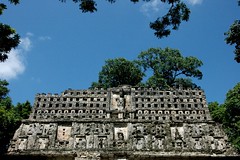
I wrote of Piedras Negras a little while ago: that remote Mayan site along the Usumacinta River where so many Mayanists did so much important work.

This is a reprise: Piedras Negras by holga.

landmark


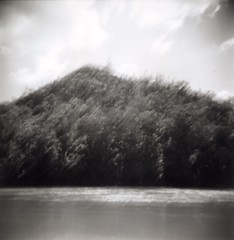
Memorize this mound of a mountain. It's just opposite the riverbank where you'll put in to climb the steep sandy bank to access the site. It's one of very few landmarks. There are no signs marking Piedras Negras.


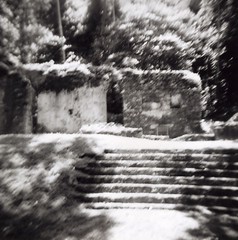
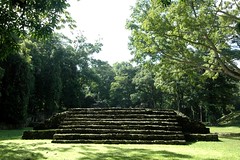
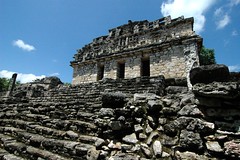
temple steps
Temple steps.


mayan temple
Temple.


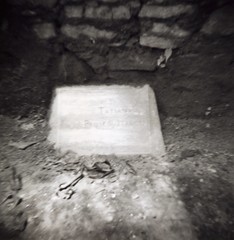
where Tatiana sleeps
Where Tatiana sleeps at the top of the temple steps.

Friday, August 22, 2008


.

She lingered near the eccentric flints.


Sunday, August 17, 2008

two boys on bikes, mexico city


holga.

Sunday, August 10, 2008

más ruinas

ruinas

There's something strangely sexy about the Mayan site of Yaxchilan, forgetting that when you're there you're dripping with sweat and constantly swatting at mosquitoes.

I blame Lady Xoc.

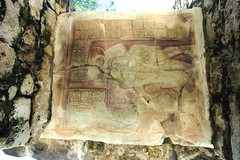
Shield Jaguar's Queen is depicted in Lintel 24 on her knees before her King, threading a rope spiked with thorns through her tongue in the female version of penis perforation. She captures her blood on a paper offering that will be burned to invoke a crazy serpent vision like the one depicted on Lintel 25. [1]

Lady Xoc’s sultry spirit is all over this place.

lintel


The site is considerably more groomed than Piedras Negras, but has none of the tightly trimmed pathways of Palenque. It's somewhat remote and requires that you put in by boat, but still brings in a respectable tourist trade -- enough traffic that when our friend and guide Alfonso set up a picnic for us all and was mashing up a bucket of guacamole to top the banana leaf wrapped tamales that he hauled in from afar, the tide of tourists would stop to ask him ¿cuánto? (Fortunately he didn't relent and we had more than enough to wash down with a cane sugar Coca -- one of the best meals ever.)

At Yaxchilan there's a deep dark labyrinth of passageways that meander through an interlocking series of excavated structures. The ceilings frequently peak in that classic attenuated Mayan triangle, and are studded with a concentration of sleeping bats -- blind sleeping bats, you remind yourself fervently, as you sweep your flashlight over them.

dance platform


Stepping around the dark corners and up unexpected steps soon you find yourself in a colonnade that spills into a wide open grassy plaza studded with a dance platform and a ball court and an abundance of free standing structures -- many of them with carved lintels, still intact in their door frames, and an occasional stucco.

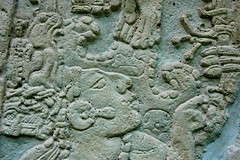
I’ve never received a satisfactory answer to my question: Why did the Maya exert so much effort into carving a surface that no one saw? Lintels are installed in that place in the door jamb just over head -- to see them at all requires the indignity of cranking your neck back hard; to shoot them requires lying flat on your back in something of a sprawl. I shot almost a dozen lintels on this last trip and each time I felt like perv peeking up a girl’s skirt.

lintel


I’ve been told by several scholars that the subjected saw them when they were lying prostrate before the king, but I’m not buying it: prostrate implies nose to the dirt, and lintel requires some serious head twisting to look up and absorb the intricate stories that they tell.

Something else is going on with the lintels, and I’m reminded of the Thai belief that spirits live in door jambs (which is why you never want to step on the wood that frames the bottom of a door in a Thai house) and wonder whether it was thought that something sleeps here too; something that looks after the stories and ensures they’re remembered.

It's a complete bullshit theory, but it's mine.


Stairways vie with lintels for predominance at Yaxchilan. The central feature of the site is a big ass stairway that ascends to remarkable Temple 33 that’s graced with an estella carved from a stalactite.

Temple 33, roof comb


Arriving, huffing, at the top you realize you still haven't gone far enough -- there are two more acropolis that lie behind a slippery hike through twisted trails, over rock faces and thick roots.

Three of us hiked it together in silence. It was a little like hiking one of the steeper trails at Yosemite, back in the wilderness areas during the early spring when it's misty and wet. But ratch up the heat and humidity by about 95%, and then drop a 3,000 year old structure on the summit. Better yet: drop three structures. And populate them with cryptic carvings.

It was something like that.

acropolis


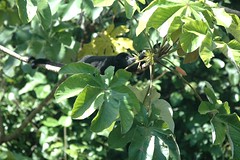
And then like jimmies on ice cream the monkeys stopped by -- at least half a dozen howlers with a baby among them, taking their time over lunch, swinging through the trees.

dear sidereal: I brought you a monkey


p.s. There was a furry tarantula too, who, near the end of the day as we ascended what would be our last temple steps of the trip, ducked into his hidey-hole just as my foot found its grip on his step, three of his eight legs protruding as he sat perfectly still, pretending to be invisible, waiting for me to move on.


[1] Both lintels -- two of the most extraordinary examples of Mayan art -- now hang in the British Museum.

Saturday, August 09, 2008

omphalos


I'm pretty sure that's a belly button on that pot.

Just sayin'.

Friday, August 08, 2008

black stones

altar

Had hoped to write something compelling and endlessly fascinating about Piedras Negras, because the Mayan site on the Usamacinta River was, after all, the whole reason I soaked myself in deet and took cloroquin only to be bitten ANYWAY by disease bearing mosquitoes (although bearing something else probably, because the malaria smear turned up negative. west nile’s the head runner, followed by dengue fever. still waiting for results on those.)

But because my brain is taking odd holidays at random moments I’ll stick to the basics and simply upload a handful of shots and prattle on a bit.

ik' window


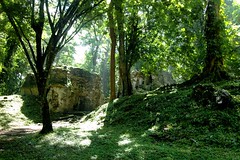
Piedras Negras doesn’t see a lot of visitors -- it’s not like the well-groomed sites of Tikal and Palenque or even the mildly groomed jungle site of Yaxchilan (pics from there to follow soon) -- Piedras Negras today is only a few narrow trails cut into a series of steep slopes.

piedras glyphs


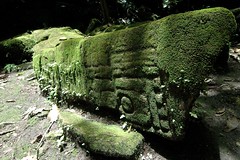
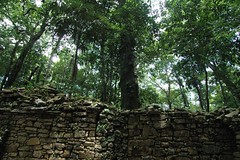
Very few of the ruins are revealed to what little light makes it through the thick rainforest canopy: much has never been excavated and the little that has has been overtaken again by the jungle in the time it lay fallow between excavations and when it was home to guerillas and drug runners.

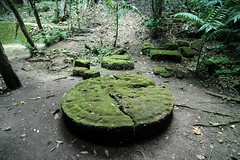
The real treasures (and they’re astonishing, the estella and thrones and other bas-relief of Piedras) have been spirited away to the National Gallery in Guatemala City (Piedras lies on the Guatemalan side of the river). What’s left on the site has mostly been overtaken by moss.

steps


Piedras Negras matters because Tatiana Proskouriakoff did some of her most important work here -- as an artist developing reconstructive drawings of what the site looked like in its prime she puzzled out the obvious: that the estella -- stone monuments erected in front of the temples and structures of the site -- recorded histories. Not mythologies, as previously believed. Actual chronicles of the kings.

Her insight led to the subsequent rapid tumble decipherment of Mayan hieroglyphics. Well, maybe not that rapid, but something of a tumble, and still underway today.

structure wall


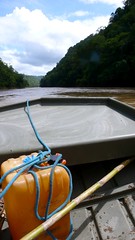
The approach to Piedras Negras isn’t easy. For us it was an hour and half in the bed of a pick up truck, a slick descent down a muddy bank (well traveled by pollo -- the Usumacinta is a main thoroughfare on the underground highway into the U.S.) into metal skiffs that would ferry us for the next 45 minutes along the river, and then a sandy ascent up another steep bank to the site.

skiff to Piedras


All of which contributed to the wholly giddy feeling that I had on the approach, and the scramble through the bush, through the green soaked sunlight and the thick under story and the muddled mossy edifices. Yeah. Could hardly see a thing. And it was heaven.

Even the indignity of squatting in the woods (there are no port-a-potties at Piedras) couldn’t shake off the feeling that comes from finally touching down at a place where so much history happened.

the ascent to the acropolis


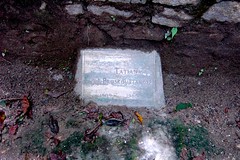
Tatiana’s ashes are interred on the acropolis -- a steep ascent up yet another mound that’s part hillside part structure part city beneath your feet. She’s surrounded by the whirring sounds of the jungle -- howler monkeys and tiny cicadas that sound like weed whackers and add a surreal edge that makes being in the middle of nowhere sound a little like being in the middle of the suburbs.

where Tatiana sleeps


Wednesday, August 06, 2008

why did no one mention this?


Had I known about the preventive powers of the unicorn, I would have packed better.

Feeling funky and suspecting at least one of those 103 mosquito bites. Getting checked out for malaria tomorrow. At worst I'm thinking I might have a mild case, given that I'm already taking meds.

Best case: It's just the flu.

Source: 10 Reasons it Would Rule to Date a Unicorn
via jenw

Friday, July 25, 2008

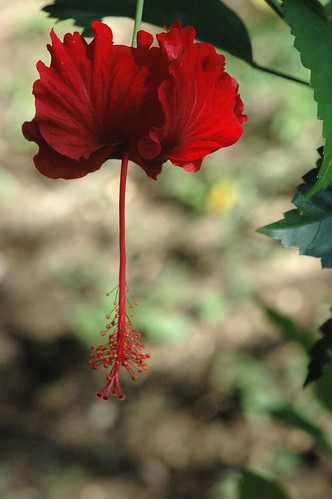
rhymes with delicious

rhymes with delicious
Hibiscus
Chiapas, MX

Thursday, July 24, 2008

lucy & desi


When it's the last room in town it's not worth kicking over the twin bed thing.

And besides: it had a great view »

Mexico City, Mexico

p.s. see the photo notes at flickr »

Wednesday, July 23, 2008

speaking of ik'

Vientos: Right on (literally: winds)

Vientos huracanados: Excellent (hurricane winds)

Vientos huracanados aztecas: Completely superb (Aztec hurricane winds)


Some of my favorite chilango, or Mexican slang, found in the Moon Handbook to Mexico City -- which yes, I realize throws the authenticity of whether or not it's really chilango into question.

Runner up to the vientos series is ¿que hongo? a homophonic play on ¿que onda? or "what's up?" (see: Beck) which actually means "what mushroom?" -- but given the prevalence of the little objects known affectionately as "hongo" that dot Mayan sites (but are actually stumpy little penii) -- I'm willing to conjecture that ¿que hongo? might be more accurately translated as "how's it hanging?"


yep. it is.


But maybe I'm just over thinking things.

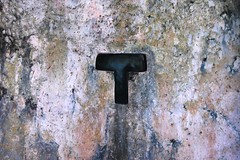
Ik'

I'k

This is a window at the Mayan site of Palenque. It's also an Ik', a glyph that means wind, but really something closer to the Chinese concept of Chi.

There's more spirit in it; more life force; more vital energy.

These windows are scattered all through the palace at Palenque. They also appear in the ruins at Piedras Negras, and other sites in the Mayan world.

Pakal, Palenque's heavy hitter, was buried in a jade mask that had an Ik' between his lips.

I've written a little bit about the Ik' before »

Tuesday, July 22, 2008

these bones

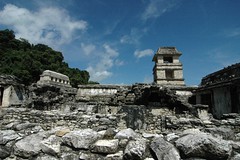
Palenque Tower and Temple


There’s a lot you should know about Palenque, a Mayan site on the Northern edge of the Chiapas highlands, but I’m probably not the one to tell you.
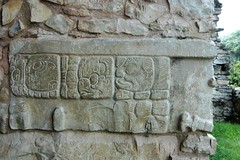
glyphs


Heavy hitters [1] have written books and papers and shared research about the place known to the classic Mayan as B’aakal, or Bone: about its art, its architecture, its friendly terms with Tikal, its antagonistic relations with Calakmul, Tonina and Piedras Negras.

At minimum you should know about K’inich Janaab’ Pakal and his cinnabar saturated jade strewn burial in the heart of the plaza. About how he was found at the bottom of a smooth bending stairway of ochre colored stone 22 meters deep in the Temple of the Inscriptions, barricaded by rubble from the world and connected only by a psychoduct through which his descendants could play telephone with their ancestor. About the marvelous greenstone mosaic that masked his face in death; about the jade sphere that his corpse clutched in his left hand; the jade cube that he clutched in his right.
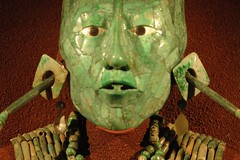
pakal's mask

pakal's cubepakal's sphere


About the marvelous inscription on the lid of his sarcophagus in which he’s resurrected from the underworld, Xibalba (which is wonderfully delicious to say out loud: she-BALL-bah), as a rapturous maize god; about his ancestors who line the sides of the monumental coffin (so tightly pinched into that small tomb that I asked a friend, who knows something about these things, “they carved it in situ? but how? the detail is so fine.” and he suggested that perhaps, instead, the massive temple was built around the stone container only after it had been carved.) who each bear a headdress that aligns them with an important crop -- cacoa (chocolate), nance, guayaba, chicozapote, mamey, and aguacate (avocado) -- crops that are passed from one generation to the next through inheritance. Like kingship. [2] Each gorgeous line etched to tell the story, to assert that I, Pakal, belong here. This was my job to do and I did it magnificently. And baby: I've *still* got your back. I'm an *ancestor* now.

Temple of the Inscriptions


You should know that the tourist traffic down the stairwell since it was excavated by Alberto Ruz Lhuillier in 1952, that the heat and breath and humidity of curious souls, threatened to destroy the treasure, and most folks can only see it now in a poorly rendered reproduction in the site museum at Palenque, or a little bit better reproduction at the Museo Nacional in Mexico City, where too the original jade mask is kept, along with the sphere and the cube and a cache of other precious grave goods.

You might be interested to know that one late night in a rainy December I had a chance to descend the ochre steps and peek into the tomb, and its an experience I’ll never forget. But that I didn’t this time: our host no longer working at Palenque, after a falling out with INAH.
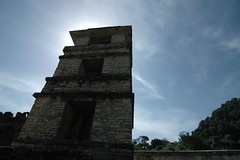
Palenque Tower


You should know too about the beautiful pieces that are still being excavated, some in just the last five years or so: About the jaw dropping details of the thrones from Temples 19 and 21, the figures so individualized, so finely incised, you can almost hear their conversation.
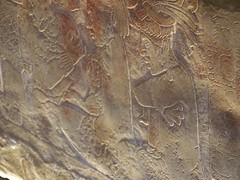
stumpy @ the palenque museo


You should know that in 1973 Merle Greene Robertson, who made magnificent rubbings of the stuccos and bas-relief of Palenque and other sites (preserving many of them before they were diminished by the ash of a nearby volcanic eruption and the relentless worry of acid rain) started the Mesa Redonda, or Palenque Roundtable, in the living room of her home on the street that is now named (and misspelled) in her honor.


How scholars and regular folks with an interest in Mayan glyphs got together to try to crack what they were all about; to uncover the stories; started telling them again. How Linda Schele was there, and her passion for that place sparked a strange and wonderful populist movement that lends a curious slant to Mayan scholarship today -- academics and independent scholars and hobbyists all working through ancient glyphic texts, with variable results, but all working, and adding their decipherings to the pile.
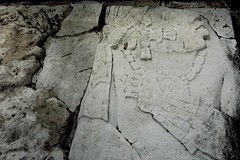
courtyard of the captives


And maybe its peevish of me to mention that ten years after its founding, and ten Roundtables into it, INAH took over the Mesa Redonda and restarted the count back at one, because that’s how INAH does things.
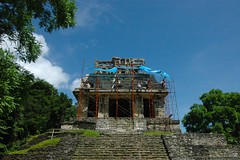
under construction


It might too be of interest to learn that Merle Greene celebrated her 95th birthday at this year’s Roundtable; that our trip was timed to coincide with the conclusion of the festivities so that our host, Nick, could share a few margaritas with the birthday girl.

And for those who have been reading detritus for awhile it might matter to know that the last day of our visit at the historic site we lit a candle in the Cathedral to commemorate the second of anniversary of the night that Kathryn died in Palenque, too young, but in a place she knew as home. In a place she dearly loved.
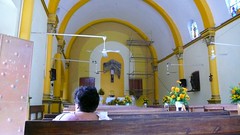
salvation under wraps


[1] A few heavy hitters worth looking at:
Chronicle of the Maya Kings and Queens: Deciphering the Dynasties of the Ancient Maya, Simon Martin and Nikolai Grube

Maya Cosmos, David Freidel, Linda Schele, and Joy Parker

The Inscriptions from Temple XIX at Palenque, David Stuart

Living with the Ancestors: Kin and Kingship in Ancient Maya Society, Patricia A. Mcanany

[2] Living with the Ancestors, p 43
Monday, July 21, 2008

bolsa de mareo


Mexicana Airlines
spot color on vinyl
with sticky peel tape affixiant
and palimpsest
11 1/2" x 4 1/2"
click.com.mx

zona rosa


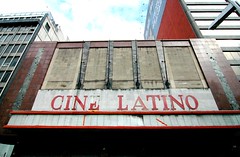
cine latino
Originally uploaded by suttonhoo
Having a chance to hang in the Zona Rosa was one of the best things about getting booted from our original hotel in Mexico City. On the first night we landed in a corner of the "Pink Zone" -- an area that the guide book described as "formerly Bohemian, now gaytown" -- which made me wonder what sort of subtlety distinguishes "bohemian" from "gay".

Alive with galleries, gay bars, bookstores, openly affectionate same sex couples, and a shop called "Condomania", it reminded me of my old Capitol Hill neighborhood in Seattle. Lovely.

And way more gay than Saugatuck.

Museo Nacional de Antropología


Decided to forgo uploading the dozens of shots that I took in the Museo Nacional de Antropología in Mexico City over five hours, and instead upload just a handful.

But five hours: yeah. It really is that big. It really is that amazing. And the restaurant buffet, on the lower level with an open patio and chattering squirrels running about, isn't bad either -- especially when you need to fortify just so that you can finish wandering through the collections. (Recommend passing on the flan, however.)

Sunday, July 20, 2008

cabeza colossal


aka Big Head.

Olmec. These guys were kicking around before the Maya came to town.

Can't really tell from the pic, but this guy's head is about 9 feet high.

Museo Nacional de Antropología
Mexico City, MX

the gulf


At least I think it's the Gulf of Mexico. The pilot wasn't all that generous with information.

Shot inbound to Mexico City a little over a week ago. Photos de ruinas y rainforest coming soon.

Saturday, July 19, 2008

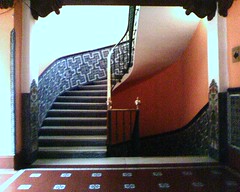
checking out


checking out
Originally uploaded by suttonhoo
The Hotel Majestic
Mexico City, MX

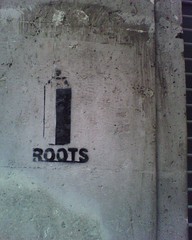
roots


roots
Originally uploaded by suttonhoo
Graffiti
Mexico City, MX

Restoring some lost cameraphone posts that got lost in a device crash during the week I was away in Mexico.

room with a view


room with a view
Originally uploaded by suttonhoo
So: We arrived in Mexico City only to discover that the hotel we booked into a few months back (an old Benedictine Monastery we had stayed at once before) was under wraps -- undergoing rennovations -- and NOT receiving visitors.

Thanks for the heads up, Expedia!

After some scrambling, and thanks to the generous good care of our cabbie, we finally found a couple of rooms. Two, because the city was booked so tight that no one hotel had a single room available for the weekend.

This was the second of the two, overlooking the Zocalo, where Montezuma and Cortes first said hello, and where each morning and every evening 13 soldiers wrassled this big ass flag up and down the flag pole -- accompanied by a full military processional.
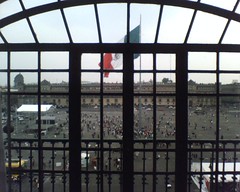
No complaints. Didn't mind watching the dawn break over the Zocalo from the warmth of my bed, either.

(Restoring some lost cameraphone posts that got lost in a device crash.)
Related Posts with Thumbnails