Sunday, June 08, 2008

4 wheels good 2 wheels better


Michigan Avenue, mid-morning
Chicago, IL

go speed racer go


Video: Original Speed Racer Opening

Right. I know. I was supposed to hate the Wachowski brother’s Speed Racer, the movie that the Rotten Tomatoes Tomatometer gave a 36 out of 100.

But I didn’t.

It might have had something to do with the ISCO OPTIC(R) Ultra-Star HD Plus Film Projection Lenses (to achieve optimal screen luminance and image resolution) [1] that the Cupertino 16 served it up with. (Right. Not my words. Try this for more on that »)

The projection definitely meant the film was a treat of pure radiant heat served up in saturated jewel tones. Maybe I wouldn’t have dug it so much if I saw it in a regular theater.

It might have had something to do with the funky pacing of the dramatic scenes, but now as then they were always offset by the heart racing time on the track. And every little vocal inflection sounded under anyone’s breath made me grin like a goof because of the way it mapped so tightly back to one of my favorite memories of the cartoon.

It might have been the groovy soundtrack that had a good beat and was easy to dance to.

Or maybe it was just the good company of b1-66er and his willingness to share his gummy treats.

There was no deep reflection, characters were not transformed by their heroic journeys -- tested maybe, but we knew their mettle at the outset -- there were only good guys and bad guys and middle of the road guys who had to make a decision about what kind of guy they wanted to be. And of course no where was it addressed that it's ludicrous to believe that burning all that petrol in a car race could possibly get us any closer to solving big problems.

What it was was wholly predictable and entirely simplistic and so much fun to watch.

And that’s all right by me.

p.s. except for that stupid Spridle. I never did like Spridle.

land of lincoln


land of lincoln
Originally uploaded by suttonhoo.
Grant Park
Chicago, IL

Posting by cameraphone

Welcome home. It's 1AM. Here's your traffic jam.

Construction season in Chicago.

Posting by cameraphone from
the Ike. Yeah. I'm driving. But no
danger: I'm not moving.

Saturday, June 07, 2008

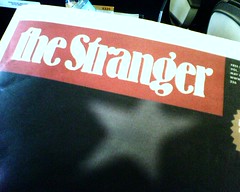
when you're strange


when you're strange
Originally uploaded by suttonhoo.
Someone left a Seattle Stranger behind
at SFO. I feel like I just found free money.

Posting by cameraphone
from SFO. Homeward
bound.

Friday, June 06, 2008

young wine


young wine
Originally uploaded by suttonhoo.
Good day at bat.
Hello weekend.

Posting by cameraphone
from Napa, CA

Thursday, June 05, 2008

this must be heaven...


this must be heaven...
Originally uploaded by suttonhoo.
...because just about everything in heaven is covered in glitter.

Posting by cameraphone from
Oakland, CA

Jack slept here.


Jack slept here.
Originally uploaded by suttonhoo.
Sorta.

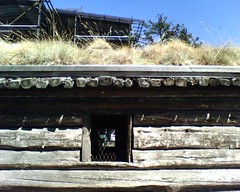
Jack London's Cabin on Jack London Square in Oakland, California.

Built from the logs of a cabin that a fan is pretty sure Jack wintered in up in Alaska. The fan shipped half of the logs to Oakland, and half of the logs to Dawson City, Canada. From there each town did what they could with what they had.

It's a squat little cabin with a sod roof and grilled off windows. A scattering of folksy log cabin like artifacts fill the interior. Folks toss coins through the grillwork (for luck I guess? a steady quill? the nerve to write like London did?) and a sign on the wall says that all proceeds go to UNICEF. The cabin sits in the middle of a spare brick lined square with some vegetation -- young trees and prairie grasses -- looking out over a harbor filled with luxury craft.

It's 4 o'clock in the afternoon and this whole place has that lonesome feeling of being forgotten.

What I think? I think it would depress the hell out of Jack.

Posting by cameraphone from the Bay Area.

where I'm at


where I'm at
Originally uploaded by suttonhoo.
(for the next little while, anyway)

Posting by cameraphone
from San Francisco, CA

ORD 6.38 Central


ORD 6.38 Central
Originally uploaded by suttonhoo.
Chicago O'Hare
United Terminal
Outbound to SFO

You know the drill.

Posting by cameraphone

Wednesday, June 04, 2008

good morning, america.


It's no secret that Barack Obama is my candidate.

Excited and scared this morning in a first kiss kind of way.

Long road ahead. Let's get this thing done.

Tuesday, June 03, 2008

found.

Photo: Weegee


It rains every day and we can’t find 2 midgets, so it looks like I’ll be here at least 2 more weeks.


The photographer Weegee, from papers which are now part of the collection of the Indianapolis Museum of Art along with a whole trove of photographs recently found at a garage sale in Kentucky -- and nearly tossed away as rubbish. As reported in this morning's New York Times.

Hmmm: Indianapolis isn't all that far from Chicago...

I think I hear a road trip calling.

Although no word (in the article, at least) about if and when the photographs will be on display.

das pintele yud

imaginary boundaries

One of the central purposes of the exhibition is not only to explore the way maps summon national identities but, conversely, to investigate the way they function to force other identities out of locations.

Curator Rhoda Rosen writing in the catalog of the exhibit Imaginary Coordinates showing now at the Spertus Museum through September 7, 2008.


The Spertus Museum wasn’t on the docket for Sunday. The plan was to hit the matinee showing of The Thomashefskys: Music and Memories of a life in Yiddish Theater at the CSO, a show that held a lot of promise if you don’t mind (and lord knows I don’t mind) running in circles that trend twenty to thirty years my senior and concern themselves with things like the Yiddish Theater in America that took root in New York’s Lower East side the last time we got all worked up over the unstoppable tide of immigrants landing on American shores.

That time it was the Irish and the Ukrainians and the Poles and the Russians who were Gilding our Age -- and a fraction of those pouring in from Eastern Europe were Jewish. The story told at the Symphony, as it was patched together by Michael Tilson Thomas, the music director of the San Francisco Symphony, concerned two of those immigrants who also happened to be Thomas’ grandparents and two of the leading lights of that Yiddish Theater: Boris and Bessie Thomashevsky.

It was unexpected that we’d have a couple hours to kill before the show, and the Spertus had been on the list of things to see ever since Blair Kamin mentioned its remarkable architecture in the Trib and we stopped by briefly with half an hour to spare sometime back to see what was doing only to discover that they wanted a good chunk of change to get to the ninth and tenth floors where the exhibition and the collections are.

Time being short we took a pass then, poking around the library instead and digging the amazing video work at the top of the stairs by the cafe (that g*d*it I didn’t take notes on), but on Sunday we circled back with our hour and half, which by the time the guide [1] was ready for us had diminished to 45 minutes. We were the only ones under her charge so she was kind enough to trim it back and gave us the floor show in the time allowed.

What we saw was this: An exhibit which I incorrectly called Imaginary Boundaries in an earlier post -- it’s actually called Imaginary Coordinates -- about mapping the thing that you might expect a Jewish American Museum to put on a show about: The Holy Land.

In a way that you might not expect from a Jewish American Museum: From an attempted non-partisan point of view.

“Attempted” because of course the place itself imposes a point of view, and you could feel the tension in the room. There was a fair amount of heat generated by the couple who we picked up in the elevator, who rode up with us, asked a few barbed questions about what was going on here and then politely excused themselves from our guide’s good graces.

We saw them later taking their seats at the Thomashefsky show. Maybe they were just in a hurry. Maybe they weren’t put off by the fact that artifacts from both sides of the conversation shared equal space; by the fact that a map rendered from the memory and by the hand of a Palestinian man in exile to describe his home village which no longer exists, was provided equal real estate alongside the hand-drawn storyboard that a father bound for Auschwitz (who would never return) drew for the four-month old son whom he tucked away in hiding, the storyboard outlining the life that he hoped for him -- his safe survival, his potty training, education, marriage, and finally, “next year in Jerusalem!” (The storyboard compelled the small boy, grown to man, to move to and settle in Israel.)

Maybe they weren’t put off by any of that -- but they sure were cranky.

Although Imaginary Coordinates is part of the citywide Map Festivus that’s been running for a little while now, the maps themselves -- among them elaborate Dutch maps from the 15th century, British renderings from World War II, a map of the Geneva Initiative from 2003 -- all of them the works by men, are offset in the exhibit by contemporary artworks, all of them the creation of women who have some connection to that same hotly contested piece of land.

Remarkable among them was Shirley Shore’s 2004 Landslide composed of a sandbox arranged to resemble a desert topography over which is projected in real time:

a square grid of blinking color cells generated by a code. Beginning each sequence with a palette of sixteen colors and thousands of color cells, the map gradually transforms as cells appropriate neighboring areas. When two colors ultimately dominate the grid, the program stops and begins anew. Landslide operates on an infinite loop in which each cycle produces a different map and a different visual experience. [2]


I asked the guide what the algorithm was that drove the colors in their consumption of one another -- she was unsure but speculated that it was the larger color blocks that swallowed the smaller ones with which they collided. The impact was remarkable: a strange camouflage that morphed into a topographical map and then began again.

As you might expect it was impossible to experience an exhibit like that, marking as it does the 60th anniversary of the modern state of Israel, without the hovering awareness of who is conquerer and who is conquered in this equation -- even with the careful attention that was given to both sides of the narrative.
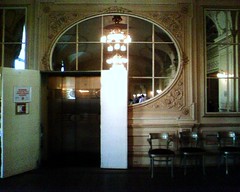
intermission


The contrast then, with the Thomashevsky show, was to be reminded of the diaspora, the thing that came before all this by just a few brief years; Jews without a home struggling to make America theirs.

The Thomashevskys were remarkable showmen but they were social activists too, providing theater for the Jewish community (in the Yiddish language, which felt like home) about the trials that they faced in this new place. One of their most popular running conceits was of the “green” immigrant and his and her comedic struggles and ultimate triumphs in their new world.

When their drama-ridden personal lives resulted in a split (but never divorce) Bessie Thomashevsky created a new theater and went to town with treatments of women’s issues like suffrage and birth control that sold out houses -- the Jewish Suffragette was one of her most popular roles.

The show was light spirited and entirely enjoyable (although maybe a little too precious, given that it was a treasure served up by a loving grandson who held his subjects a little too close), but the contrast that it presented to the Spertus exhibit was remarkable. In the CSO show the theme of liberation was unmistakable: It vouched for the freedom to live a creative life and to fiercely claim human rights for oneself and one’s community. One of the more memorable themes that defined one of the Thomashevsky’s biggest blockbuster was Das Pintele Yud (sounds like: "das pintela yee"), which spoke to something ineffable and untranslatable from Yiddish -- a grammatical mark that symbolizes (what the song board attempted to translate as) the “spark of Jewishness”. Working, striving, inexhaustible. Rich, spirited, alive.

Brilliantly uplifting in the context of the immigrants’ underdog story on foreign shores. Wholly unsettling (confronted hard on the heels of the quick sprint we made down Michigan Avenue to bridge the distance between the Spertus and the Symphony Hall) when the underdog has become ubermensch, and a chord change has been sounded.


[1] The Chicago Tribune reported in May that Imaginary Coordinates “closed earlier this month for organizers to re-evaluate content, [and] reopened with the major change being that visitors now must see it on guided tours beginning at the head of every hour. Nearly everything else is unchanged, meaning the show is still the most surprising of the eight with art in Chicago's Festival of Maps as well as a rewardingly unconventional commemoration of the 60th anniversary of Israel's founding.” Coordinates' Rewardingly Unorthodox by Alan G. Artner (May 22, 2008)

[2] Imaginary Coordinates (Spertus Press Chicago)

Monday, June 02, 2008

fob off


fob off
Originally uploaded by suttonhoo.
Car's in the shop, so I'm driving a fancy loaner. It's one of those no key just a fobber jobbers, and I spent a stupid and pitiless few minutes trying simply to make it GO, thinking that maybe it drove like the push button rental Prius that stumped me in Virginia a little while back. (Which, btw, I loved -- even with no key.)

At least the loaner provides a slot for the fob, which you depress to fire up the engine. A friend of mine drives a car that requires only that the fob be with you, and gives you no ignition slot to receive it. What are you supposed to do: put it in your pocket?

Apparently: yes.

The fob solution strips out one of the more satisfying tactile haptics about driving a car: the feeling of sliding it in, hearing it click, and turning it to go. Sure yeah it's suggestive of something carnal and crude and entirely piston-driven. THAT'S OKAY WITH ME.

Not to mention that this design trend away from the key in favor of the fob deprives us of one of our more satisfying metaphors: because, honestly, why would I *want* to give anyone the fob to my heart?

Right. No. I wouldn't.

Sunday, June 01, 2008

intermission


intermission
Originally uploaded by suttonhoo.
Grainger Ballroom
Chicago Symphony Orchestra

Just enough time to score a cup of coffee and a Santander chocolate bar.

Saaannntaaannndeeer. (I can only speak for the dark, but it's the best.)

Posting by cameraphone from the Loop.

imaginary boundaries


imaginary boundaries
Originally uploaded by suttonhoo.
Stopped by for the architecture, got bowled over backwards by the Imaginary Boundaries exhibit at the Jewish American Spertus Museum on maps of Jerusalem, the marketing of nationalism, and representations of place and country as woman.

Wow.

Spertus Museum
Chicago, IL

Posting by cameraphone

Saturday, May 31, 2008

tapas


tapas
Originally uploaded by suttonhoo.
& much (well, some) talk of Mayan Calendrics
at Emilio's.

Sangria, too.

Posting by cameraphone from Hillside, IL

the privet hedge

green growing thing
a found poem


Pruning is not my natural thing.

Unlike my father
who has waged grim war
with invasive weeds, ivy and
old man's beard

I have a weakness
for the vigour
of our cottage-embracing
vine

Forcing its tendrils
through my study window

Likewise the privet hedge
growing wildly
in all directions

Ching Ling silently
hands me
the hedge-cutting
shears. I

Am on the side
of untamed growth
she

On the side
of discipline


Found in Harry Eyres' Pruning vines and verses column in this morning's Financial Times.

Friday, May 30, 2008

like I was saying

Photo: Joe Fornabaio for The New York Times

You kept hearing ‘oh, oh, oh,’ [and then the guests became] literally like wild animals, tearing apart everything on the table.


Franz Aliquo, lawyer and Supreme Commander of "flavor tripping parties" involving the West African fruit synsepalum dulcificum which "rewires tastebuds" as reported in yesterday's New York Times.

The fruit, when “you pop it in your mouth and scrape the pulp off the seed, swirl it around and hold it in your mouth for about a minute,” makes everything sweet.

Via Enyasi

feed me


I play a game when my mind starts to wander in those unfamiliar social situations where I’m surrounded by people I’ve only just met. If for some reason I haven’t yet found those few folks from whom a whole world of conversation will emerge, and I’ve grown tired of looking, I play my game.

I watch people eat and I wonder about them in bed.

Not in a naked hyper porn kind of way. I have a theory that you can tell how a person is in bed by watching them eat. By watching how they choose and handle and consume food. What they decide they want to eat; what they decide they won’t. Whether they approach it with enthusiasm or like a dentist’s chair. Whether they’re curious, selective, investigative, or simply take the first lump to pass before them on a plate. Whether they wolf it down quickly or savour it slow.

Because I think if you can figure out how a person plays in bed, you can figure out a whole lot about how they tackle life.

My data set is small (she says modestly) so it’s not a proven theory. But it keeps me occupied, because I think our relationship to food says worlds about our relationship to life.

It’s a sensuous oral activity, of course, (eating is) and it shocks me a little (when I’m deep into playing my game) that we would conduct this activity in public. The way we consume and devour; the way we tear and slice and shovel and slurp. Think about it. You may never sit down to a meal with friends again without blushing.

But it’s not just the act of eating that reveals us to others. It’s how we’re oriented to food. This meal: are we going to relish it or choke it down because it's compulsory? How do we choose our dinner companions; how do we attend to them when they’re in our company? And what about the occasional solitary meal: do we savor the solitude, use the silence to better enjoy the sensation, or do we eat quickly and furtively, hoping no one spots our onanistic moment.

(And now you know entirely too much about me.)
Related Posts with Thumbnails