Showing posts with label samuel beckett. Show all posts

Saturday, May 09, 2009

had Eisenstein replied


Video: Opening clip from Sergei Eisenstein's first full length feature Стачка (1925)

How I would like to go to Moscow and work under Eisenstein for a year. ... What I would learn under a person like Pudovkin is how to handle a camera, the higher trucs of the editing bench, & so on, of which I know as little as of quantity surveying.


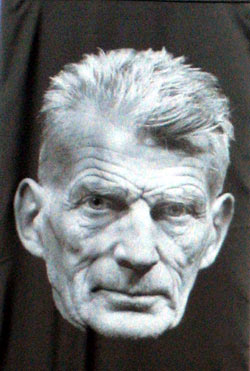
Samuel Beckett in a series of letters to his friend Thomas McGreevy, cited in The Making of Samuel Beckett in the 30 April issue of the New York Review of Books.

Beckett wrote to Eisenstein and requested admission to the Moscow State School of Cinematography. He didn't hear back.

It's strange to speculate what kind of films the author of Play and Endgame and the just now running on Broadway Waiting for Godot might have made, had Eisenstein replied.

Friday, May 09, 2008

slam BAM thank you ma'am


slam BAM thank you ma'am
Originally uploaded by suttonhoo.
Met up with Rahul last night for some Beckett at BAM -- his first, which is all kinds of risky for me, because Beckett productions skew to the very very good or the very very bad with very very little middle ground.

Mitigating my risk was knowing that John Turturro and Elaine Stritch were in the Endgame cast, and we were soon to learn of two others (whose names I'm having trouble ferreting out from the BAMbill) who nearly outshone the two knowns.

Just nearly. The performances were pitch perfect across the board (nearly: Elaine disappointed just a smidge, playing the part a little too hard, but I think maybe my expectations are too high for my favorite dame.) and R generously guffawed where expected, giggled on cue, and had periodic extended laughing fits, all good signs that I hadn't led him too far astray with the suggestion.

But it was a safe bet really: R and I met in a hostile office environment where we quickly and almost subversively discovered that we found the same crazy absurd realities funny.

And that we were the only ones laughing.

Followed the performance with an astonishingly comforting Italian/Spanish/Portuguese meal in a Brooklyn basement that felt like a Spanish cava (is that a wine cellar? maybe it's a wine... anyway: we were in a wine cellar.) sharing astonishing, comforting stories about misadventures with one-eyed grandmothers and other excavated memories.

And then the subterranean ride home in which R demonstrated his unnerving knowledge of the NY public transit system's coming and goings, listening like a Pawnee guide to the incoming rail cars from a central spot and dashing to the appropriate platform when the train came rushing in, to take us back across the river to my swank corporate crib, already chasing into the next early morning hours but still, done too soon.

Tuesday, April 10, 2007

the malady of the quotidian

a found poem

There is a peculiar intensity about some streets in Dublin
which becomes more gnarled and layered the longer you live

in the city

and the greater the stray memories
and associations you build up.

Sometimes this sense of the city
can be greatly added to by history and by books;
sometimes, however, the past
and the books
hardly matter

seem a strange irrelevance.

On a busy day it is easy to go
into the GPO in O’Connell Street
without a single thought
for MacDonagh and MacBride and Connolly and Pearse
or without remembering

for a second

that Samuel Beckett once asked his friend to
measure the height of the ground to Cúchulainn’s arse’
the ancient Irish hero
patron saint of pure ignorance and crass violence.

The need to buy a stamp
or a TV licence
or fill in a form
is often too pressing
the queues too long
the malady of the quotidian
too richly detailed to be bothered by heroes.

Found in Darlings: Colm Tóibín on Beckett’s Irish Actors in the 5 April issue of the London Review of Books.


It is a not insignificant artifact of my life that I am homeless. Meaning, that although I have more than sufficient shelter, I have no ancestral home to return to. The one that I might have claimed, my grandfather’s, was sold long ago, and my parents have long since moved elsewhere (each to a different destination) to places that have very little purchase in my heart, although they’re pleasant enough, all three (counting a step-parent in there).

For that reason, home for me means the company of the people I love. And, not insignificantly, the memory of their company is tied, concretely and discretely, to the places where we exchanged evidence of that mutual accord – through conversation, the squeeze of a hand, a shared look, a snug hug, a tumble beneath sheets.

I realized recently with a start that this specificity of geography in the landscape of my heart is also tied tightly to time. This occurred to me when, just this last week, I asked a colleague to let me off at the top of Taylor Street in San Francisco, with the intention of walking down to my hotel. I stepped out of the car and discovered that I was directly in front of my girlfriend M’s place – or at least where she was living when I visited her in the early 90s. She’s somewhere in Vermont now. I was just married at the time, to a man who would make me a chump, but I didn’t know that yet and thought myself luckier than most. It was a time bender, to stand there and remember a very different set of circumstances when I visited her back then; and to wonder how much of that Me is still left?

This is a question that comes to mind often lately: “Where have I gone?”

Or, more to the point: “Where am I?”

Traveling west of the Mississippi stirs it up the most, seeing friends that are tied, in my mind, to that landscape leaves me longing for a home that I’ve lost. Living in Chicagoland I feel sometimes that I’m a stranger to myself. This landscape doesn’t store up memories for me, and yet there’s something about the broad sweep and openness of this place that has become inhabited with parts of me that I’m still getting to know. Older. A bit more detached.

All of this came to mind as I read Colm Tóibín’s piece this morning in the London Review of Books, because it reminded me of crossing a street in Dublin just about a year ago now, and spotting a distinguished gentleman whose carriage emulated my Irish grandfather’s almost exactly. I embarrassed myself, without thinking, by stopping and staring with an impolite familiarity. Although I stood a distance from him my sudden stillness was enough to catch his attention and he turned to look, startled, at what I was up to. Our eyes locked. There was no smile, just puzzlement at the rude American. I wonder still how much I gave away. I wanted nothing so much at that moment in time than to sob and reach out to the ghosts that are my home and bring them close to me.

But of course, there’s no holding a ghost.

The moment passed, and we moved on.
trinity college

Monday, July 03, 2006

beckett on the lake

The last time we met he said he wasn’t feeling the best – “crock”. Something was affecting his balance and he had fallen twice. I said I was sorry to hear that. “Cheer up”, he said, “I’ve written a poem for you”. “Where is it?” I’ll say it to you, only an Irishman would understand it. Then he smiled and said, ‘Ochón, ochón, dead but not gone’.

At the end of our meeting he got up to say goodbye and somehow I sensed it would be our last meeting. “I’ll walk you to your door.” No, he wanted to leave quietly, without fuss. Take it easy, I said. He held my hand in both of his and said, “you sit there and finish your coffee”. When he was halfway across the café floor he turned and said: “Michael. If I fall, don’t bother to pick me up”. The smile, and then gone.

Michael Colgan remembering Samuel Beckett in the Gate Theatre’s «Beckett on Stage | April 2006» program published during the Beckett Centenary Festival.


It seems to be my lot, like some obedient Sisyphus, to return repeatedly, hot and tired and smelling badly after a day spent slugging about the city streets, to see selected Beckett shorts. I did it in Dublin in May and again last night in Chicago.

The billing promised to be different from the shorts that we saw at the Gate as part of the Beckett Centenary celebration – there it was Play and Catastrophe (the latter written for Václav Havel and devastating) – last night, at the Theater on the Lake, it was expected to be Eh, Joe; Rough for Radio 1; and then Texts for Nothing Nos. 4, 7, and 12.

Turns out Play was on the billing too, but I had missed it when I booked the tickets.

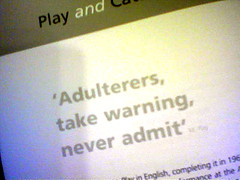
Which wouldn’t be a bad thing if Play were not about three people in pots. Who are all sleeping together. And if it weren’t for the fact that (if you’ve seen it you know) they run through the script twice – the second time with slightly different intonations. All of this well and good if you’re a freak like me, but a bit tiresome if you just indulging a freak like me, which was the situation my husband found himself in.

Earlier, in Dublin, on the day we slugged about the city and landed finally at the Gate where Dublin’s toniest were decked out in their best to the see the show in packed house, my darlin’ companion had been particularly grumpy about how things were going (I suspect the Writer’s Museum earlier that morning had put him over the edge – later he would confirm this to be true), and so as we took our seats I debated whether or not to explain to him that we were about to see three people up to their necks in pots, their faces encrusted with mud.

I opted not to.

All in all, after the curtain came up, he took it quite well.

But that experience wasn’t enough to prevent the long look and a good humored rolling of the eyeballs when the curtains pulled apart last night to reveal, indeed, three people in pots.

I enjoyed the contrast: an American company v. an Irish company, playing the same script. The staging was strikingly different: at the Gate they brought the players to the very edge of the stage. At that proximity an intimacy is reached that makes you almost forget these people are in pots. (Although I'm not convinced that Beckett wanted us to forget.)

At the Theater on the Lake the pots were at the far rear of the stage, and they attempted to close the gap somewhat by adding a fourth player who ran the curtain and the lights and sat in the middle distance. But they were remote from us, and that remoteness was exacerbated by the lighting – the stage directions have each player being illuminated in their turn, as they speak, and last night that light came from within the pot. (The pots themselves were paper maché which made for a nice effect when illuminated from within.)

Unfortunately to have the light come from below rather than above (did the players activate it themselves?) meant that their faces were obscured by severe shadows – made worse, of course, by all that mud. We never got to see who they were, which made it a bit more difficult to care for them. At the Gate the lighting was direct and from above: we could see their humanity through the crap that covered them. The outcome was quite different.

But the most notable difference between the two performances was the delivery: at the Gate Play was a very funny show. Insightful and poignant, of course, as well – you can’t get away from a Beckett without catching a glance at the worst of ourselves, and walk away loving humanity anyway – but really very funny. And this would be an important attribute when the topic is adultery. Otherwise: Ouch.

The Chicago show was played ponderously. Not quite the same thing.

Worth the price of entry, anyway, and the sweltering conditions of the theatre (it’s a seasonal playhouse and has a summer camp feeling -- they hand out fans at the front door) meant that our stink, gleaned from an afternoon running around the Taste of Chicago, was scarcely noticed (the same, I’m sure, cannot be said about our attendance at the Gate).

Eh, Joe, by the way, was brilliant. And there’s more goodness promised throughout the year – The Curious Theatre Branch is doing nothing but Beckett until they put the season to bed.

The farther he goes the more good it does me. I don’t want philosophies, tracts, dogmas, creeds, ways out, truths, answers, nothing from the bargain basement.

He is the most courageous, remorseless writer going and the more he grinds my nose in the shit the more I am grateful to him. He’s not fucking me about, he’s not leading me up any garden path, he’s not slipping me a wink, he’s not flogging me a remedy or a path or a revelation or a basinful of breadcrumbs. He’s not selling me anything I don’t want to buy – he doesn’t give a bullock whether I buy or not – he hasn’t got his hand over his heart.

Well, I’ll buy his goods, hook, line and sinker, because he leaves no stone unturned and no maggot lonely. He brings forth a body of beauty. His work is beautiful.

— Harold Pinter on Beckett

Monday, June 05, 2006

hold tight


ginko
Originally uploaded by suttonhoo.
Hold tight to your despair and make it sing for us.

— Samuel Beckett

Saturday, April 29, 2006

beckett at the gate


beckett @ the gate
Originally uploaded by suttonhoo.
"The greatest weapon the English ever gave the Irish was their own language."

Placard at the Writer's Museum in Dublin

Beckett Festival on in Dublin to celebrate the 100th anniversary of his birth. Caught a great showing of Play and Catastrophe this evening -- also the last night of the Festival. More on that later. Earlier today read up on Beckett in the Writer's Museum and learned that, having emigrated to Paris, he had difficulty returning home to Dublin -- to the point of experiencing physical pain and sickness.
Related Posts with Thumbnails