Used to be you could get one of the best cups of coffee in the Loop on Michigan, right near Jackson and next to the Artist’s Café, behind this door, at a place called the Rain Dog.
That’s no longer true -- the Rain Dog done shut down. (And I am so, so blue.)
Sunday, June 04, 2006


fire starter
One of the advantages of doing some of your growing up in a backwater like the Olympic Peninsula (a ferry ride away from Seattle) is that you know about folks like the poet Tess Gallagher and her dearly departed, Raymond Carver, the way you know about the artsy couple who blow glass down at the end of the block (you know the ones I’m talking about – they live just this side of the Agate Pass Bridge).
So when you’re standing in line at the Printers Row Book Fair in Chicago waiting for Gallagher to sign your copy of Dear Ghosts (and trying not too look too eager), you can (pretend to) be a bit more composed than the gal in line next to you who's shaking her head in wonder (the reading has just wrapped up) and asking: “Have you heard her before? Did you know about her? Oh my God. Oh. My. God.”
But that doesn’t mean you won’t be startled by a tear when she reads a passage like this and you realize just how much it matters that someone takes the time to string together words that mean and sing like these do:
Excerpted from Fire Starter by Tess Gallagher – a poem about a job her father held during WWII, starting fires in people’s homes in the early damp dawn of the Olympic Peninsula before he made his way to his day job. Recently published in Dear Ghosts, by Greywolf Press.

So when you’re standing in line at the Printers Row Book Fair in Chicago waiting for Gallagher to sign your copy of Dear Ghosts (and trying not too look too eager), you can (pretend to) be a bit more composed than the gal in line next to you who's shaking her head in wonder (the reading has just wrapped up) and asking: “Have you heard her before? Did you know about her? Oh my God. Oh. My. God.”
But that doesn’t mean you won’t be startled by a tear when she reads a passage like this and you realize just how much it matters that someone takes the time to string together words that mean and sing like these do:
My young fire-starter father
has done his work. The street he leaves
uncoils white plumes scribbling
the damp air; signs of life rising
from the chimneys of the wood-framed houses,
as if each had a comic-book voice for a comic-book
time in which war was going to succeed,
after which an eagle would sift down
into the hemlock, the men would come home
under confetti, and women, laying aside
their welding tools, would again disguise themselves
with aprons. A time in which horrors might
be stopped by the quick fix of war.
My flesh-and-blood father
glances back at the peace of his neighborhood
to which he has added one small, necessary magic: fire.
The lights are going on. Households are stirring.
The sweet wood-smoke nostalgia of democracy
hangs over the town.
Excerpted from Fire Starter by Tess Gallagher – a poem about a job her father held during WWII, starting fires in people’s homes in the early damp dawn of the Olympic Peninsula before he made his way to his day job. Recently published in Dear Ghosts, by Greywolf Press.
i want
I want this chair.
No: Not the Knoll Studio reproduction available at DWR.
THIS chair. Broken in and worn down after 50 years of seating the bums of students on the IIT campus. This chair with the leather scratched in the front, probably by some bonehead freshman who didn’t know WTF he was sitting in.
The chair that Mies put here and probably sat in himself, thinking his Miesian thoughts, surveying his creation.
God is in this detail.
But if the chair were mine it wouldn’t be here, in the Admissions Building, where it completes a rag tag set where it’s needed, wanted and belongs.
So instead I try to stop by when I’m in the neighborhood and just sit a bit. Wanting it. Savoring that rich, libidinous feeling of unrequited desire.
It'll never be mine.
But if it was, would it feel as good as it does right now?
goes to show

It all goes to show the danger of entrusting anything spiritual to the clergy.Frank Lloyd Wright in 1957 during a battle to save the Robie House from destruction. The Chicago Theological Seminary had acquired the house in the 20s, and in the 50s wanted to tear it down to build new dorms.
As cited by Blair Kamin in Why Architecture Matters »
careful what you wish for
So yesterday in passing my darlin’ companion said “We oughta just tear down our house and build a Usonian.”
Oh, dear. You really NEVER should have put that thought in my head.
Oh, dear. You really NEVER should have put that thought in my head.
rem's desk

Nothing much to say -- just digging this shot of the security guard behind his desk at the Campus Center designed by Rem Koolhaas on the IIT campus on the South Side of Chicago.
Spotted him yesterday during the last of four classes with Blair Kamin, Architecture Critic for the Chicago Tribune.
Wanna see it big? Click here »
Saturday, June 03, 2006
petersen's mint chocolate chip & the frankencheezie
Petersen's in Oak Park, IL has been serving up 32% butterfat ice cream since 1919, god bless 'em.
Also on the menu: The Frankencheezie, a "charbroiled quarter pound frankfurter stuffed with cheese and wrapped in bacon and served on a butter toasted bun with all the trimmings."
Only in Chicago, folks, can you buy this kind of cardiovascular disease for lunch.
(I stuck with the grilled cheese -- substituting muenster for american -- because I prefer my death on toast to take me just a little bit more slowly, thank you.)
aging out
 It may interest to you to learn that kiwis, when they age (and it's not too hot), don't weep, the way a pear or an apple might.
They shrivel like an ancient dame once lovely. Their fur holds the rot intact.
I discovered this because I just found two, forgotten for some time, in a bowl that I had set aside.
Friday, June 02, 2006
slow lift

During the planning stage for the construction of a new condominium in Hino City, Tokyo, the prospective residents had a heated debate on whether or not an elevator should be installed. Some were opposed because it would consume energy, guaranteeing carbon dioxide emissions. Others were in favor, insisting that elderly people living on the top floors would need it.Adapted from “The End of Growth,” published in the Japan for Sustainability newsletter and cited, where I picked it up, in the May | June 2006 issue of Orion »
In spring 2001, a “slow elevator” was the solution. They agreed to install an elevator that is slower than walking. Young people wouldn’t want to wait for the elevator, while elderly people could use it if they wanted to, since they are usually not in a rush. As expected, the slow elevator is now used only by the elderly, and it consumes much less energy than a conventional elevator.
Hmmm – second Orion citation within 10 minutes. Wonder what magazine I’m curled up with tonight…
give it up

Hope is in fact a curse, a bane. I say this not only because of the lovely Buddhist saying “Hope and fear chase each other’s tails,” not only because hope leads us away from the present, away from who and where we are right now and toward some imaginary future state. I say this because of what hope is.Derick Jensen in the May | June 2006 issue of Orion ». . .
When we realize the degree of agency we actually do have, we no longer have to “hope” at all. We simply do the work. … We do whatever it takes.
When we stop hoping for external assistance, when we stop hoping the situation will somehow not get worse, then we are finally free – truly free – to honestly start working to resolve it. I would say that when hope dies, action begins.”
otis on shuffle
Just now Otis Taylor shuffled by on iTunes, playing Please Come Home Before it Rains.
His chords fall like raindrops. Pure sweetness.
For the curious, here it is on itunes »
His chords fall like raindrops. Pure sweetness.
For the curious, here it is on itunes »
music is medicine
Research has confirmed listening to music can have a significant positive impact on perception of chronic pain.Reported in BBC News Online
US researchers tested the effect of music on 60 patients who had endured years of chronic pain.
Those who listened to music reported a cut in pain levels of up to 21%, and in associated depression of up to 25%, compared to those who did not listen.
The Journal of Advanced Nursing study also found music helped people feel less disabled by their condition.* * *
Researcher Dr Sandra Siedlecki, of the Cleveland Clinic Foundation, said: "Our results show that listening to music had a statistically significant effect on the two experimental groups, reducing pain, depression and disability and increasing feelings of power."
When I was a kid my dad was involved in a small music label called Music is Medicine for a brief period of time. It's nice to see that the research has born him out.
Thursday, June 01, 2006

mummy under glass
Last Friday there was a piece in the paper about an embarrassing incident in Chicago that occurred when a local businessman was showing off his digs to the visiting Zahi Hawass, the Secretary General of Egypt’s Supreme Council of Antiquities.
The businessman was John Rowe, Chairman of Exelon (big power, big money), and he’s particularly proud of a 2,600 year old Egyptian sarcophagus that he keeps in his office -- in a glass display case.
Hawass reacted the way you might if he invited you into his living room where you found your Aunt Nell lying in state under glass.
Well, okay, it wasn’t quite like that. Here’s Hawass’s soundbite as reported in the New York Times:
I’m guessing maybe the latter, because he goes on to say:
Tut-tut.
Hawass, who the NYT’s says “is also known for his ability to stir controversy at an opportune moment” demanded that the Field Museum drop Exelon as a sponsor of the King Tut exhibit immediately unless Rowe either returned the sarcophagus to Egypt or gave it to the Field.
Rowe complied by offering it to the local museum on indefinite loan.
[photo credit: Torbein@Flickr]
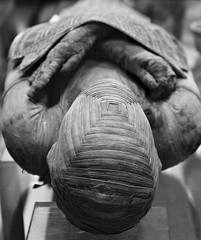
The businessman was John Rowe, Chairman of Exelon (big power, big money), and he’s particularly proud of a 2,600 year old Egyptian sarcophagus that he keeps in his office -- in a glass display case.
Hawass reacted the way you might if he invited you into his living room where you found your Aunt Nell lying in state under glass.
Well, okay, it wasn’t quite like that. Here’s Hawass’s soundbite as reported in the New York Times:
Ancient artifacts are not for display in homes and offices; rather they are meant to be shown in museums and institutions.I’m still trying to puzzle out Hawass’s stance. Does he equate the museum with a sacred space, like a cathedral, and the sarcophagus with a relic on display? Or is he down with the fundamentally democratic nature of the museum, and its access to all comers?
I’m guessing maybe the latter, because he goes on to say:
King Tut himself would not be pleased to see a priceless Egyptian artifact trapped inside the office of any one individual.This is funny for a couple of different reasons: 1) that Hawass feels so confident in his ability to channel the desires of the boy king and 2) that a KING would be all about ACCESS FOR ALL.
Tut-tut.
Hawass, who the NYT’s says “is also known for his ability to stir controversy at an opportune moment” demanded that the Field Museum drop Exelon as a sponsor of the King Tut exhibit immediately unless Rowe either returned the sarcophagus to Egypt or gave it to the Field.
Rowe complied by offering it to the local museum on indefinite loan.
[photo credit: Torbein@Flickr]
Wednesday, May 31, 2006
radio waves
Ever have one of those days when it feels like the radio is reading your mind?
Earlier tonight I was thinking about some dear friends in Seattle, the Santos, who are my extended family -– and then WBEZ here in Chicago queued up and played a track from one of Jovino’s CDs. Nice.
Then, just now, I was thinking about a writing project I want to tackle to spend some time working through my memories and grief for a dear friend recently lost. Just as I settled on a framework that I thought would work well, WBEZ did it again – they pulled out a track that TD4’s dad chose for his memorial service – a track that I don’t think I’ll ever be able to listen to again without thinking of Tom -- Shirley Horn’s Here’s to Life.
Okay. I’m listening.

Tuesday, May 30, 2006
whole lot of coolness
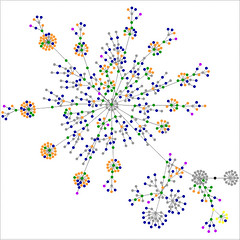
The image to the right is this site (clickthrough to watch it bloom!), as visualized as a graph by a guy in Zurich, who's also knocked together a funky mathematically driven art project that really skyrocketed today when Boing Boing got a hold of it.
Go 'head -- plug in your own URL »
Or see more funky lifeforms on Flickr »
Go 'head -- plug in your own URL »
Or see more funky lifeforms on Flickr »
the 9% solution
If the roads to love are so varied and random, how do we decide on a particular mate? It turns out that the problem of choice under uncertainty can be described and solved mathematically. Evolutionary psychologists Peter Todd at Indiana University and Geoffrey Miller at the University of New Mexico used a computer simulation to determine how a person might best choose from a number of potential partners. They set it up so that the person first assesses a number of the options available to them to decide what is the best they can aspire to in terms of attractiveness. They then go for the next person they come across who meets their aspirations, out of those they haven’t already encountered.From Sexual Attraction: The Magic Formula in the Times of London.
The researchers found that the optimum proportion of possible mates to “examine” before setting your aspirations and making your choice is a mere 9% — so at a party with 100 possible mates, it’s best to study only the first nine you randomly encounter before you choose. Examining fewer means you won’t have enough information to make a good choice, examining more makes it likely you’ll pass the best mate by. No doubt the models underestimate the complexity of real mate choice, but the fundamental insight is clear: don’t search indefinitely before choosing, lest you miss out on all the good mates or run out of time altogether.
Um...how do you know when you’ve got your initial dataset nailed down? Otherwise, how you can be sure that your subset is a true 9%? (It's not that I'm looking; it's just that I’m wondering...)
this morning's zen
I don't have to do anything special. I'm in New York. Look at me, I'm in an elevator and it's in New York. I'm in a taxi, in New York. I'm in a subway and it's in New York.William Hamb, petty officer first class, on his shore leave, as quoted in this morning's New York Times.
Yeah, I get it: It's NEW YORK. But it's also brilliantly Zen.
Monday, May 29, 2006
alan doherty
When I was in Dublin earlier this month I had the opportunity to hear a really astonishing boxwood flute player perform – on, of all things, the Musical Pub Crawl.
The back story went something like this: The pub tour is shared by a handful of local Dublin musicians who rotate the work; on the night we went a fellow named Joe Brennan (also quite good – and a brilliant wit, which made for a fun evening) was leading the tour.
By pure happenstance he bumped into his buddy, Alan O’Doherty, on the street before the gig started. Alan was visiting from Galway, where he had recently moved from Dublin, and where he’s now playing with a group called Gráda. (The name of which proved to be my undoing – but more about that in a bit.) Joe invited him along, and Alan was kind enough to sign on for the night.
What a night. His playing floored me. He gave us a good dose of traditional Celtic fare, but the thing that was most astonishing (and transporting) was the way he mixed up the Irish strains with bluegrass and jazz improvisation. Glorious good stuff. When they finally wrapped up it was far too early for my liking – I wanted to follow him home like a puppy.
We caught a flight home to Chicago the next morning so there wasn’t time to hunt out his CD in the local shops – but I figured I’d have no trouble tracking it down in the States. I was so wrong. My biggest misfire was hearing the name of his group wrong – so once I came up empty handed trying to track down “Alan O’Doherty” I started my fruitless search for a group called “Garda”. No dice.
Until today. In an offhanded conversation thread re a bumper sticker on a VW bus, debaird@flickr steered me toward Road Records in Dublin, and after a few email exchanges they straightened me out. The group’s name is Gráda, and although Road Records is presently out of their discs (but think about buying something else from them ‘cause they’re good folks), you can pick up a disc or three from Gráda’s site, and you can also download The Landing Step from iTunes, where this review will give you a glimmer of what you’re in for:
Gráda play with obvious respect for the ancient roots of their music, but also without any apparent fear that they might break it through experimentation. So the first thing you hear on “Tread Softly” is the cello; the melody of the original composition “Inis Dornish” sounds more Eastern European than Irish; the vocal numbers are cover versions of modern songs written by the likes of Emily Saliers and Teddy Thompson (son of Richard).Trust me. This isn’t your daddy’s Celtic music.
In short, this is an album that will be filed in the Celtic section with the trad stuff, even though it spends as much time looking to the future as to the past. Still, there's nothing quirky about the band's sound; singer Anne Marie O'Malley delivers everything with a gentle elegance, and even when the band lapses into jazzy jam band mode it never goes on long before the flute and fiddle are suddenly playing closely arranged harmonies or lilting off into another traditional reel. Most albums of Celtic music yield their charms quickly, but this one grows on you. Highly recommended.
Subscribe to:
Posts (Atom)