As part of a recent user interface study I talked to about thirty Web shoppers about their online shopping habits and learned not only that 1) the reach of the kinds and types of sites that they frequented was remarkable in its diversity with 2) one remarkable exception.
They all shopped Amazon.com.
I knew Amazon was big. I knew that Amazon sells across many categories and has substantial penetration in online search both paid and organic, but it was the study -- conducted across a diversity of age groups, economic strata, geographical location, and experience with the Web -- that drove home how deeply Amazon.com represents online shopping in American minds.
Everyone shops at Amazon.
And, of course, I do too. I even used Amazon to source a recent camera purchase -- the merchant was Adorama, but Amazon was the middle man.
When I’m traveling and I spot a title that I want but don’t want to pack I make a note of it -- and later I’ll pick it up online. At Amazon.
It’s easy. They have my account info. If I buy a bunch at once they ship it to me for free.
At an industry conference recently I heard a catalog copy writer comment on “B.A.” and “A.A.” -- Before Amazon and After Amazon. Before Amazon the catalog successfully carried books and DVDs as part of their core assortment -- titles that appealed to their base. After Amazon? They have a warehouse full of titles that they can't move.
And it’s no secret that independent booksellers are struggling in the age of Amazon. Cody's Books in Berkeley is only one example of an indie that's been recently forced to close given the changing market.
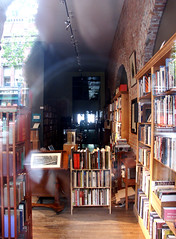
Yesterday I spent a few spare minutes at the Harvard Book Store before I had to head out to Logan International. I had been hoping for a few hours at least to tool around Cambridge, but the meeting got pushed back and then ran a couple hours longer than expected, so in truth I had twenty minutes. Which I unwisely pushed to 30 (unwisely because those few minutes almost made me miss my flight). But I don’t regret them.
In twenty minutes during my quick browse through one of America’s oldest bookstores I found a mother lode of titles that were relevant to my interests, that through their proximity to other titles, other categories, carried me into other shining veins of discovery. For the last ten minutes I debated whether I should buy all five of the titles that I had to have, or save a few for later.
I was reminded of something I heard when I sat on a citizen’s advisory council for the Seattle Public Library (back when they were trying to bankroll that Koolhaas Main Library, before they knew it was Koolhaas who would do it): The importance of the stack. SPL was adamant about keeping the books out and available and browseable; adamant about letting folks wander through the dusty shelves and discover what all was out there.
They felt the stacks afforded a means of discovery that was difficult to attain in the flat virtual space of the online directory -- which had only recently replaced the card catalog.
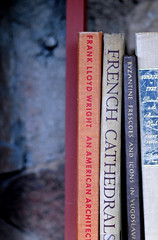
Sidereal recently turned me on to an online bookstore -- Zoomii.com -- that takes the stack model and brings it alive online. It looks to me like Zoomii may be an affiliate partner of Amazon, meaning they merchandise the goods, Amazon takes your order and fulfills it, and Zoomii receives a slice of that revenue for sending the order their way.
It tries to tackle the stack, and is a lot of fun to browse, but still. It’s not quite the same, is it?
My long rambling point is only this: Yesterday I was reminded how rare and remarkable independent bookstores are; the brain trust that goes into building and maintaining the information architecture of these places, the branching paths of relevancy and curious associations. The thrill of finding that book by those authors who answer the questions you’ve cradled forever -- or at very least asks them too, so you realize you’re not so alone.
At the end I decided to save two titles for later, and yes I loaded them into my Amazon wish list almost as soon as I got home. But I’ve made myself a promise to buy them from harvard.com, the bookstore that brought them to my attention. I’ve made myself a promise to do more of that, to order less from Amazon and more from the independent bookstores that I love, because I need them to learn more about who I am, and I can’t bear to see them go.
A few of my favorite independent booksellers:
Elliott Bay Books, Seattle
Prairie Avenue Books, Chicago
The Tattered Cover, Denver
Powell’s Books, Portland
Bailey/Coy, Seattle
Harvard Book Store, Cambridge
City Lights, San Francisco
Trident Booksellers, Boulder
Boulder Bookstore, Boulder