Showing posts with label field museum. Show all posts
Showing posts with label field museum. Show all posts
Thursday, October 30, 2008


Tuesday, May 13, 2008
kappa maki
Dropped by the Field Museum's Mythic Creatures exhibit over the weekend, which was all good and a lot of fun except for the gal who was reading the placards to her children in a tinny not conducive to reading outloud voice (I can only imagine what bedtime is like around that house) (& a request: SUMMARIZE the key points for the kids. in your natural voice. we'll all appreciate it.).
The creature who won my heart was the Japanese Kappa, whose love for cucumbers is the reason we call cucumber rolls kappa maki.
The Kappa lives in water, which gives him his power, and when he emerges from the water in search of the small children whom he loves to eat as much as cucumbers he carries his power with him -- in a small depression on the top of his head.
This curious circumstance means that a small child under threat need only bow to him and he will bow in return, spilling the water, and his power, subsequently losing his strength.
Disarmed by politeness.


The creature who won my heart was the Japanese Kappa, whose love for cucumbers is the reason we call cucumber rolls kappa maki.
The Kappa lives in water, which gives him his power, and when he emerges from the water in search of the small children whom he loves to eat as much as cucumbers he carries his power with him -- in a small depression on the top of his head.
This curious circumstance means that a small child under threat need only bow to him and he will bow in return, spilling the water, and his power, subsequently losing his strength.
Disarmed by politeness.

Friday, May 02, 2008

Friday, March 28, 2008
anybody want a peanut?

I started crushing on George Washington Carver right around the time I developed a thing for Abe Lincoln and Madame Curie -- somewhere in that shapeless divide between elementary school and high school called middle school. I’m pretty sure it stemmed from the “great people in history” biographies that were spooned to us as social studies reading.
All three of them had a solitary bookish quality that felt like family to a little girl who’s favorite illicit act was to sneak out onto the dormer roof outside her bedroom window to read in the sunlight that baked down on the shingles that smelled like tar. Images of Abe reading his books long into the night in front of the fire and glances of Marie and George locked away in their labs, captivated by questions, felt like home to me.
They all three had an awkwardness about them, something I knew a lot about (uh, still do); something strange and singular that mostly comes off as peculiar.
The other night at the Field all those shy familiar feelings sprouted up when we took a pass through the George Washington Carver exhibit. His is an extraordinary story -- enslaved child, abducted with his mother by slave raiders and left for dead before he was found again (mother gone forever), emancipated at 9 months and then a lifetime of learning in spite of being told that a black man couldn’t have what he wanted: An education.
He got his education. And from all that learning he gave. The achievement he’s known for, of course, is giving the South something to grow besides soil starving cotton -- and the Field’s exhibit does a great job of underscoring all his other gifts as well. Including the Jessup Wagon -- a “movable school” that he designed at Tuskagee to take education -- most of it agricultural and vocational -- into the community.
The exhibit also speaks frankly to the heat that he took from the African American community and folks like W.E.B. Dubois who thought he dodged the issues surrounding racism too much and that his dreams for the black community were too small.
The most curious aspect of the exhibit is how it handled Carver’s sexual orientation. George Washington Carver never married, and from 1934 until his death in 1943 he co-habitated with a fellow named Austin W. Curtis, Jr. I didn’t know this going in to the exhibit, and I certainly didn’t learn it from middle school social studies -- I googled it just today.
But I wondered enough to google it because my gaydar was on high alert from the moment I walked in the door: Carver was an impeccable dandy, beautifully decked out in all the photographs on display, and he had a life long passion for needle craft which made me crush on him even more -- his knitting, crochet and rug making are on exhibit -- not that fiber arts makes a man gay. I’m just sayin'.
The sirens went off when I approached one of the interactive displays and fired up an audio recording of an interview with Carter. His voice was high-pitched, with unique intonations. But that’s not what made me decide I would google the gay question when I got home. The deal that sealed it was the curious apologetic placard that accompanied the recording -- the Field Museum’s editorial on Carver’s voice, including a warning that the listener might be surprised by it, and the consolation that it may have been the result of a childhood illness.
Which is when I thought: Someone at the Field is extremely uncomfortable with the possibility that this great man of history, this extraordinary American, a man who stepped out of slavery and created a tremendous legacy for himself, for African Americans, and for our country -- that this great man may have been gay. [1]
Which made me wonder if Dr. Carver may have taken his conciliatory approach toward combating prejudice because he was saddled with the dual discrimination of being both a black man and gay in America -- the latter for which there still has been no Civil Rights Act.
[1] And I say "may have been" because I need to go deeper, of course, to know for sure -- one Google hit doesn't a truth make. If he were straight, and married, that would be called out in his biography and mentioned in the exhibit. As a gay man with a partner we have no convention for designating that partnership in polite society.
We should do something about that.
& on a lighter note: 10 pts if you get the movie allusion in the title. ;)

Update: Received an email from a straight friend shortly after I posted this that warned my use of gaydar might be offensive to some. Which was of course exactly what I was worried about when I posted: how to write, as a straight person, with sensitivity about being aware of others' sexual orientation.
There are few safe places in America if you're gay or lesbian, and it's been my experience that new acquaintances will take a good long while to come out to me -- months, sometimes -- even if I know almost immediately that they're gay. (There's that gaydar again.)
It's not my business what a person's sexual orientation is. But I am interested, from a human rights perspective, in creating an environment where everyone I encounter feels safe and welcome and accepted for who they are. If you're gay in America you learn very quickly that that's not always true, and you're frequently walking on eggshells.
'Cause baby, we're still lynching gay folk, after a fashion. See: Matthew Shepard. And I recently heard a group of gay high school students speak about the intolerance they encounter at our local high school because they're Out. It shocked me anew about the depths of discrimination that gays and lesbians encounter, just for being gay and lesbian.
I still remember with shame being present, years back, when someone in the room expressed intolerance for gays. I was there with a gay friend. He said nothing, and neither did I. I won’t be forgiving myself for that anytime soon.
It's not easy being gay. We straight folk need to do what we can to make it easier.
Thursday, March 27, 2008
yer inner Indy

Members Night at the Field Museum.
Unfortunately, after you've been to a few of these, and spend way too much of your time attending the Field's Anthropology Alliance events (which are smaller, with great free buffets and open bars), they start to suffer by comparison.
For one thing, you have to buy your own food.
So last night was fun. But honestly, they've done better.
Not as many slide shows as the years before, where scientists share their current research in cramped hot dark rooms and field questions. Which I missed. But still lots of folks showing off specimens and talking about how they do what they do.
Also paid a visit to the home offices of the Encyclopedia of Life, the massive scientific undertaking that's working like crazy to document all the species of life on earth. There's been buzz on the project for awhile, but they opened their offices for real only three days ago, on the ground floor of the Field Museum. So that was cool.
And I took some pictures »
Wednesday, March 26, 2008
view of an enormous head of an unknown animal
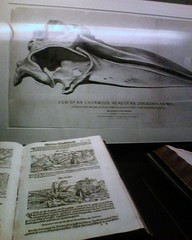
Found in New Orleans, 160 miles from the sea, and 75 feet from the earth's surface.
Weighing 1700 pounds.
Reduced from the original head, 18 feet by 7
Quoting directly from the text on this scientific plate from 1835, on display in the Rare Books Room of Chicago's Field Museum.
Tonight was Members' Night, where The Field throws open the doors and lets the common folk run through the scientific offices and storerooms.
Fun.
And I brought my wide angle.
Will post pics soon.
(And for what it's worth, I'm pretty sure this one's a whale.)
Posting by cameraphone on the road home.
Thursday, November 08, 2007
curiosities of the sciences and marvels for the eyes [1]
Where am I? Where do I want to go? How do I get there?
—What Maps Tell Us, per the Field Museum
Maps, Finding our Place in the World, which opened up at Chicago’s Field Museum on November 2nd, is a peep show for the schematically inclined.
Caught it last night in a private showing put on by the good folks at the Anthropology Alliance, who also brought in Ryan Williams, one of the show’s curators, to speak on the technologies of mapping. (The buffet, for those who care most about these things, pulled in a meager 3 points out of 5. Full points for the open bar were offset by the unidentifiable Satay, which may or may not have been poultry product. Admittedly the score would have plummeted to 2.5 if the desserts weren’t as solid as they were: mini-carrot cakes, lemon bars and a molten brownie glazed in frosting, sprinkled with jimmies, and vaguely reminiscent of an uptown Hostess ding dong)
But to the exhibit.
All the big guns were there: Lindbergh’s Flight Chart for his historic New York to Paris trek. The first Mercatur projection (I know -- get out!). Cook’s chronograph (although no word on whether it was with him during that unfortunate incident in the Sandwich Islands in which the locals mistook him for Lono -- the second time).
Edmund Halley’s 17-hundred-something map of the magnetic North -- the very first graphical representation of the earth’s magnetic field, bifurcated by the lovely curvilinear “line of no variation” -- also put in an appearance; and Cortes’ map of the Aztec capitol he conquered was also in attendance.
Even a 15th century rendering of Ptolemy’s Geographia was there.
Fans of Edward Tufte will be sure to recognize John Snow’s 1855 Cholera Map of London and Minard’s Figurative Map of the Successive Losses in Men of the French Army in the Russian Campaign 1812-1813.
The freaking cool North/South digital military map of the Civil War conflict from the Lincoln Museum in Springfield, which I wrote about back in August of last year, was there, although it lost some of its impact on the small screen that it was afforded (about twelve inches across -- in Springfield it fills a wall).
Thomas Jefferson and Benjamin Franklin also put an appearance, mapping colonies and the Gulf Stream respectively, but it was the more obscure gems that were ultimately the most interesting.
- Places Visited by Emperor Yu by an unknown Chinese mapmaker in 1136 was one of the first maps to use uniform scale to represent distance. The map itself is carved in wood -- copies were made via ink rubbings. The image is a strict grid -- solid blocks of black outlined in concave lines of white -- intersected and overrun by the sinuous meanders of what I assumed was the Yangtze, but realize now that I failed to write it down
- A map of Oaxaca, Mexico, when it was still called Amoltepec -- drawn just like you would expect a Mixtec artist would draw it on paper in 1580 -- hauntingly reminiscent of the few remaining Mayan Codices
- A map drawn from memory by Wetallok, an Inuit, of the Belcher Islands in Canada, on request for Explorer Robert Flaherty, that in its harsh expressionistic lines appears to be strikingly abstract -- until you compare it with the satellite image of the area that hangs alongside it, and you realize that folks who work the land know the land better than any surveyor ever could
- A spectacular letterpress map of Venice executed across six panels on that gorgeous stout Italian-made paper, the upper rightmost of which, in all its peripheral abstraction, earned my award for “map I most want to take home to live with me and be my love”
- The beautiful mystery of seeing first, the 1863 map by John Hanning Speke, on behalf of the Royal Geographic Society expedition, that verifies Lake Victoria as the source of the Nile River and then rounding the corner to find Francesco Roselli’s 1508 map of the world -- the first one post-Columbus’ discovery -- that not only tries to make sense (and does so badly) out of North and South America, but also harbors a sweet little divot cut clean through the paper where the heart should be in Africa that is, in fact, Lake Victoria -- and is fed by all those marvelous rivers, including, yes, why isn’t that the Nile? Hey...waitaminute...
I only got two-thirds of the way through in the hour before we were called away to the lecture, and then again in the brief twenty minutes that we squeaked in after the lecture before we had to hit the road home. So I’ll return soon to finish it, and to circle back to see the rest of the exhibit and to visit my favorites again -- including the sweet little slash of blue turbulence, perfectly tamed, that caught my eye like the crystalline call of an eagle’s cry [3] just as we were heading out the door. A story beautifully told, a man’s plan to tame the Arno and turn Florence into an economic powerhouse to rival its sister city: The Plan to Regulate the Arno River in Florence drawn by the hand of Leonardo da Vinci.
p.s. If you’ve never read Stephen Jay Gould’s explication of da Vinci’s Mona Lisa and the role that, he believes, water as an energy resource plays in that painting -- well, who am I to tell you what to read? But honestly -- you won’t be disappointed.
p.p.s. This map thing is going on all over the city for the next little while -- good times »
[1] Stole the title of this post from a remarkably beautiful Egyptian series of maps -- 13th century copies of 11th century originals by an unidentified mapmaker who turned out strikingly graphic and geometric representations of the European world that looked unlike anything the Europeans were producing at the time
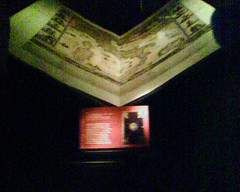
[2] The image is illegal, taken by cameraphone before I saw the “no photography” sign, of an Italian book of maps, c. 1665, that, had it been standing, would have stood as tall as me -- and I’m 5 foot 12.
[3] Have you ever heard anything like it -- that clear blue chime that an eagle makes when it’s calling to its mate? I heard it once on Christmas Day walking through Seward Park in Seattle and it took me several disorienting minutes to realize that what I heard was a living breathing creature.
Tuesday, July 10, 2007
dust to dust
I don't think I've ever met an archaeologist who wasn't happy.
Solid happy like out in the sun messing with the dirt, happy; happy like a gardener who's just hoed a row; happy like a kid playing hard in mud puddles, important work kind of playing with the sun on your back and dust in your mouth and dirt under your nails to let you know you're alive, kind of happy.
(I want that kind of happy.)
Spent the evening with two happy folk who dig around Oaxaca and work for Chicago's Field Museum hearing about their recent discoveries at El Palmillo. Excavated residences, mostly, and funerary urns; strange distributions of ancestral burials and legends of the powerful presence of mountains.
Good stuff.
Buffet rocked four stars out of five – there was a white fish in a chile sauce and a tasty mole-topped tostadas (Oaxacan-style) that especially stood out. Whole thing might have hit five stars if we hadn't arrived late to find the quesadillas congealed.
Posting by cameraphone on the way home from Chicago's Field Museum. T.Rex is from one of those funky little mold-your-plastic-while-you-wait machines. (If you close your eyes you can just. smell it.)

Solid happy like out in the sun messing with the dirt, happy; happy like a gardener who's just hoed a row; happy like a kid playing hard in mud puddles, important work kind of playing with the sun on your back and dust in your mouth and dirt under your nails to let you know you're alive, kind of happy.
(I want that kind of happy.)
Spent the evening with two happy folk who dig around Oaxaca and work for Chicago's Field Museum hearing about their recent discoveries at El Palmillo. Excavated residences, mostly, and funerary urns; strange distributions of ancestral burials and legends of the powerful presence of mountains.
Good stuff.
Buffet rocked four stars out of five – there was a white fish in a chile sauce and a tasty mole-topped tostadas (Oaxacan-style) that especially stood out. Whole thing might have hit five stars if we hadn't arrived late to find the quesadillas congealed.
Posting by cameraphone on the way home from Chicago's Field Museum. T.Rex is from one of those funky little mold-your-plastic-while-you-wait machines. (If you close your eyes you can just. smell it.)
Tuesday, March 06, 2007
another free meal courtesy of the Field

Field Museum opening with all the trimmings tonight: the new Ancient Americas hall debuted with a 3 ½-out-of-5 star buffet (for me, when I hit the door at 6, it’s all about the buffet. After I eat I’m ready to think about the artifacts.) attended by the requisite mix of anthro-types, ethnically diverse hipsters and bankrolling doyennes (one of whom --I suppose not inexplicably but still surprisingly -- came clad in what appeared to be a baby harp seal fur coat).
The new hall turned out to be indigenous-Americans-lite, of course, because increasingly that’s what a museum installation needs to be if it’s going to work across its chief demographic – kids on field trips.
But I don’t mean to detract from the accomplishment: it’s a terrific addition to the museum's permanent collections, a story well told, and its focus on the indigenous people of the Plains before it travels in a straight swipe down to Central and South America was the right call, I think, for the Field, given its Midwestern provenance. (The Northwestern tribes get theirs in a hall of their own, newly refurbished, right outside the Ancient Americas' exit. I didn't spot any representatives from the Five Nations, but I'll betcha they're in there somewhere.)
The signage and placards are insightful and easy to understand, and the pieces selected from the Field’s collection are, of course, stunning. If Clovis spearheads and eccentric flints rock your world, you’ll do just fine here. (There I go again, revealing too much about my predilections.)
For whatever reason I got giddy stepping into the entry, where vertical video screens feature a diversity of indigenous Americans who appropriately introduce “their grandparents” – the ancestors -- in their native tongues.
From the entry the visitor moves into an antechamber where a moody CGI of the Illinois plains 10,000 years previous plays in ceiling-high surround screens, and the occasional mastodon scampers by in the distance. The experience comes across as a little black light and velvety, and is not as successful as the Cambrian animation that plays in Evolving Planet, because the landscape isn't as varied and diverse (of course it could be that I missed all the action because one of the doyennes was poking me in the kidneys to move along).

For me, the natural fibers and textiles were the panty wreckers of the evening (to borrow an anniemcq-ism) – I get weak all over when I spot indigenous fibers and threads, even more so when they’re really, really old -- and the new installation has three tremendously ancient and surprisingly vibrant and lovely textiles from the Americas on display -- plus a few 500 year old (intact!) Andean spindles and whorls to boot. Sweet.

The crowds were too thick and the timing too tight to take it all in -- and besides that there was dessert to be had (another three and a half stars) -- so we skipped out after 2 hours, with the implicit promise to take the rest in, in another round.
Not to worry: I’ll spare you the next trip.
p.s. The Hall of the Ancient Americas opens for real this coming weekend »
p.p.s. Relive the glory that was the sneak preview last November »
Tuesday, October 17, 2006
what I learned tonight.
You can call an Eskimo an Inuit, but please don't call an Inuit an Eskimo.
Just don't.
Field Museum, Chicago
Just don't.
Field Museum, Chicago
Monday, April 03, 2006
disembarkation
 It took me awhile to recover after seeing this image. A detail from The Auschwitz Album: The Story of a Transport, now on display at the Field Museum in Chicago, it was taken by an SS Officer on the day these individuals disembarked at Auschwitz.
It was taken before they’ve been selected for the “showers” or as laborers; before they’ve been shaved, stripped of their clothing, depersonalized. They look concerned and wholly human. It appears that the gentleman first in line may be trying to reason with the German officer who roughly handles him by the lapel, or at least lighten the moment with a comment or two.
We know, as spectators to their misfortune, that if they are selected as laborers they may hope to live another three months, in the worst possible conditions. And we know, with the luxury of history, that this is just a brief glimpse into a much larger horror that will continue to unfold for some time yet to come.
And it's likely that they know none of the things that we know about this moment in their lives. The whole exhibit is like this: shots horrifying in their mundanity.
Sunday, April 02, 2006
letter from liam
Member's Night at the Field Museum in Chicago reminds me of Parent's Night when I was in Elementary School. Not only is the whole museum open after hours with special activities, but they open the top floor where the departmental offices are, and it has that cool "we'd be in trouble if we were here any other time" feeling. This letter was posted outside one of the anthropology offices. It reads:
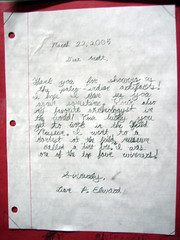
Dear Matt,
Thank you for showing us the paleo-indian artifacts! I hope I can see you again sometime. You'r also my favorite archeologyst in the world! Your lucky you get to work in the Feild Museum. I went to a contest in the feild museum called "dino bee". I was one of the top four winners!
Sincerely,
Liam P. Edward
Monday, March 13, 2006
cambrian animation
One of the coolest features of the new Evolving Planet exhibit at the Chicago Field Museum is a computer animation of a Cambrian seabed circa 543 Million BCE that runs in an extended loop on a gi-normous surround screen (three panels, actually). Fantastical creatures reconstructed from fossils swim through the seascape and do all kinds of clever sea-creature like things.
Lower the lights, put Dark Side of the Moon on the turntable, and come back for me in morning. Beats the heck out of those laser lightshows we had when I was a kid.
Lower the lights, put Dark Side of the Moon on the turntable, and come back for me in morning. Beats the heck out of those laser lightshows we had when I was a kid.
Subscribe to:
Posts (Atom)