Showing posts with label exhibits. Show all posts

Monday, January 08, 2007

oneirical vision


The nets are here transformed into a oneirical vision, a perceptive exploration to unveil the complexity concealed behind the reality.


From the English Translation of a brochure accompanying Istos, an exhibition of works by the Italian photographer Massimillano Lattanzi, now showing at the National Gallery of Modern Art in Guatemala City

Oneirical is a curious translation of the french onirique, which according to a definition that I pulled off Google (define: onirique) means "relatif aux rêves, qui rappelle un rêve ou qui est inspiré par le rêve" -- or as sloppily translated by Bablefish: "Relating to the dreams, which points out a dream or which is inspired by the dream".

This is a new one for me -- at first I thought they were going for "unique" and then wondered (somewhat sheepishly) if they weren't talking about "onanism". Wikitionary spits up an instance of the word as "oneiric," which I suppose will have to do.

The closest word I can think of in English common usage would be "reverie", but that doesn't quite do it, does it? It doesn't have that delicious sense of something unique and vision-like -- it describes instead a driftless dreamer, not one who listens to dreams.

Tuesday, October 17, 2006

what I learned tonight.


nosh before the lecture
Originally uploaded by suttonhoo.
You can call an Eskimo an Inuit, but please don't call an Inuit an Eskimo.

Just don't.

Field Museum, Chicago

Monday, October 16, 2006

missing sontag

I don’t want any make-up on her. I don’t want any of that crap.

Annie Leibowitz to the undertakers who were dressing Susan Sontag’s body for burial. As reported in the Guardian piece, My Time with Susan, on October 7.

Good god – have I been sleeping under a rock? To learn today that two of my favorite women in the world – Susan Sontag and Annie Leibowitz – were partners in the later years of Sontag’s life and I missed the whole thing… Goddammit.

But I’m so glad they were. It makes such perfect sense: It’s like hearing about two friends you’ve known forever -- loved dearly, each for their own gorgeous talents -- who found each other somehow. Perfect fit.

Leibowitz has published a book of photographs of Sontag’s last days. The Guardian published a beautiful piece a little over a week back about the book, and about their life together.

The photographs will soon be on display as part of a larger Leibowitz exhibit at the Brooklyn Museum. (Unfortunately you just missed a wonderful special exhibition framed around Sontag’s On Photography that was hanging at the Met back in September.)

Saturday, October 14, 2006

richard nickel: chicago's cassandra

Half a dozen years ago, just as I was getting ready to make the move to Chicago, I saw the Lookingglass Theater production of They All Fall Down -- which told the story of Richard Nickel, the photographer turned salvager who waged a losing campaign against the wrecking ball in an effort to save the Chicago buildings of Adler and Sullivan and then, as time went by, tried to save all the historic architecture of Chicago that he could.

Louis Sullivan was Frank Lloyd Wright’s mentor and employer – FLW called him Leibermeister – and he was arguably one of the first architects to forge a distinctly organic American style of architecture.

The Lookingglass production portrayed Nickel as something of a geek and a freak – you feel pity for the poor guy as he wages his campaign with his camera hanging perpetually round his neck -- but he was so awkward that you (that I) never entirely sympathized with his plight. And it certainly never became my problem.

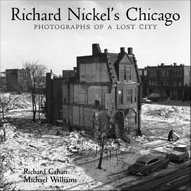
City Files Press has published a book that just changed my idea about who Nickel was and what he did. I picked it up today at the Chicago History Museum after the Sullivan Symposium wrapped up, without realizing that it’s hot off the presses – the Chicago Tribune is running a portfolio of some of the shots in the book this weekend in their Sunday Magazine – and popped it open tonight to see what it had going on.

It’s a simple collection of Richard Nickels' photographs – many of which have never been printed before – peppered with brief excerpts from his writings and letters. He covers two thirds of the trinity that concerned his friend and mentor, Harry Callahan -- limiting himself to People and Buildings (Nature appears in Nickel’s work only in the detailed terracotta of Sullivan’s facades, or the imminent encroachment of a weedy lot) – but his work introduces pathos in a way that Callahan’s does not – it’s a powerful ache that something is not right – that everything must be turned on its head if things are going to turn out okay – but that turning never happens. One by one we watch, through Nickle’s eyes, the glorious structures erected by Adler and Sullivan – and other Chicago landmarks -- demolished to make way for parking garages and featureless office buildings.

The passage of pages in Richard Nickel’s Chicago: Photographs of a Lost City has the same chilling effect that creeps up when Cassandra starts tugging at our sleeve – that poor gal who warned the lugheads of the Iliad that their actions would lead to terrible consequences, knowing of course that no one – absolutely no one – was listening.

But still she was compelled to prophesize. And so was Richard Nickel.

Nickel fell in love near the end of his life. He promised his sweetie he’d pull back on being such a pitbull on the conservation issues. He bought a building of his own and started renovations – something he could save. “I should have owned a building several years ago,” he said. “I enjoy all the steps I am going through, but I worry if I will ever make it.”

He was right to worry. In 1972 he made a salvage trip to Adler and Sullivan’s Chicago Stock Exchange, which was then under demolition. He had photographed it on previous trips – photographs that would be used to reconstruct the trading floor at the Art Institute of Chicago.

It was late, he was alone, and no one’s entirely sure what happened next. All that is known is that he was buried so badly in the rubble it took 28 days for construction workers to recover his body.

I knew that going in, of course, but I didn’t know how deeply I’d be moved by Nickel's images. Not only of the buildings, but also of the kids on the South Side playing under Sullivan’s arches, and of the self-portraits that showed not a freak and not a geek – but a man who cared deeply about what he was trying to save. And who worked like hell to make someone else care too.

The book hit me the way some movies do when they strike something deep and sleeping (Wim Wenders Paris, Texas affected me this way) – I was relatively still as I paged my way through the 200 some pages, and then, when the last page was turned, I closed the cover and had myself a good cry.

The problem with landmarks – the basic problem – is that material things are short-lived, easily replaceable in the USA. ~ Richard Nickel

Saturday, September 30, 2006

from the W.T.F. department

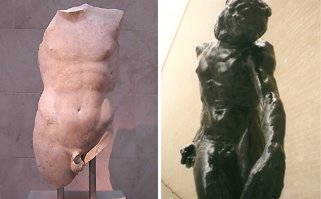
Retracing her route this week through the museum’s European and contemporary galleries, Ms. McGee passed the marble torso of a Greek youth from a funerary relief, circa 330 B.C.; its label reads, “his nude body has the radiant purity of athlete in his prime.” She passed sculptor Auguste Rodin’s tormented “Shade;” Aristide Maillol’s “Flora,” with her clingy sheer garment; and Jean Arp’s “Star in a Dream.”
Ms. McGee is the fifth grade teacher in Frisco, Texas who was suspended from her job this week when one of her students was “exposed to nude statues and other nude art representations” during a Principal approved school trip to the Dallas Museum of Art, as reported in the New York Times. The kid’s parents complained.


Here’s a thought: Any cities acting stupid and disregarding hundreds (thousands!) of years of cultural understanding regarding the Arts gets mandatory secession. Starting now.

Let’s go ahead and include respected scientific theory in this one – Kansas City: you can follow Frisco, Texas out the door for that Creationism nonsense last year.

Update: But wait, there's more! Just when you thought you had the whole crazy American morality thing figured out, then there's this: Kellie Everts, Stripper for God » (via Gaper's Block)

Friday, September 29, 2006

space is the place

From the moment he discovered the material, Corbett wanted to keep it together as a singular archive of Sun Ra’s Chicago years, and he hopes eventually to find an institutional home for it. “It only articulates a story if it’s together,” he says. “Little bits and pieces of it are collectorfetish ephemera, but when it’s all together you start to see this interesting phenomenon . . . which is the way that Ra sort of fit into a southside Afro-futurist community of thinkers, designers, and musicians who were all pondering the future, independent businesses, and separatism.”
John Corbett in « Ra Materials » by Peter Margasak in this week's The Chicago Reader

You're either going to care about this a whole lot, or be completely indifferent. I'm posting this for someone dear to me who I expect will trend toward ape-shit.

The show, "a treasure trove of Sun Ra ephemera: album art, recordings, writings, ledgers, and scraps of paper like ticket stubs and gig flyers," opens on Sunday in Chicago's Hyde Park Art Center.

Pathways to Unknown Worlds: Sun Ra, El Saturn & Chicago’s Afro-Futurist Underground, 1954-68
Hyde Park Art Center, 5020 S. Cornell
773-324-5520
Reception 10/15, 3-5 PM
Show runs from Oct 1st through January 14th
Admission is Free

Saturday, September 16, 2006

baby mine


Picture this: You’re in a room, painted white. There are two large movie screens – regular old movie theater size movie screens – erected on the floor, roughly perpendicular to one another. As you enter the room you’re facing the screens; to exit the room you must cross either between or behind the screens (I walked behind).

Projected on either screen are two asynchronous shots of the same elephant, doing elephant like things – getting up, lying down, walking -- in a room painted white, very much like the room painted white in which you are now standing. As a result of the fact that the movie screens are movie theater size large, the elephant is big ass elephant large. As big as, well, an elephant.

This is what Douglas Gordon does (along with some other very cool and entirely different kinds of things with film). There are some brief clips from the installation on the MoMA website, but it doesn’t do the experience justice.

Tuesday, August 22, 2006

a house divided

rolynBarthelman.jpg

One of the most impressive presentations at a museum that strives to impress (that would be the Lincoln Museum in Springfield, IL – a multimedia spectacular that puts Disneyland’s robotronic Lincoln to shame) is a brief four minute movie -- an animated timeline, actually -- that plots the progress of the Civil War from the point of Lincoln’s election, through secession, his inauguration, and on to battle.

The Union and Confederacy are represented in blue and red (ya think they could have used blue and grey, but oh no -- had to be blue and red), and as the clock ticks -- with one second equal to one week -- the battlefront oscillates and morphs and serpentines, punctuated with the brief explosions of battles (Shilo, Antietam, Gettysburg), as the body count tallies in the corner (over 1 million before the war is done). Then Sherman marches to the sea and cuts the final gash that seals the surrender of the South.

The movie closes with Lincoln’s assassination.

Edward Tufte would be proud – it’s brilliant information design.

I, frankly, was a wreck.


[Image Credit: The flag graphic above is by Rolyn Barthelman of NYC who created it after the last presidential election.]

Wednesday, July 26, 2006

lepidoptera dreams

I have often dreamt of a long and exciting career as an obscure curator of lepidoptera in a great museum.

Vladimir Nabokov in an interview in 1964, referring to his scientific passion for butterflies, and quoted today in a story about «The Nabokov Code», an exhibition in St. Petersburg that looks at Nabakov's work in the context of his entymological pursuits.

Should I take comfort -- or despair -- in the thought that even Nabokov wanted to be something else when he grew up?

For what's its worth -- according to the article -- Nabokov worked in his desired capacity at Harvard for awhile, reclassifying the Lycaeides genus, which earned him a mention in the 1951 «Field Guide to the Butterflies of North America».

(Here's a link to the St. Petersburg show -- but heaven knows I wasn't able to get it to load.)

Wednesday, July 12, 2006

tut job


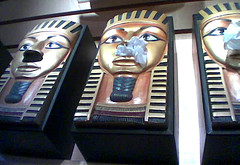
king tut tissue
Originally uploaded by suttonhoo.
Disappointment presupposes high expectations. Knowing that, I’ve made a pact with myself not to care, not to want, and not to hope about anything having anything to do with Tut.

Because the hype has been too big, and the run is going to be too long (through January 1 at the Field Museum), and too many people who don’t care about desiccation on an ordinary day care are going nuts over this kid’s canopic jars.

As if.

But the Anthropology Alliance generally puts on a good show, so I had high hopes for last night’s private viewing of the King Tut exhibit.

The Anthro Alliance is a satellite group of Field Museum members who care about things anthropological. Recent past events have catered the geek in me: There was a viewing and lecture and book signing about some of the best remaining examples of Madagascar textiles (“remaining” because the museum housing the best burned down in Madagascar a few years ago, and took the textiles with it); and a presentation by Bob Martin regarding the paper he was getting ready to publish in Science on the Flores Man.

Besides: The food's always good, and the bar's usually open.

But last night was pretty tepid. Big crowd, meager spread, and a lecture that tried to cover way too much old ground (yep – thanks – picked up that bit about the cyclical flooding of the Nile in 5th grade world history – got anything fresh?).

The exhibit, on the other hand – the thing I was prepared to be unimpressed by – was pretty dang cool. Of course the pieces that grabbed me the most didn't show up in the catalog (at least in the little mini-catalog that was the only one I was interested in forking over the cash for) and my darlin’ companion was hovering close by and pointing to the “no photography” sign, so I came away without any pictures to show.

So you’ll have to believe me when I tell you that there are some pieces that really are worth seeing:

  • There’s a wonderful obsidian bust cracked down one side – the contrast of the glassy unfinished obsidian against the finished surface is alone worth the price of admission

  • A leather dog collar. Very cool. And very big. (For a big dog, apparently.)

  • A child’s seat with the woven reed seat still intact

  • The gold base of a fan that used to hold ostrich plumes (as a matter of fact ostrich are indigenous to Egypt, as we learned later that night [okay -- so the lecture wasn't a total wash]) – and if you peek into one of the holes where the plumes were mounted you can see where one busted off and left the nib behind

  • A beaten gold covered sarcophagus lid that on which bits of the linen shroud, soaked in resin, is still stuck to the gold (I love it when the organic stuff survives. I’ll take fibers and seeds over gold and silver any day.)

  • And the simple inlaid wreath that served Tut as a crown – the one he wore on his head under all those layers and layers and layers that they entombed him in

  • The crown is delicate and intricate and divine, and the expressiveness of the cobra and the vulture that peer out from the front of it had me ogling for much longer than was polite.

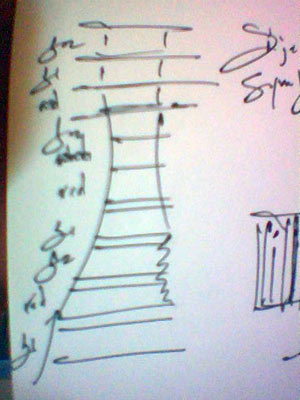
    One of my favorite pieces of the show was a wooden carving of a symbol that I learned about for the first time last night – cousin to the Ankh, it was a Djed, and there seemed not only to be an importance to the number of bars that crossed it at the crown, but also the way it was colored – and maybe even the sequence of that coloration. With the dc keeping me honest I had to resort to sketching (in a hurry) a rough outline of what I saw:


    In the same way the Ankh represents life, the Djed represents stability, and it appeared repeatedly in the pieces that peppered the show -- pulled, of course, from a period of turbulent history, emerging from the religious upheaval that Akhnaten wrought and trying desperately to set things right again.

    The symbol usually showed up as an object that was clutched and held aloft -- almost as if a wooden staff, were it beautiful enough and crafted out of enough precious metals and semi-precious stones -- could possess the power to settle the upsurges of a violent world.

    As if.

    (But wouldn’t that be something if it could?)

    Tuesday, June 20, 2006

    being ware


    chris ware at the mca
    Originally uploaded by suttonhoo.

    1. As a child, you were
    a. sort of happy. b. not so happy.

    2. To occupy your time, you like to
    a. watch television. b. go to movies. c. draw. d. play video games. e. talk in weird voices into a tape recorder. f. read comic books.

    3. The presence of members of the opposite and/or attractive sex makes you feel
    a. weird. b. awful. c. terrified. d. hopeless. e. like killing yourself.

    4. If you don’t like a comic strip, it’s because
    a. it sucks. b. the cartoonist is an idiot.

    5. If you don’t like a painting, it’s because
    a. you don’t understand it. b. you’re ignorant of the history of art theory and art in general.

    If any of these questions made any sense at all to you, you are now welcome to enter the exhibit. Please do not speak loudly, carry beverages, or scratch your initials into the plexiglass.
    A «Quick Preparatory Quiz» from the poster-size brochure accompanying «The Public Exhibition of Original Cartoon Drawings, Preparatory Doodles and Printed Ephemera Selected From the Life Output Thus Far of the Juvenile Book Artist, Typographical Stylist, and Comic Strip Lobbyist Mr. F.C. Ware» now running at the Museum of Contemporary Art in Chicago

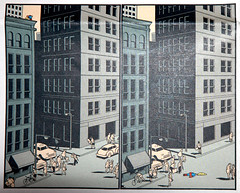
    Chris Ware is the Flemish Master of comic art. Not only because he executes a scene the way they did -– by painting achingly small and vulnerable players against the big sweeping backdrop of the city in which they live –- but also because he gets that thimbleful of grief just right -– the thing that Auden wrote about --
    About suffering they were never wrong,
    The Old Masters: how well they understood
    Its human position; how it takes place
    While someone else is eating or opening a window or just walking dully along
    Ware builds a scene with exacting details and then occasionally telescopes it forward, back and sideways in time in Run Lola Run style. It’s wonderfully engaging, hard on the eyes, and takes hours to devour. Tough going for a museum show like the one that’s running at the MCA through (nearly) the end of August; better that you pick up one of his books and sit awhile.

    Thursday, June 15, 2006

    (enough already with the Ah!s)


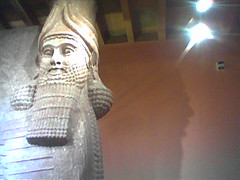
    winged beast of ninevah
    Originally uploaded by suttonhoo.
    Ah! in what quarries lay the stone
    From which this pillared pile has grown,
    Unto man's need how long unknown,
    Since those thy temples, court and cone,
    Rose far in desert history?
    Ah! what is here that does not lie
    All strange to thine awakened eye?
    Ah! what is here can testify
    (Save that dumb presence of the sky)
    Unto thy day and Nineveh?

    Dante Gabriel Rossetti
    The Burden of Nineveh


    Hope you'll indulge an old English Major -- how often do you get to pull out a classic poem about the very thing you're looking at? Wingèd Beasts from Ninevah are far and few between.

    (Just you be glad I didn't paste in all 20 stanzas.)

    This fellow now lives at the Oriental Institute in Chicago, and he's quite extraordinary, really.

    Tuesday, May 09, 2006

    guinness good for you


    guinness good for you
    Originally uploaded by suttonhoo.
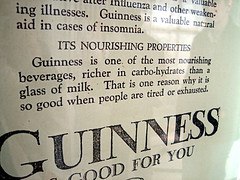
    One of the original ads for Guinness Stout reads:
    ITS NOURISHING PROPERTIES
    Guinness is one of the most nourishing beverages, richer in carbo-hydrates than a glass of milk. That is one reason why it is so good when people are tired or exhausted.
    We queued 20 minutes and paid €14 (per head) to visit the Guinness Storehouse – pardon me – the GUINNESS Storehouse – in Dublin where we spiraled up five stories in a slow crawl along with the rest of humanity to learn all about the manufacture, marketing and distribution of Ireland’s most famous stout – with time to spare on the tail end to grab a “free” pint and take a spin through the gift shop.

    Advertising, Baby. Branding pure and simple. And I paid for the privilege.

    We were on the tourist circuit in Dublin, and visited every museum known to man. No where else did we queue for 20 minutes. No where else did we push through crowds like we did at the Storehouse. No where else did we lay down €28 for the privilege. No where else did we see so many smiling faces.

    Did I mention the library where you could read up or listen to audio lectures on how to avoid a hangover or why beer is good for your health? It was packed.

    I spend a lot of time (probably too much time -- fortunately, much of it is compensated) thinking about branding and merchandising, so the part of me that wasn't baffled tried to parse the stories, displays and exhibits to better understand why people connected so deeply and affectionately to this product.

    Turns out all I really needed to do to understand it better was spend a little time in a pub with a pint of my own, good music playing, and my darlin' companion close by.

    By the time I hit the bottom of that first pint it had become perfectly clear.

    Monday, April 03, 2006

    disembarkation

    250_auschwitz_IMG_0615.jpgIt took me awhile to recover after seeing this image. A detail from The Auschwitz Album: The Story of a Transport, now on display at the Field Museum in Chicago, it was taken by an SS Officer on the day these individuals disembarked at Auschwitz.
    It was taken before they’ve been selected for the “showers” or as laborers; before they’ve been shaved, stripped of their clothing, depersonalized. They look concerned and wholly human. It appears that the gentleman first in line may be trying to reason with the German officer who roughly handles him by the lapel, or at least lighten the moment with a comment or two.

    We know, as spectators to their misfortune, that if they are selected as laborers they may hope to live another three months, in the worst possible conditions. And we know, with the luxury of history, that this is just a brief glimpse into a much larger horror that will continue to unfold for some time yet to come.

    And it's likely that they know none of the things that we know about this moment in their lives. The whole exhibit is like this: shots horrifying in their mundanity.

    Sunday, April 02, 2006

    letter from liam


    letter from liam
    Originally uploaded by suttonhoo.
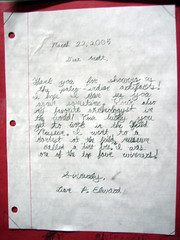
    Member's Night at the Field Museum in Chicago reminds me of Parent's Night when I was in Elementary School. Not only is the whole museum open after hours with special activities, but they open the top floor where the departmental offices are, and it has that cool "we'd be in trouble if we were here any other time" feeling. This letter was posted outside one of the anthropology offices. It reads:


    Dear Matt,
    Thank you for showing us the paleo-indian artifacts! I hope I can see you again sometime. You'r also my favorite archeologyst in the world! Your lucky you get to work in the Feild Museum. I went to a contest in the feild museum called "dino bee". I was one of the top four winners!

    Sincerely,
    Liam P. Edward

    Monday, March 13, 2006

    cambrian animation


    cambrian animation
    Originally uploaded by suttonhoo.
    One of the coolest features of the new Evolving Planet exhibit at the Chicago Field Museum is a computer animation of a Cambrian seabed circa 543 Million BCE that runs in an extended loop on a gi-normous surround screen (three panels, actually). Fantastical creatures reconstructed from fossils swim through the seascape and do all kinds of clever sea-creature like things.

    Lower the lights, put Dark Side of the Moon on the turntable, and come back for me in morning. Beats the heck out of those laser lightshows we had when I was a kid.
    Related Posts with Thumbnails