Kansei is manifested in three ways. The first is the expression (hyojo) of an object, or its appearance. This includes color, texture, material, and surface treatments: all the qualities visible to the eye.
The second is the creator’s gesture or intent (dosa), or the body’s physical responses to the object. These become apparent upon using or touching the object—how it feels in the hand and how its fragility or strength dictates one’s movements.
Finally, there is the heart (kokoro)—the emotions an object stirs. This psychological dimension is the most abstract, but it’s also the most prized by Japanese designers, who speak of the feelings of recognition, attachment, or playfulness that an object elicits in its user, perhaps because it functions so well or is pleasant to look at.
It's very sweet. When they're doing this singing thing, they're reaching their legs across to the other one, trying to do footsies.
Medical entomologist Gabriella Gibson of the University of Sussex and the Natural Resources Institute of the University of Greenwich commenting on her mosquito research in Science.
Gibson found that two variant mosquito types -- which are visually indistinguishable -- find others of their type through the music they make:
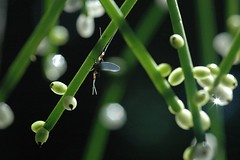
Gibson and colleagues collected larvae of the two forms in Burkina Faso and raised them in the lab. Then they stuck a short piece of wire to their backs with beeswax and brought them within a few centimeters of another bound mosquito of the opposite sex. The pair flapped in place while a microphone recorded their "music"; mosquitoes sing by speeding up or slowing down their wing beats, which changes the frequency of their high-pitched whines.
The mosquitoes harmonized--but only with mosquitoes of the same form. A pair of two M or two S mosquitoes aligned their wing beats so that the female beat her wings twice for every three beats of the male's wings. Like a bowed violin string, the beating wings also created higher frequencies, which match when males and females are harmonizing. "If they're of the same form, they'll stick with each other with this harmonizing just for seconds on end," says Gibson. "If they're the two opposite types, they really won't come together."
Photo: Me & my daddy on a family camping trip in Vermont.
I was probably three.
The mother of my high school boyfriend was the first person to call me a nomad. J told me about it later, saying she remarked it was a wonder I was so normal, seeing how I lead such a nomadic life. I was a high school senior then, and I had attended twelve different schools, only a small fraction of which were in the same school district.
We were the renters on the block; the kids who were always a little unkempt. I learned in awkward and sometimes embarrassing ways that we were different from the kids who rooted long and hard in a single place and all knew each other from Kindergarten; learned in bright hot flashes that we were the transient ones.
But being the new kid in many lonely lunchrooms gained me the skill of knowing always how to be anywhere, easily. How to make friends; how to be the first to say hello. I suspect it’s also the root cause of my persistent solitude and my wandering. Never having a place to settle and be easy in your skin means it’s best to keep moving.
I know now that our curious habits were my father's doing. At the time I assumed no agency -- that was just how things were. Always. Predictably. Now that I’m grown I have a heart full of theories about why we were on the move so much, but this post isn’t about what was missing, or about what gnawed through the electrical lines in the dark; this post is about what made it all okay somehow.
I suspect the music had something to do with it; somehow managed to anchor it all, somehow produced in all four of us kids a solid center to start from and make our way in the world with some kind of certainty that what we were doing was all right.
The music was always there, and the music was always home. It was there when friends gathered late around the table, or when my dad let us come with him to the studio. It was there when he picked up his guitar, whether an emotional storm had just blown through the house and throats ached from the yelling, or we were just floating collectively on a the sweet tide of Sunday morning.
I still feel it every time my daddy picks up his guitar and plays. Felt it when he strummed just a few fragments over Christmas; felt it when he played for the first time after his coma, after he came back from the dead, when he was home at last and I handed him a rental six-string on the doctor’s prescription, who said it would help the neurons destroyed in the accident wire back up again.
There is something inarticulate in a tune, when it's shared and when it's authentic, that says: it’s okay to search this thing out, to figure out for your own self what it all means. When the music's playing there's an unspoken invitation to ride it, it’s yours; and there's an unspoken understanding that the ones playing with you will keep you company, ride right alongside, and find their own measure.
Where everything is all right.
A note about the clip: My dad recorded this a long time back when he was recording and promoting and producing for Jerden Records in Seattle. It's shown up on a couple of compilationCDs in recent years, but it's impossible to find a shareable clip online, so I patched together this brief video with Apple's iMovie program. I'm still a newbie at the app -- I prefer Adobe Premiere but my PC hard drive combusted and there's no getting at my installation -- so regrettably, until I can figure out how to override the time constraints, all I can offer you is a one minute clip of a three minute track. Of my daddy. Walking in darkness. (It's an old blues cover -- I'll see if I can hit him up for more info about the song's history and the recording itself.)
p.s. My grama, my father's mother, hated this song -- in a what-will-the-neighbors-think kind of way.
Christ, can you imagine what Calder would do with this space?
Artist Brian Clarke commenting to New Yorker writer John Seabrook on Zaha Hadid's MAXXI gallery in Rome which opened recently as an exhibit itself -- there isn't any art hanging on the walls just yet.
Clarke was responding to the concern, raised by an Italian journalist, that the space might be too daunting.
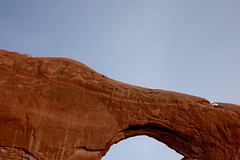
I shrugged off the folks in the Midwest who had never heard of Arches National Park, when I mentioned I was headed that way over Christmas. It's not unusual for folks around here to know little about the American West. Maybe it's because they think of it as one lump sum of mountain ranges and cowboy hats; maybe it's because they don't think of it much at all.
But when we mentioned it to the executive chef at our Denver hotel (who prepared an exceptional meal for us that I really need to Yelp) and she'd never heard of the lovely little gem of a national park just six or seven hours distant, nestled into the red rock canyon country just outside of Moab, Utah, cousin to the marvelous expanse that is Canyonlands, I got nervous.
This is all ours, America. This is the land we wrestled away from the folks who had it first, with gunpowder and infectious disease. This is what we fiercely claimed we could never live without. This is the country we abducted like a young bride from her kin. This is the land we killed for.
And while none of that is right, the very least we can do it pay our respects.
What you'll be needing after a day kicking around Arches in the cold and snow. (And I do mean cold: teens and single digits for most of the day while we were hiking the snow packed trails.)
Stopped by the bagel deli of my youth to grab a bite for the road. Their bagels aren't quite up to NYC standards (or Philly, as my Fishtown- dwelling brother pointed out), but they're pretty good for West of the Mississippi.
Posting by cameraphone from Hampton and Monaco in Denver. Headed for the hills.
Le 1er février 2008 à 5 heures du matin, un incendie a ravagé Deyrolle, magasin historique d'entomologie et de taxidermie situé au cœur de Paris. Les collections de milliers de papillons et d'insectes rares, d'animaux empaillés de tous horizons et de minerais divers, formées depuis sa création en 1831, s'envolèrent en fumée, ne laissant de traces que dans la mémoire de générations de rêveurs fascinés par leur immobile beauté.
Swiss cheese & sour cream omelette with my sister's ugly apple chutney on the side.
It may not be pretty but it's *delicious*. And it's breakfast. Or rather: lunch. Working from home to avoid the ice on the roads and I didn't realize it had gotten so late.
Posting by cameraphone. Getting ready to launch into Christmas.
Ducking the crowds in the darkened sanctuary of the church that hosts our PADs shelter in the wintertime. We always manage to overstaff these things, and the do-gooders generally trample each other in an effort to make sure everyone's fed and bedded.
Frozen rain is falling outside; sleet sheeting every surface with ice.
Tonight a well-dressed gentleman walked in long after everyone was signed in and chatting over their plates piled high with fried chicken and mashed potatoes and green bean casserole. He said, "this is my first night homeless: what do I do?"
Eat, we told him, and warm up some. Then we'll do the paperwork.
Posting by cameraphone. Dry & warm & and a little bit heartbroken.
Found in The 20 W sleep-walkers by Ladislav Kováč1 of Comenius University, Bratislava, Slovakia in the current issue of EMBO Reports.
Also found in Kováč1's piece, as directly quoted:
The energy output of the resting adult human body is equal to the power of a 100 W electrical light bulb.
The brain alone consumes 20% of the body's chemical energy, even though it accounts for only 2% of the body's mass. Metaphorically speaking, we all have a 20 W light bulb burning in our head, even when we lie still in complete darkness doing physically nothing.
The brain as a whole shows no difference in the energy budget between ‘resting’ and ‘busy’ states.
The brain guzzles up—per unit weight—as much energy as the heart muscle, about 16 times more energy than the skeletal muscle at rest, or as much as the leg muscles during a marathon race.
And:
When the brain receives no signals from the environment, a considerable part of its energy is used in daydreaming: the human mind may be spending as much as half of its wakeful time daydreaming (Klinger, 1990). This comprises not only the creation of fanciful stories similar to those we dream during the night, but also the rehashing of all possible and impossible alternatives of the past, present and future activities.
This interior universe of daydreaming creates a continuous series of fictional rewards and punishments, which steadily builds up the unique and idiosyncratic personality of every human individual by conditioning. This may explain our capability to work for years on our career, tenaciously, with self-restraint and self-denial, as if we were motivated by the mirage of an ultimate reward.
Apparently, it is not the latter in the remote future, but our present fancies of it that provide immediate, positive rewards and function to reinforce our deeds.
Flight cancelled due to snow in Chicago. Rumored to be booked on the 8.10, but with snow in Chicago who's to say we'll get off the ground? That said, all on the ground sources report nothing more than light flurries. Reserved a one-way rental car just in case, but after waking at 4am I'm not sure a 5 hr drive home through the snow is a stellar plan.
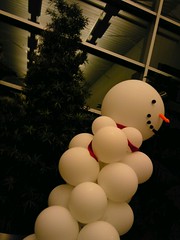
This snowman, btw? Entirely made of balloons -- even the coal and carrot facial features.
This video is maddening -- almost entirely because the Italian who strung together a pop song from American-sounding nonsense (sometime in the 70s, it seems) pulled off the tonality so perfectly that I spent all my time listening trying to make out what they're saying.
That strange frothy microbrewed substance in the IV bag that looks like a nice small-batch wheat beer? That's my plasma.
This is the second batch; the first batch had already been returned to me, along with saline, in an icy transfusion after the blood center extracted a concentrated dose of red blood cells from what I gave them. How much was that? I got *two* "be kind to me I gave blood stickers" over the usual one. So two pints, but they gave me all the leftovers back. At the end of the hour the phlebotomist handed me a form to sign saying: "sorry I forgot about this before."
The consent form detailed the strange side effects I was already feeling -- weird tingling in my lips; severe chills; nausea -- and states at the very last: "Long term side-effects from the depletion of lymphocytes are unknown." That would be my white blood cells; the ones that fight infection.
Lovely.
Also in the small print: a prohibition against donating blood if you are a man who has had sexual contact with a man anytime since 1977. This question comes up some time after one is queried about sexual contact with an individual who is HIV positive, male or female.
So basically gay men are out, just because they're gay, unless I'm reading that wrong.
It may not be marriage, but it's still discrimination, and it made me even more curious to read Martha Nussbaum's pending release on the politics of revulsion in which she theorizes that much of the antagonism to gay marriage is rooted in homophobic disgust over queer sexuality.
I want to see where she goes with that and whether she draws a parallel between sexual discrimination and our sorry history of racial segregation.
Although I am only ten, I want an i-pod touch. Here are 3 main reasons I should get an i-pod touch for Christmas. I really want to get one.
The first reason why I would like an i-pod touch is because if I get one now, I won’t need any other i-pods. K has a shuffle and a nano and barely uses them. The i-pod touch can last years without needing a new i-pod to keep you entertained. I really wish you would consider getting me the i-pod that will last a lifetime.
The next reason I would like an i-pod touch is because how much it can do. This amazing i-pod has music, free games, and much more. I will always get free games never a game you have to pay for. Just a regular i-pod can’t beat an i-pod touch. Not even 2 of them are as amazing as an i-pod touch. And dad, If I got an i-pod touch, I wouldn’t be asking to play your i phone.
The last reason why you should consider getting me an i-pod touch is well, just listen. Think, you bought K 2 i-pods and if you bought us all 2 i-pods it would be like this. Why not just buy 1 i-pod that for each of them that they will use a lot and not have an i-pod that they don’t use sitting around the house, make that 2 because neither one of those i-pods are as good as an i-pod touch. Please please please get me an i-pod touch.
These are 3 main reasons why I want to get an i-pod touch; they are good for you and me. Please consider getting me one, and if you just don’t want to get me like you did with my DS, you can get gift cards but I would really really like an i-pod touch.
PS. Sydney and Natalie both have an i-pod touch
A letter from my niece, M, to her father, posted here with both her consent and her dad's.
I was mostly impressed with the three-point essay construction.
The dark socket of the year the pit, the cave where the sun lies down and threatens never to rise, when despair descends softly as the snow covering all paths and choking roads:
then hawkfaced pain seized you threw you so you fell with a sharp cry, a knife tearing a bolt of silk. My father heard the crash but paid no mind, napping after lunch
yet fifteen hundred miles north I heard and dropped a dish. Your pain sunk talons in my skull and crouched there cawing, heavy as a great vessel filled with water,
oil or blood, till suddenly next day the weight lifted and I knew your mind had guttered out like the Chanukah candles that burn so fast, weeping veils of wax down the chanukiya.
Those candles were laid out, friends invited, ingredients bought for latkes and apple pancakes, that holiday for liberation and the winter solstice
when tops turn like little planets. Shall you have all or nothing take half or pass by untouched? Nothing you got, Nun said the dreydl as the room stopped spinning.
The angel folded you up like laundry your body thin as an empty dress. Your clothes were curtains hanging on the window of what had been your flesh and now was glass.
Outside in Florida shopping plazas loudspeakers blared Christmas carols and palm trees were decked with blinking lights. Except by the tourist hotels, the beaches were empty.
Pelicans with pregnant pouches flapped overhead like pterodactyls. In my mind I felt you die. First the pain lifted and then you flickered and went out.
Part the first of a lovely poem by Marge Piercy called My Mother's Body which I found at the Poetry Foundation.
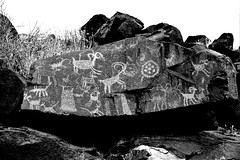
Having visited hundreds of sites all over the world, including Lascaux and Chauvet in France and the Côa Valley in Portugal, [archaeologist David S. Whitley] believes the Coso Petroglyphs to be one of the most important rock art sites on earth.
Mr. Whitley estimated that there may be as many as 100,000 images carved into the dark volcanic canyons above the China Lake basin, some as old as 12,000 to 16,000 years, others as recent as the mid-20th century.
The Coso Rock Art District, just off the road between L.A. and Vegas, has defied disturbance because it also operates as a firing range for U.S. Naval air weapons.
Go figure.
It's open for visitors (during which time I'm pretty sure they turn the bombs off). You can arrange a tour through the Maturango Museum »
Dear Mrs. Morrison, Someone sent me a copy of The Black Book and if at all possible I would like to have two more. I need one copy to give to a friend, another to throw against the wall over and over and over. The one I already own I want to hold in my hand against my heart.
A letter from a prison inmate to Toni Morrison, editor of the Black Book while she was an editor at Random House, upon the book's initial release in 1974, cited by NPR.
Roadside stop to see Louis Sullivan's Merchants Bank in Grinnell, Iowa. I wasn't expecting the green-patina gilt running along the columns and the facade, but the impact in the weak winter sun is remarkable.
It's Sunday, which means the bank is closed and we couldn't get a peek at the interior, so we had to make what we could of the art glass from the outside. Still: stunning.
Most remarkable is the way this jewel box by the grand-daddy of the Prairie School who fathered the emergence of modern architecture feels right at home in the quiet farming town of Grinnell, wearing its Sunday best without putting on airs.
We have learned to be a little sad and a little lonesome, without being sickly about it. This feeling is caught in the song of a thousand juke boxes and the tune whistled in streets and homes, 'I'm Dreaming of a White Christmas.' When we sing that song we don't hate anybody. . . . Away down under, this latest hit of Irving Berlin catches us where we love peace.
The poet Carl Sandburg, referring to how Irving Berlin's 'White Christmas' captured the spirit of life in the U.S. in the early years of WWII. Cited in this morning's Wall Street Journal.
According to the WSJ Irving Berlin's White Christmas is the best-selling song of all time: "Guinness World Records puts its sales at more than 50 million copies, with album and other sales taking the total above 100 million."
The memory is of my grandmother, dropping a frozen strawberry into a glass of white wine.
Or maybe it was champagne.
Whichever it was it was filled to the brim and she drank it to the bottom, devouring the berry, laughing, alongside my Bompa, who drank -- did he have a glass of the same, or was it one of his martinis? Carefully created, as my father recently reminded me, by gently stirring the gin ("so as not to bruise it") and pouring it into a martini glass that had been prepared with a twist of lemon, expressed around the lip. If there was vermouth at all it was a trace of vapour only, released when he passed the open bottle over the glass like a priest blessing the saved with his smoky incensor.
They drank theirs while I had my root beer float and we watched the Sound of Music curled up on their davenport. (There were no couches in my grandmother's house, but there were three davenports.) When the credits rolled my grandmother sang "Climb Every Mountain", lustily smiling through her song, knowing every word, hitting every note.
They said it would come like this: memories welling up from the dark earth long after it was carefully tamped down. This one was triggered as I tore through the index of Ginette Mathiot's classic I Know How to Cook, recently released in translation by Phaidon, and spotted the strawberry recipe. I was looking for ways to prepare the abundance of celeriac (p. 523), turnips (p. 559), carrots (p. 520) and squash (no squash. squab. but no squash) that I've acquired from my winter CSA share.
I'm pretty sure this is a cry I've been cradling in reserve ever since we drove the distance this last week to Omaha and I stepped into Mr. Hoo's dying grandmother's room, turned off the fierce fluorescent over her head and pulled open the curtains to allow the morning light into the room.
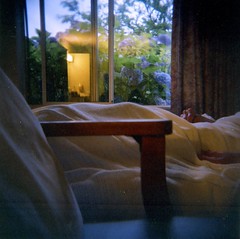
I was startled by the hydrangea bush that stood in the sunlight just beyond the glass: dried, brown, done. Close kin to the blue bush that bloomed bright outside my grandmother's window this last summer, while she made her last ascent.
Strawberries Marinated in Wine fraises au jus Scant 4 1/4 cups strawberries Superfine sugar to taste 1/2 bottle red wine, maraschino liqueur or Champagne, chilled
Prepare several hours in advance. Wash, drain and trim the strawberries and place in a bowl. Add sugar to taste and just cover the fruit with wine, maraschino liqueur or Champagne. Macerate in the refrigerator for several hours before serving.
Practice this thought now; turn it over in your mind; fabricate a muscle memory inside your imagination. Because when the day comes and you approach the bed of the dying your first impulse will be to say nothing. She may almost certainly say nothing to you. You may sit stiffly and look on politely before you look away. It may seem impolite to stare as her breath grows labored and her eyes grow wide.
If you have practiced this thought the compulsion might come to you easily, and gently you will take her hand. You will stroke her skin with its sheen like rice paper; you might fear that it will tear like tissue beneath your fingertips. If there's lotion close you might think to warm some in your hands and spread it on her thirsty skin.
Address her shoulders, her sternum. She may respond with a sigh of ease. She may not.
Rub her tired traveler's feet. They are dry and turned in on themselves and weary.
Practice this thought now, because the dying need to be touched like the newly born do. The dying need to know we're near.
It may be impossible to find a decent meal on Thanksgiving in America.
Or, at the very least, in Omaha, Nebraska.
Unless of course you've planned ahead. If you've shopped in the days before for the bird that you will stuff and truss and the cranberries that you will simmer until they pop and the Karo syrup that you will transform into the inexcusably sticky mess of a pecan pie that is the hallmark of a successful Thanksgiving -- if you've done all this then you will eat.
But if you descend out of the long dark drive from Chicago upon family tired and worn from a month of hospital attendance and the tired resignation that the patient has decided she is done, then you will find refrigerators empty and grocery stores closed and everyone too busy with the business of keeping her company on the long road home too worry too much about the rest of it.
Last night I missed the Moth StorySLAM by a whisker. Through a series of misfires my companion and I got on the long rainy road into the city too late, and the show had sold out by the time we arrived. Every month Moth hosts a StorySLAM in Chicago, where you throw your name into a hat and, if it’s selected, you have five minutes to tell your story. I’ll try again next month. The theme will be different so the story will be fresh. This time around it was “Blunders.”
This was the story I carried rain-soaked into the city.
My ex- likes the tell the story of the time he spent in Kenya as a kid, when his father was on a meteorological mission, seeding clouds to turn hail into rain. And he likes to tell about how, when he returned with his family to Clarksville, Tennessee, he would entertain the kids in the playground with stories of the zebras and the lions and the giraffes; with stories of the bush babies whose many eyes blinked and glowed in the headlights as the family returned in the dark to the tea plantation they rented while they were there.
He liked to tell the kids about the monkeys that lived in his backyard.
All this led to a Parent-Teacher conference in which his teacher pointed out to his mother that, while B was bright boy, he had an overactive imagination, and he was he was in the habit of telling lies. For example: he liked to tell the students that he had monkeys in his backyard.
To which his mother replied: “We’ve just returned from Kenya. We had monkeys in our backyard.”
I loved this story; I loved how the man I loved was unjustly accused and exonerated in the end. I loved it until I learned that I had married a liar, and a wondered then if it was a plant, a decoy, designed to distract me from all the stories that were untrue.
When we finally arrived at that awkward middle place between deciding to divorce and signing the decree, we had dinner one night at one of our favorite places, a cheap sushi joint on Broadway in Seattle. Over dinner he told me he was sorry; over dinner he told me everything would change; over dinner I told him I didn’t believe him. Then I asked for the check.
They brought us a couple of fortune cookies with the bill and B cracked his open. He laughed a little and handed it to me with a tear in his eye. It read: “A liar is never believed, even when he tells the truth.”
But this story isn’t about that blunder. This story is about when his family was still in Kenya, and his mother wanted to ask the academic wives over for tea. She asked the gentleman servant, a man named Jealous whose services came with the house they had rented for the season, to help her prepare a place for tea by clearing a small overgrown area near the house, under an ancient spreading shade tree; a tree that had been planted by some British colonial who knows when, or maybe had been left to stand when the other trees were cut down around it. A tree that offered shade from the hot African sun. A perfect place for tea.
“Clear it?” he asked, concern in his voice.
“Yes,” she said.
She left him to his task, which he approached reluctantly. She returned later to find he had cleared the grasses away, and then he sharpened his axe. He took his axe to the trunk of that ancient spreading shade tree.