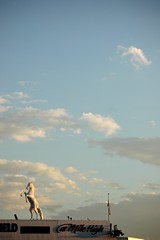
I'm not a big sports fan, but I am a big sister, and I'm a huge fan of my little brother who gigs for the Broncos now that he's all grown up (the man has three almost four kids already -- guess that counts as all grown up).
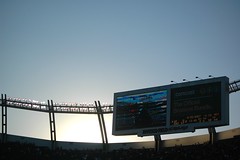
Flew into Denver yesterday AM, hung out with the family, and then headed over to the stadium to see Game 1 of the Bronco pre-season -- ostensibly. But mostly really to see my brother do his thing as the producer of the video content that runs on the ThunderVision board for the duration of the game.
And then tour the control room and the press box and his offices afterwards, and hear silly stadium trivia like: they used to have to climb right up to the giant monitor to flip the switch that lowered the protective metal guard, but then they had stadium engineering rig a run-of-the-mill garage door opener to handle the task -- so now after the game they just pull out the garage door remote and lower the guard on the multi-million dollar video panel from inside the control room.
And there's also the mouth guard -- if you've been to the new Invesco Field in Denver you know that sculptures of football gear writ large litter the promenade up to the main entrance -- but maybe you didn't know that the gigantic mouth guard is the actual impression of Terrell Davis's teeth.
All fun. But the best part was heading back to the homestead, sleeping late this morning and waking up to a pancake breakfast prepared with careful attention by my young nieces, swapping stories and laughing with my family.
Home again.
Posting by cameraphone. A week worth of roadtripping through Colorado and New Mexico ahead. (Posting will probably be sporadic -- so far my uploads aren't behaving.)
we were at at high mass on a summer Sunday in Prague sitting below a large bishop in a swingy skirt bottomed off with gold booties thinking his moves had a sort of stripper quality to them
Found in Justine Hardy's "Guilt in the Golden City" in the 25 August issue of The Financial Times.
Traveler's tip: when traveling to Watsonville for a business meeting with the expectation that you'll hook up with friends for dinner in the capitol of chill, Santa Cruz, CA, for the love of god toss a pair of levi's in your bag, or you'll feel like a freak of nature walking the boardwalk all suited up.
Shot in Santa Cruz, CA Posting by cameraphone sometime after that.
I took this shot during an intensely lonely moment as I clambered around the tiny island of Agathonissi in the Dodecanese many years ago. (God that sounds rich and privileged, doesn't it? For what it's worth I was sailing on the cheap, in a trade for work.)
I was reminded of it recently while exchanging notes on goats and their cheese with a Flickr friend, but here's why I'm posting it: When I took it, with this grandmother's kind permission, the plastic bag bothered me; broke the pastoral perfection that I was hoping for. Now it's my favorite part of the image. Nearly a punctum. Not quite, but gives me hope that I'll get there some day.
And just down the hill on that tiny little island in the very moment this image was taken were two strangers who, within hours, I would share glances of recognition, and then over a week we would decide that yes, we'll know each other for a while, and now going on years I gratefully count them as friends I would never want to live with out.
Life's funny like that: Matters of great importance waiting for you just a little way down the hill.
And if you're into wondering about how situational context teases the mind in magical ways, Who’s Minding the Mind? from a few weeks back (same paper) makes for a great contrapuntal read.
Flickrite ReyGuy has posted some intriguing digital pinhole shots in his photostream. Always a generous teacher, he was kind enough to respond to my inquiry with a how-to -- I'm posting it here with his permission:
I sent this to two other inquiring souls. It may talk down to your experience level since I was unsure of theirs. I shot more this morning on the way to golf just as the sun was coming up. Quite a trick while doing the driving too. At least you don't look through the viewfinder. It's a real point-and-shoot technique.
Take a body cap (you better have one), drill a small hole in the center of it. Use a needle to prick a very small hole in a 3/4 or so inch square piece of semi-heavy paper (construction paper?). Tape this with the pin prick in the center of the hole you drilled on to the cap. That'll do it. Now you have a hole with a much smaller hole over it. You can not drill a small enough hole and you can not pin prick through a plastic body cover.
Then just experiment with the shutter speeds and ISO settings to get what you want from the effect. You have no aperture with a pinhole. It is what it is and it's maybe f/200 or smaller?? Ever heard of an aperture like that? All you can do is semi-long exposures. Nothing much faster than 1/15. You use the ISO settings to control the blur. At ISO 100 you must shoot at say, 1 second whereas at an ISO 800 it's 1/8. Also at higher ISO settings the pictures are more grainy.
Sounds complicated but it's not. I'm assuming you're using a good camera with manual control. If you're using a fully automatic amateur camera you're probably out of luck as it will simply not respond to only a lens cap being on the camera. Manual control is a must.
I’m thinking now of the plums Italian prunes As I do each time I tongue one Tease out the moment Before my teeth break The flesh Do now, a bowl before me
How you climbed On the broad back Of the rusted bus
To reach The top branches Pulled them out of the sunshine Into the shade of the house
Your whole body a wag Like a mutt ready to play
How our teeth tore Through the tart skin Wet from a quick tap bath Into the sweet flesh Irrevocable We devoured each Complete Its own counterpart
To Whom it May Concern, Suttonhoo has informed me that Pepsi has decided to change the Mountain Dew bottle design temporarily to an aluminum bottle. She was afraid that it might disrupt the entire Joe Henry Engineering Test Program (and lord knows that program is far enough behind already).
And indeed she was right to be concerned.
Fortunately the shape of the Mountain Dew container was critical only in those experiments using cans. But there is a deeper underlying danger. The Mountain Dew advertising remains unclear about the disposition of Diet Mountain Dew. If they redesign those containers as well, you could accidentally procure a Diet Mountain Dew instead of Mountain Dew.
There are probably people who think I'm a paid agent of Pepsi, bribed to sway the powerful Engineering market sector into buying Mountain Dew. But no, I do this out of a sense of civic duty. And it is this same sense of duty that drives me to say this: Diet Mountain Dew is a both vile and noxious substance. And it is potentially dangerous. I'm a guy who tries to suppress his conspiracy theories because there have been a few too many conspiracy theories in my family. But I'm going to run with this one for a second.
Aspartame was approved by the FDA after a very shaky bunch of tests involving contaminated control groups. The test mice showed the same number of brain tumors as the control group mice. But the number of brain tumors were above average for both groups. It turns out the control group food was contaminated..... with Aspartame.
Two years after Aspartame was released to market, the brain tumor rates in the US started climbing. This is correlation to be sure, not causation. Guess who was in charge of the company that made aspartame at that point? Donald Rumsfeld, Chief Machiavellian of our generation.
So we can't have our young potential engineers sucking down Aspartame for ten years before they even get to college.
The message here is to carefully check your label on that lustrous Mountain Dew bottle. Make sure your Mountain Dew is full of sugar (brain food) NOT Aspartame (brain killer).
As an added side note about Mountain Dew and the brain, some recent studies suggest that caffeine improves memory, especially in women.
Good catch Suttonhoo. Only your keen marketing mind [1] could detect this brand of subtle danger.
[1] Ed. You know I love you friend, otherwise I’d give you grief for calling mine a “marketing mind”. Blech. ;)
[She] taught him to spot an orphan in a crowded room
to recognize in [the] eyes
the bottomless loneliness no parented person can know
Found in Arthur Miller's Missing Act in the September 2007 Vanity Fair. A heartbreaking account of how the playwright Arthur Miller institutionalized his son Daniel, who had Down syndrome, from birth. "She" is Miller's ex-wife, Marilyn Monroe, who was herself raised in foster care.
From an MRI I had taken a loooooooooooong time ago when they were looking for something that, fortunately, I didn't have. Everything turned up fine on the scans, so I called the lab and asked if I could have the film of my brain.
The guy on the other end of the line paused. No one's ever asked for that before. And then: Yeah. Sure. I guess.
'Cause why wouldn't you want an xray of your own brain if you knew that one existed?
Just now starting to mess around with it. More images might come of this. Or not.
It's amazing how consistent people are in their politeness and empathy.
Netflix exec Michael Osier, speaking of folks from Portland, Oregon. Netflix just ramped up their call center operation just outside the city. They chose Portland over a long list of candidate cities because the people are well, just so nice. As reported in this morning's New York Times.
My little niece K has always been a buddha girl. So self-possessed, calm, the oldest of three (soon to be four) kids, she looks out for the little ones -- lifting them down from ledges, sharing her meatball, making sure their drinks don't spill.
Always thinking about something, still and silent, searching the outward and internal horizons, then suddenly she'll launch into a story, and beam golden like the sun.
One of my dearest memories is when she was so small she was walking but not talking and I visited her and her folks (her daddy's my brother) bringing with me The Maestro Plays, a wonderful book by Bill Martin Jr. and Vladimir Radunsky.
She picked it up and brought it over to me, sitting next to me. We started to read. A few pages in she crawled into my lap, folding her legs and nestling in, turning the pages as we moved through the story. Two thirds of the way in, when the book got really good, she turned her whole face up at me, craning her neck straight back, watching me read and intonate the wonderful language that Martin and Radunsky use to tell Maestro's story.
I looked down in her eyes and kept on going. She stayed that way for what seemed like a really long time. Still, silent, joyful, curious.
Much later her mother told me an imaginary friend had appeared on the scene, and K named him Maestro.
So wonderful to watch her grow big and beautiful and searching. So glad to count her as family.
At the Trinity test site, as soon as he saw the blast, Fermi started ripping up little pieces of paper. At the very moment the shockwave from the blast arrived, it blew Fermi's paper scraps away. Fermi then took out a slide rule and said, "Ah, 12,000 tons of TNT." From the papers and position, he could calculate the explosive power of this new weapon.
Physicist Gino Segre, relating a story he heard from his Nobel Prize winning uncle Emilio Segre, about working with Fermi on the atomic bomb at Los Alamos, in an interview in today's New York Times.
When I tell folks I did some of my growing up in Sonoma -- a handful of years just before and after I turned five and a steady scattering of summers through junior high and high school -- they say "oooohhhh – Sonoma!" and it's that instant recognition that makes me suspect strongly that they're thinking wine country and tony tasting rooms and gourmet cheeses.
PR machine Sonoma.
Not my Sonoma.
My Sonoma is a hard working rural dusty pick up truck kind of place. Not that anyone in our family owned a pick up -- we were (and still largely are) VW people with a few leftover limos from the funeral home. But the neighbors did, including Shari's daddy who lived next door and delivered Shasta soda all over the Valley in his.
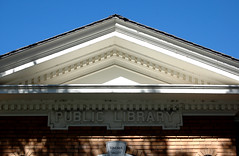
My Sonoma is my very first library -- the old Carnegie that's been converted to the visitor's center since -- on the central plaza just a block from our old home. My Sonoma is sleepy enough (or my hippie mother was just that unaware enough) that I walked the block alone when I was somewhere between 4 and 5 years old and tried to check out a stack of books of my own -- only to be told I needed to get myself a library card to get that done. Or bring a grownup with me next time.
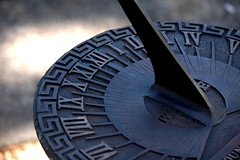
My Sonoma is the sundial in the little rosette of a rose garden next to the library with the strange roman numerals that amazed me every time the sun was shining and I happened by because someone told me you could tell time with that thing. Of course, I couldn't. Didn't mean I was any less amazed.
It's the Sebastiani movie theatre with its classic marquee across the street, which thank god is still open and running; and it's the thick crusty loaves of sourdough that they made in the bakery next door (which, regrettably, is no longer there) that we ate with cheese and salami until it grew stale and my mom sliced it up for French toast on Sundays.
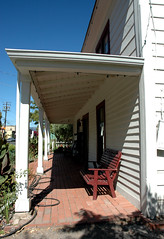
My Sonoma is the little house on East Napa with the porch flush to the foundation and the white picket fence with the gate ripe for standing on and swinging in endless repetitions whenever grown ups weren't around.
It was during one of those steady silent swinging meditations that I sorted out in my four year old mind that there were three kinds of humans: men, women, and babies. I racked and racked my brain expecting to find more, expecting people to be as varied as bird species. Looking back I can't figure out whether I was cloistered in a white world and wasn't exposed to other plumage, or if this was me at that age figuring out the sexual creature -- men and women being the mature and sexual, babies being the immature and asexual.
My money's on the sexual creature, because the house we lived in was ripe with sex, even though I wouldn't know it if I saw it, but you could feel it everywhere. Two other hippie couples lived there with my mother and the three of us kids. We were downstairs; they were in the upstairs rooms and the attached mother-in-law apartment out back. The memory of that house is what I insert whenever I come across a reference to "free love": soft and languid and a little bit lonely.
During that time my mother was exercising her 1970s post-divorce freedom with some, but maybe not enough, discretion. My memory of her pink birth control pill compact (with the bas-relief cameo) is crystalline, as is the conversation we had about it. My kindergarten self: What are these for? Her dewy soft still so beautiful self: Women take them so they won't have babies, which made me think too, for too long, that babies appeared like blisters unbidden, or aliens erupting, and had to be staved off like a fever is with baby aspirin.
My Sonoma is Shari's house, the old quasi-Victorian next door, with the garden out back where a nameless grown up (her mother, maybe?) coaxed me (I didn't want to do it) into eating a dusty cherry tomato warmed by the sun right off the vine and it exploded hot in my cheeks, sweet and unexpected, leaving me smiling and surprised. The same garden where we took turns behind her daddy on his motorbike racing the length of the lawn, and I scorched my naked calf against the hot pipe so that it turned red and blistered. Where her daddy dressed the injury and his strong tender hands made me ache for my daddy, who was far enough away to be a fiction to my friends.
Shari's house is a boutique now called être -- "to be." And our little clapboard house is a dance and art academy. The white picket fence is gone. I know because I walked past it this morning, a pit stop on my way to SFO, after burying my grandfather in Napa, after receiving hugs so tight and long and good from my nieces and nephews (ages almost 5 through 10) they left me with a weepy spot square between my breasts.
I wanted to walk through my Sonoma with a camera, giant woman that I am so many years since and so many more feet tall than I was then, and try to take pictures of what I remember it being; of what I remember I was.
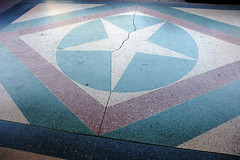
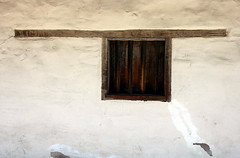
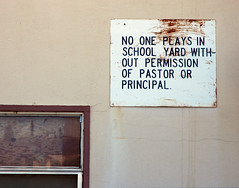
And so I shot the sundial and the library and snatches of the mission and the barracks. I shot St. Francis Solano where my mother went to school before she married my father there, and I shot the little clapboard house where we lived after their divorce. I shot the lawn behind the courthouse in the central plaza where I tried to turn a cartwheel at my 5th birthday party.
And I shot the Creamery, which isn't the Creamery anymore, but was for a long time before it wasn't. It was an ice cream parlor -- more like a cavern -- owned by the Italian parents of a man my mother dated who would later marry her sister (such is a small town), where I stepped into the cool room from the heat of the summer and crossed the cold tile floor (in my memory I'm barefoot, which as a hippie kid was not an impossibility, and I can feel the cold tiles under my toes), and where J scooped me my first coffee ice cream cone, marking the moment from which I would forever forsake chocolate as my favorite.
This morning I shot it all quickly, feeling hurried and unsatisfied because I knew snapshots wouldn't capture the rush of emotions I feel in that town; the feeling of being small and alive and curious and full of excitement in a world full of warmth and light and deliciousness.
I swung on my first big kid's swing in this park, my aunt pushing me high and dive bombing beneath me, thrilling me with my first taste of danger. Hungry for more I tried a big kid move on the merry-go-round (the contraption is gone now), running to push it with the other kids and slipping as I jumped on board. I can still remember the chaos of light and shadow as I was pulled beneath it, the hot metal spinning overhead. The fear.
My first artichoke happened here; my first avocado; the slices of salami with the peppercorns that burned my mouth until I learned to pop them out before I rolled the fatty slippery slice and chewed it down.
I stopped short of shooting the golden hills lined with grapevines that roll around the valley because my wide angle lens isn't wide enough to capture their embrace, and it's the one that I want to really get right. Want to capture the way they warm you and hold you during the day. Want so much to capture the way they seem small while at the same time expansive when the night comes and the fragrance of the eucalyptus reminds you that the sun was just here a short time before.
Want to, but know I won't nearly ever be able to recapture the night I was five and felt wholly alive, hustled into a VW bug with crazy happy high school kids (my aunts and an uncle, all of them high on acid, I'd learn a lot of years later) and we chased down the harvest moon that hung heavy and ripe in the sky, so big and close you could touch it.
Chased it through the hills down the old highway, bouncing over railroad tracks where we held our hands to the roof to keep it up (a crazy tradition that I maintain today), laughing, speeding, never quite reaching, the moon warm to bursting, that moon that gives this valley its name.
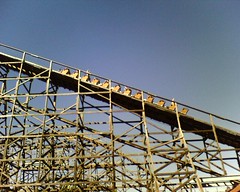
Been away riding roller coasters and burying family, which in some surprising ways are quite alike -- like the way they both make you grateful to be alive and grateful for all the good folks who are alive along with you.
Cameraphone shot of the rickety wooden Roar at Six Flags in Vallejo, CA.
When I was a kid we had a book of Aesop's fables "retold" for modern times. Which meant they lost all the fragrance of the Greece they were born in[1] and came out feeling like something that happened on the Upper East Side.
Yesterday, as I was spinning once again on my crossroad of options as I near the middle-distance of my life (this is mostly what I do these days), one of the fables startled awake in a far corner of my brain.
It involved a little boy with his hand in a jar of filberts. I had no idea what a filbert was when I was a kid and I never bothered to look it up like my dad encouraged me to, and in all honesty I don't think I could tell you today what a filbert is. (A nut maybe?)
The story played out something like this: the little boy wanted some filberts. He REALLY liked filberts, so he grabbed just as many as his hand could hold.
One problem: the neck of the jar was too tight, and he couldn't get his hand free, so he couldn't get those goddamn filberts out.
He fussed and fumed for awhile, generally feeling sorry for himself, until some wiser person who was a bit more in control of her passions happened by, witnessed the scene, and offered him some advice: "Take fewer filberts, you knucklehead."
He let about half of his filberts go, his hand came free, and he was at last able to enjoy his filberts. Whatever the hell a filbert is.
I hated that story when I was a kid -- I mourned for those lost filberts.
It took me just this long to finally figure out what was going on.
[1] Thank god for Bulfinch, which gave me a richer sense of how the sun-baked thyme on the hillsides carries through the air in Greece and made me want to go there. Or maybe it was Henry Miller. Different sun-baked scent.
(Queuing this up somewhere over the Rockies on Flight 451 inbound to SFO, so you'll have to forgive me for not looking up filberts -- wireless is off.)
Kids don't just ask for food from McDonald's. They actually believe that the chicken nugget they think is from McDonald's tastes better than an identical, unbranded nugget.
(...)
We found that kids with more TVs in their homes and those who eat at McDonald's more frequently were even more likely to prefer the food in the McDonald's wrapper.
Thomas Robinson, director of the Center for Healthy Weight at Lucile Packard Children's Hospital, commenting in today's AdAge (McNuggets Are Good, but Branded McNuggets Are Even Better) on a study conducted in concert with Stanford University School of Medicine involving 63 Northern California children that showed that:
Kids aged 3 to 5, when presented with identical foods -- one in a McDonald's wrapper and the other without -- overwhelmingly rated the branded one as tasting better.
Anyone looking for a portent might have noticed a ship leaving Petrograd that September
Carrying into exile writers intellectuals scholars whose ideas the regime found objectionable
The names involved are unfamiliar
The idealist philosopher Nikolai Berdyaev The literary critic Yuli Aikhenvald The religious thinker Semyon Frank The sociologist Pitirim Sorokin The medieval historian Lev Karsavin
The secret police officers monitoring the launch raised their hats in salute as it left the harbor shouting We are all Russians. Why is this happening?
In an interview Trotsky carefully explained the expulsions were an act of mercy
This funky vinyl bag (available at Unica) makes me giddy happy. Not enough to buy: I don't do vinyl. But I did once.
I was four and we lived in New York. My dad worked on the Avenue of the Americas at Elektra Records and I can still remember going to meet him for something or other -- I remember the sidewalks -- they were so big and full of cracks and I had the awesome responsibility of not breaking my mother's back -- but I don't remember the blind man selling pencils who I toddled up to, my Dad tells me, and who smiled when I did.
My first NY con man.
What I do remember is this bag: it was my very first handbag. Mine was PanAm blue and it came with a pair of pilot's wings. I don't know if my dad brought it home from a business trip, or my Grama brought it with her when she flew cross-country from Seattle to see my little brother G when he was born (and who was a source of great disappointment to me when my parents refused to name him Cindy as I requested).
But I knew it was an airlines bag, and I knew that airlines had something to do with far away and brand new everything, and I knew I wanted a piece of that. Even then.
Packing tonight, for the day after tomorrow. Pleasure this time (mostly). Nice change.
Clearly Dr. Bronner was crazy in that wonderful way that only America makes possible. An endearing elder uncle, shilling product and philosophy with the best billboard available to him -- the label of his soap bottle -- squeezing every little ounce out of that sacred marketing real estate with statements like these:
1st: If I'm not for me, who am I? Nobody! 2nd: yes, if I'm only for me, what am I? Nothing! 3rd: If not now, when? Once more: Unless constructive-selfish I work hard, like Mark Spitz, perfecting first me, absolute nothing can help perfect me!! 4th...
Yes, there's more. Getcher self a bottle to read it all. Or just check out the label blow up here »
You may notice a not altogether faint resemblance to the cover of John Hodgman's book, Areas of My Expertise »
We used Dr. Bronner's soap when I was growing up as a hippie kid, and I got turned on to it again when we stayed at the uber-hip Hotel San Jose in Austin this last spring, and the bath was stocked with it. I've been back on the bottle ever since and, truthfully, it does the job right.
But if you take up the cause you'll want to be sure not to tote it with you when you're driving your girlfriend to an AA meeting in Orange County wearing a furry Russian hat -- as Dan Bolles of the Germs found out the hard way »
Laid up with a killer belly ache today (I suspect it was the pasta fagioli) and even though I'm loading up my brain with all kinds of goodies (newpapers, magazines, books, blogs) it's gone on strike.
Sandra Blakesless's piece from way back when is my only excuse -- apparently, people really do think with their gut »
beautiful women learn not to speak of it the way the climate changes when they enter the room
the way men square their shoulders like mountains favored by the sun and rivals glower grey like lower slopes threatened by rain
beautiful women learn not to speak of it the breeze they stir as doors open eyes lift
beautiful women learn not to speak of it not of this and then
not of the moment (time's motion incorruptible) when she enters and leaves the room unchanged
Written on the occasion of my beautiful Grama's 88th birthday. The image is a (very poor) cameraphone shot of a pastel portrait that my grandfather made of my grandmother when they were dating.
Heading home this afternoon from Evanston, after a wonderful conversation with a friend, my mind strayed randomly to something I read once about Chagall's Self-portrait with Seven Fingers. It was this:
The mysterious extra fingers on his left hand can be explained by a Yiddish saying, whereby to do things with seven fingers means doing something really well and with all one's heart. [1]
Not so random, I guess, because the conversation of the morning was about exactly that: deciding to do a thing and then pouring your whole heart into it. Owning it. Giving it your full talent.
Because to do less it to set yourself up for later regret.
And then tonight, a Flickrite commented randomly on a photo that I posted a couple years back (July of 2005 -- it's rare that photos that deep in the stream receive attention) with a question about provenance. I pulled up the image to answer his question, and realized that here, in the impression of hands left by a Mayan artist around about 1000 B.C.E. -- were seven fingers.
Who knows if the artist intended the seven fingered impression, or if his hand just slipped. But for me, this night -- with Jung as my witness -- I took it to heart as a telling punctuation mark.
For weeks now, you and I have been eating tomatoes as if the harvest’s bounty will never cease. My breasts, too, are tomato-heavy, the bowl of my belly dense with the curve that will only continue to deepen in the months ahead. Lingering in bed this morning, I lay my hands along the rise, palms and fingertips listening for our daughter. Quickening, the doctor called it, the desire for the coming child. Imagine: next August, we will carry our daughter into the garden. We will hold the fruit to her face; we will teach her tomatoes.
The second half of Jacqueline Kolosov’s lovely poem Quickening, from the July | August 2007 issue of Orion
The 'hoo kids have been all over the media lately -- why, just a few weeks ago my sister made the Washington Post, pontificating on gazpacho (that's her nicely turned out thigh behind her son's head).
Moving is one of those things, like showing up, that you do for friends. I’ve run out of fingers to count the times I’ve moved my own life from one point to another, and I’m nearly through the toes, which means I’ve learned from experience that moving is always better with a crowd.
Which is why when friends ask, I’m there. (Although I hesitate a little to broadcast this fact to the blogosphere. ;)
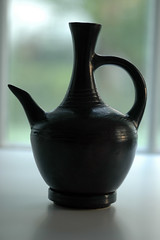
Moving karma always comes back around, and sometimes it comes back in curious ways. One of the curious objects that I love in my life is a coffeepot that came to me in a move.
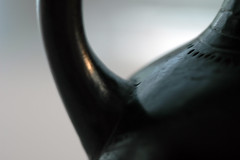
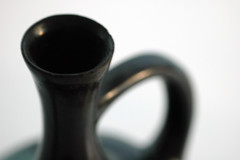
It’s old school, from Ethiopia[1], with a rounded bottom so it can’t stand on its own – I set it in a little dish designed for mixing soy sauce with wasabi for sushi, and it sits, balanced just so, on the top of my Bompa’s bookshelves.
It was given to me by a dear friend whom I helped move once upon a time, who dug it out of a box that we were just about to seal up and said: “Here – you like these kinds of things – would you like to have it?” M is from Ethiopia, and she explained to me that she used it to make coffee – first they’d roast the beans, over the fire, and then they’d grind and boil them, by setting the pot in the coals.
“But won’t you need it?” I asked her, and she laughed. She’d been in the U.S. for several years at this point and she shook her head. “Not at all,” she said, “we use Mr. Coffee!”
So of course I said yes, please. And thank you.
[1] Lest we forget, coffee was discovered in Ethiopia by, legend tells it, a goat herder named Kaldi – which makes a coffeepot from Ethiopia just about as old school as you can get.
“They’re called nurdles. They’re the raw materials of plastic production. They melt these down to make all kinds of things.” He walks a little farther, then scoops up another handful. It contains more of the same plastic bits: pale blue ones, greens, reds, and tans. Each handful, he calculates, is about 20 percent plastic, and each holds at least thirty pellets.
“You find these things on virtually every beach these days. Obviously they are from some factory.”
However, there is no plastic manufacturing anywhere nearby. The pellets have ridden some current over a great distance until they were deposited here—collected and sized by the wind and tide.
Don't bother reading the Orion piece unless you're ready to be shocked and horrified into ageographical[1] conformance with San Francisco's ban on plastic bags, possibly even feeling compelled to pick up a pair of needles and follow Aija's Everlasting Bagstopper example, because that guy in The Graduate wasn't kidding -- there's a great future in plastics -- because they never die.
To quote the man: Think about it. Will you think about it?