Wednesday, July 19, 2006

lake effect


Here’s a fun trick: The next time you find yourself in a small-ish gathering of Chicagoans or long time Chicagoland-residents, ask them where the Lake is.

Then, like needles on a compass, watch them spin and point in an Easterly direction – with unerring accuracy and a beautiful, almost eerie, synchronicity – all the while looking at you with that strange mixture of pity and disgust that Midwesterners reserve for people without any common sense.

I’m probably the only one in the room who finds this fascinating, but it never fails to amuse and amaze me. It could be because, growing up for a good while in Denver, my polestar was to the West – and it’s hard to miss the Rocky Mountains.

But this is Lake Michigan we’re talking about – it’s FLAT. You can’t see it from anywhere except the lakeshore. And being able to pick it out of the grid – regardless of where you are in the Chicagoland area – is the hallmark of true residency.

I’m not there yet. I still haven’t experienced that polar shift.

If it does happen I suspect it’ll come on suddenly, the same way the tectonic plates shifted on the Eisenhower when that minivan crashed into my lane without signaling or allowing decent clearance.

Without thinking I did the thing that no one in my family (we're not from these parts) would believe or understand: I leaned long and hard on the horn and issued a steady and violent stream of obscenities that generously and sufficiently described the driving and mating habits of the thoughtless wonder behind the wheel – all the while looking at her with that same strange mixture of pity and disgust.

Just like a Chicagoan.

flickr is not a truck.

I’m not going to write about how Flickr was down tonight. Because everybody else did. (That's just an excerpt below -- here's a better sample.)


Daily traffic rank trend graph courtesy of Alexa.org »

dawes tomb


Passed by Charles Gates Dawes' tomb on Saturday's pitstop at Rosehill Cemetery during the Egyptian Revival Tour (oh you REALLY don't want to hear about ALL the egyptian revival mausoleums we looked at in that unbearable heat -- do you?). A history fan had dropped by -- probably over the 4th of July holiday -- and festooned the doors with flags.

Led me to research what he was all about -- Vice President under Coolidge he picked up the Nobel Peace Prize in 1925 for his work on the Dawes Plan -- an effort to ease the pain of German reparations. Apparently it didn't pan out so well, as WWII would soon prove.

Of course I took a wrong turn while researching and dusted off the Dawes Act. Kinda wish I hadn't. Seems whenever we get around to imposing our American Way we manage to bung it up somehow.

Here's an excerpt from Wikipedia (in dispute of course -- because it's an unpleasant notion) about the Act put forward by another Dawes, this one a senator from Mass:
The Act had one of the most substantial impacts on Natives, most significantly affecting Native gender roles. This Act broke up the reservation lands into privately owned parcels of property. In this way, the legislators hoped to complete the assimilation process by deteriorating the communal life-style of the Native societies and impose values of strengthening the nuclear family and values of economic dependency strictly within this small household.

Legislators' opinions of communal living saw the extended family as “needy” since the Indigenous ideas of wealth contrasted and disagreed with Western ideas of wealth (Stremlau 277). Indigenous people valued generosity and received status by being generous. Western values form around individual wealth and surplus and status is gained from these same values.

***

The Act forced Native people onto small tracts of land distant from their kin relations. Traditionally, in most Indigenous societies, women were the agriculturists while the men were the hunters and warriors. The Allotment policy depleted the land base, ending hunting as a means of subsistence. According to Victorian ideals, the men were forced into the fields to take on the woman's role and the women were domesticated.

This Act imposed a patrilineal nuclear household onto many traditional matrilineal Native societies. Native gender roles and relations quickly changed with this policy since communal living shaped the social order of Native communities. Women were no longer the caretakers of the land and they were no longer valued in the public political sphere. Even in the home, the Native woman was dependent on her husband.

Before Allotment, women divorced easily and had important political and social status for they were usually the center of their kin network (Olund 157). With this Act, women were deprived title to land and the distribution of allotments proves this point. To receive the full 160 acres, women had to be married and even then, her husband received title to the land.

Here's a link to the whole act, if you're curious »

Tuesday, July 18, 2006

torch it

Some girls dream of their wedding dress. I dream of the dress I'll be wearing the night I climb on top of a grand piano in some smokey jazz club and start belting out standards and torch songs.

You think I’m kidding. I have my list:

Night & Day
Summertime
Blue Skies
A kiss to build a dream on
They can’t take that away from me
I won’t dance (you can’t make me)
Sinnerman

That’s the warm up.

Which is of course why I cajoled litwit into a Monday night out to see a girl singer that neither one of us had ever even heard before – except one of us, briefly, in a Henry Jaglom film a long, long, time ago.

But the Algonquin, where Andrea Marcovicci performs a generous share of her winter months, lends her some serious cabaret cred, so I figured we couldn’t miss.

Well. We did. Sorta.

I suppose she pulled it out in the end, and left us with some really charming moments, but as litwit writes up beautifully, she stumbled considerably in the beginning -- with some funky phrasing, curious high notes mixed in with a whole lot of Rex Harrison-talkie-like thingys -- and an all around general lack of dame-ness – the one quality that a girl singer has gots to have if she’s gonna make it happen.

It was the kind of show my grandmother would have loved – sentimental songs from the 30s and 40s – although I suspect she would have said, under her breath (or at least thinking it was -- the poor dear is awfully deaf) as we exited the theater: “it was lovely to hear the old songs: but we didn’t exactly sing them like that.”

(Much the same way she whispered, overloud, as we exited the Troldhaugen Concert Hall in Oslo after a round of – well, of course -- Grieg choral pieces: “that was a lovely. But did they have to sing all those beautiful songs in Russian?” An understandable grievance. She’d waited a long time and came a great distance to hear some Norwegian in Norway. And I suspect she was still holding a grudge against the Russians for the Cold War, the same way she’s still holding a grudge against the Swedes for the way they let the Germans just march right through during WWII. But all good Norwegians do.)

But I shouldn't be so hard Marcovocci -- there were some genuine lovely bits in the evening -- she's a marvellous storyteller and had moved through the awkwardness by just about the halfway point -- and I did come away with one more song for my list that is almost as remarkable for its provenance as it is for its smoldering wonderfulness – Kurt Weil and Ogden Nash? Collaborators? For Marlene Dietrich? Who knew?
Speak Low
Speak low when you speak, love
Our summer day withers away too soon, too soon
Speak low when you speak, love
Our moment is swift, like ships adrift, we're swept apart, too soon
Speak low, darling, speak low
Love is a spark, lost in the dark too soon, too soon
I feel wherever I go that tomorrow is near, tomorrow is here and always too soon
Time is so old and love so brief
Love is pure gold and time a thief
We're late, darling, we're late
The curtain descends, ev'rything ends too soon, too soon
I wait, darling, I wait
Will you speak low to me, speak love to me and soon
So there's that.

And there's the dress.

Monday, July 17, 2006

monadnockhamen


Monadnock
Originally uploaded by suttonhoo.
Here's something that maybe you didn't know about the Monadnock Building, Burnham and Root's gorgeous 16-story brick skyscraper in Chicago's downtown Loop -- considered by most CAF docents to be the first skyscraper. Ever. Which meant it was also the tallest -- if only just for a brief while after it was erected between 1889 and 1891.

The spare lines of the Monadnock -- which rise off of 6 foot thick masonry walls which flare at the base and are frequently praised as a harbinger of Modernism -- almost weren't. (Spare, I mean.)

Burnham dolled up the original architectural plans with crazy Egyptian Revivial ornamentation. Then he went on vacation. And while he was away Root stripped the papyrus inspired cornice off the top of the building, and all the frills that came along with it.

My source: Michael Berger, Egyptologist and knowledgable guide on this weekend's tour of Egyptian Revival architecture in Chicago. (I know, I know: I keep doing this Tut thing to myself. Somebody stop me. Please.)

Rumor has it that Burnham was pretty pissed when he got back. But he eventually cooled off. And the Monadnock pretty much impressed the pants off everyone who cared about these things, and continues to do so today.

And you've gotta admit it's the most huggable skyscraper you've ever seen. (You're laughing -- but have you ever stepped right up to it? You'll wannna hug it. I promise.)


too darn hot

These are the days of talc and lemonade.

As forecast by Gaper's Block:

THE HEAT IS ON
High: 92F, Low: 71F

They forgot to mention the 90% humidity.

oy vey.

(hey cool [she says, having browsed to gaper's block to pick up the weather report] -- one of my pics made Rearview. woo hoo!)

carnie ride

hang it up

I have an unnatural fear of clothes hangers in a state of repose (goes back to an unhappy incident when I was a kid and hooked my foot on a hanger that was lying on the floor when I was pulling off a pair of jeans -- I pulled the hook end of the hanger up my leg and cut a deep and narrow and painful gash).

But I thought these were strangely beautiful.

Shot at the Oriental Institute -- a brilliant little museum on the University of Chicago campus. They call themselves the "best kept secret in Chicago". I suspect if they would just change their name (it's so pre-Said) they would get more traffic.

But then you'd lose all that great history...

Sunday, July 16, 2006

how do you solve a problem like kohlrabi?


I got lucky with my hubby: We share many of the same inclinations when it comes to architecture, archaeology, theology, politics, and how to make the best use of nap time.

But we don’t eat eye-to-eye.

I was raised a hippie and love the whole foods; he was raised Nebraskan and loves his meat and potatoes.

Friends who knew something about the way I used to cook before I moved to the Midwest (lamb tagine with meyer lemons and kalamatas; fresh oysters served with horseradish and Tabasco alongside home-seasoned sausage patties and a crisp green salad [try it: you’ll be amazed]; roasted tomatoes stuffed with basil, garlic, bread crumbs and anchovies and served over cold rice; odd concoctions with swiss chard; anything with arugula) would be surprised to see the compromises I arrive at now in an effort to keep everyone happy: Meals like free-range turkey brats with fresh-off-the-cob creamed corn (yep: I’m not making this up), and anything that incorporates the holy veggie trinity of Midwestern cuisine: corn, potatoes and beans. (Salade Niçoise accommodates the combo pretty well.)

Enter the Green Earth Institute. We signed up this year for a CSA subscription – that means that we pay a flat fee at the beginning of the summer and every couple of weeks we pick up a big bushel of veggies.

The selection of which we have no say in whatsoever.

But they’re always fresh and just this side of amazing.

I love the surprise part of the equation. But it introduces some challenges – because not once yet this summer have corn or beans been in the mix. Sugar peas so sweet you could eat ‘em like candy have been in the bag; but no beans.

And the last couple of weeks, kohlrabi has been waiting for us.

This veggie is entirely new to me. It’s not really a root vegetable – it grows above ground and looks like the lovechild of a cabbage and a turnip. And I don’t know about you, but I didn’t know WHAT the hell to do with it.

Googling recipes was fruitless. Lotta sautéed in butter or mustard recipes that would make more sense in wintertime. My favorite online standbys – the Saveur and Epicurious recipe databases – came up mostly empty on the subject of kohlrabi (unless I felt like german-style stuffed kohlrabi. I didn't. Still don't.)

So I had to take matters into my own hands. Inspiration struck last week when I pulled out a recipe that had run the Sunday before in the NYT Magazine and had all the makings of Midwestern contentment: Clementine’s Tuna-Macaroni Salad. (The things a girl will do for love.) But when I got around to making it I realized I was missing celery and scallions – and the idea of a glutinous mass of mayo slathered macaroni with tuna and cheese and not a crispy, spicy bit in sight really got me down.

In kohlrabi lay my celery salvation. Diced up nice and tiny it's all crispy with just a little bit of heat. And for scallions: I substituted this funky curly flowery spur that’s trimmed off of garlic before it comes into its own. (Pic provided below for edification – but don’t even ask me to tell you what it’s called. It was in the CSA bag. That's all I know.)

Here’s the NYT’s recipe – I’ve struck out ingredients and penciled in my own where I made substitutions.

Clementine's Tuna-Macaroni Salad

  • Salt

  • 1/2 pound uncooked elbow macaroni penne pasta

  • 1/2 cup 1/4 -inch diced celery kohlrabi

  • 2 ounces sharp Cheddar, cut into 1/4 -inch cubes (I used coarsely shredded parmesan because I had some around)

  • 1/4 cup thinly sliced scallions funky garlic-y thing-y

  • 1/4 cup sliced cornichon rounds

  • 2 tablespoons mild Tennessee chow chow (optional) didn’t happen

  • 1 cup mayonnaise (happily got away with about half that much)

  • 2 6-ounce cans chunk light tuna in water, drained Freshly ground black pepper to taste


  • 1. Bring a large pot of salted water to a boil. Add the macaroni and cook. Drain and cool completely.

    2. In a large bowl, fold together the macaroni with the remaining ingredients.
    Season.

    Serves 6. Adapted from Clementine in Los Angeles.
    Note: Chow chow is available at http://ecommerce.lcs.net/stores/whites/

    Figured out another application for kohlrabi tonight, when I just didn’t feel like making anything interesting (90 degrees w/ 90% humidity always brings out the slug in me) so I pulled out some frozen buffalo patties and cooked up a couple of burgers: It makes a nice substitute for an onion slice. Kind of a funky, crunchy jicama and radish hybrid.

    light my fire


    Hand Shoot Fire
    Originally uploaded by Thomas Hawk.
    First b1-66er posted some amazing low-res shots this morning that were all mystery and fire and light. (You might need to scroll a bit once you hit his home page.)

    [update: b1-66er has posted a write up of the event -- definitely worth the read »]

    Then I got this email from a friend:

    Went to the Crucible's Fire Arts festival. It is an art school in Oakland that teaches art that is related to fire. Blacksmithing, goldsmithing, glassblowing, neon art, etc. Once a year they have a festival with fire arts performers. It was spectacular to say the least.

    A lot of Survival research labortories type robotic sculptures, devices that spewed fire, sometimes colored fire, sometimes inches, sometimes many feet into the air. They had a dance video machine set up where you competed with someone else, but they put you in a fireproof suit and they blasted you in the face with a flamethrower if you made a mistake.

    A couple guys had some fans set up. They were wearing fireproof suits and were armed with flamethrowers. They were making a fire tornado that at times would get to be 30 to 40 feet in the air. Very impressive.

    Then I hit Flickr, figuring if anyone else was there it would be Thomas Hawk. Well: almost. He got his last year, in 2005. Check out his chronicle of (last year's) event »

    Being there would have been better, but baby, sometimes the story's all you've got.

    [Photo credit: Thomas Hawk]

    apple, sisu & mangosteens

    “Sisu,” [a Finnish word] which denotes a grim determination to do what must be done, regardless of circumstances.

    Came across this word in a travel piece on Helsinki in the Sunday paper. I dipped into the article not because I’m interested in going to Helsinki, but because there was the promise of learning something about Finnish architecture, and indeed I did (more about that later), but I kept reading it because mid-way into the piece I came across a passage that made me wonder “who is this wonderful writer?” and, looking at the by-line for the first time, I realized it was my favorite living food writer (MFK gets the dead accolade): RW Apple, Jr.

    Apple is, of course, more than that – he’s also an associate editor of the NYT which makes him an all around big-shot – but I love him most for writing things like this:

    The Savoy, founded in 1937 and designed by Aalto, is Helsinki’s much lower-key counterpart to Manhattan’s Four Seasons, founded in 1959 and designed by Mies and Philip Johnson – playpen of the powerful, defender of the local culinary faith, temple of classic form.

    Perched on the eighth floor of an office building, amid the Esplanade treetops, it is furnished with chairs, light fixtures and even coat racks by the master and filled with his trademark free-form vases, whose shape is echoed in a serving table.

    This was the favorite restaurant of Finland’s national hero, Marshall C.G.E. Mannerheim, and his favorite dish, vorschmack, a mixture of ground beef, mutton and minced herring, is always on the menu.

    Too folkloric for me, I’m afraid, and I confess that I wasn’t thrilled to see an “orange tart with Sri Lankan cinnamon foam” on the menu recently. Catalonia has a lot to answer for. But there are always lots of things Betsey and I love to eat in this ever-fresh setting, with bright blue and white pansies in its window boxes: white asparagus in season, partridge mousse, grilled herrings with dill butter, pike perche with horseradish butter and salmon with creamed morels (game and wild mushrooms from the all but limitless forests are Finnish passions, and on June 20, the first day of wild duck season, you’ll find the duck on many restaurants’ menus).

    See how much you know about Finland now? About its restaurants, historical cuisine, architecture, national heros, Catalonian influences, passions, limitless forests, general atmosphere, and – good lord – duck hunting season.

    And only two paragraphs later. Unbelievable. And he spoons it out so deliciously: You take it in like ice cream.

    Still not convinced? Read RW Apple Jr on Mangosteens. That should make a believer out of you. (I ache for mangosteens – and I’ve never had one in my life. That’s what makes Apple my favorite food writer.)

    So I promised you a morsel on Finnish architecture. Here it is, with a very sweet association with Chicago architecture:
    Consider Eliel Saarinen’s Helsinki train station (1919), with its four forbidding stone guardians, strange and giant figures bearing illuminated globes, straight from Nordic myth.

    It led to Saarinen’s entry for the Chicago Tribune Tower competition in 1922, in which he finished second, and that in turn led to his appointment to head the Cranbrook Academy of Art, near Detroit.

    There he trained a whole generation of quintessentially American designers, including Florence Schust Knoll, Harry Bertoia, Ray and Charles Eames and his own illustrious son, Eero, the creator of such soaring, optimistic structures as the Gateway Arch in St. Louis and Dulles airport near Washington.

    From RW Apple Jr's «Helsinki's Shining Season» in this Sunday's New York Times.

    Hmm. Eames, eh? And the St. Louis Arch? Maybe I should think about checking out Helsinki after all.

    painting pigeons at the tate

    a found poem

    it’s elephant time
    for our cherry tree
    a flock of starlings

    black, glossy, speckled

    land and scramble
    among the leaves

    a pair of wood pigeons
    soft grey backs
    pink-pug breasts
    white collars

    land and cling unsteadily

    they reach for cherries
    which they swallow whole

    it is late one a warm afternoon
    we watch the birds

    strong green and black
    patterned with splodges of cherry red

    pigeon-breast pink
    pigeon-wing grey
    speckled slab of starling-wing black
    small, pigeon-collar comma of white

    the pleasure
    which is considerable
    in flowers
    feathers
    lichens
    minerals
    sunsets

    the brilliant green of a pool of stagnant water
    a stain left by rust
    the grey veil of distant rain

    and in fabrics
    and works of art


    The rules of the game remain the same: No resequencing, only deletions, and an occasional [insertion] (but none here today).

    Thanks and apologies to Peter Campbell who wrote the original piece, a highly enjoyable review of Howard Hodgkin’s show «At Tate Britain» in the 6 July edition of the London Review of Books.

    have a seat

    When I spotted this Schwinn on the University of Chicago campus, I thought I had spotted a rare treasure. Walking around the neighborhood later I realized it was the bike of choice for grad students who had stayed through the summer session. Battered old Schwinn's were a dime a dozen.

    But that didn't make them any less lovely.

    Hyde Park, Chicago IL

    Here's the whole (brief) Schwinn set »

    Saturday, July 15, 2006

    you are.

    Shot in the Loop.
    Chicago, IL

    awkward silence

    I never know whether to be flattered or insulted when someone repeats back to me -- as if it was their original idea -- something that I've said before to them.

    Clearly they thought it was clever enough to appropriate; but I suspect -- if they're giving it back to me as though it's the first time I've heard it -- that they don't think I'm clever enough to have thought of it.

    lockers emptied daily

    Shot at the Oriental Institute.
    Hyde Park
    Chicago IL

    home of engine #42


    chicago firehouse
    Originally uploaded by suttonhoo.
    Just got a gem of an email from obtr32@flickr (aka Pauly) who dropped me a line a few weeks back after one of my Chicago Firehouse pics ran on the WBEZ home page (part of a larger set of a really lovely, albeit dilapidated, structure in Chicago's River North neighborhood).

    He told me that he was reading a book on Chicago Firehouses and thought he might be able to find some more details about the structure.

    He did.

    Here's his email:

    I GOT YOUR CHICAGO FIRE HOUSE.

    It took me a while because it is actually 228 W. Illinois street. I was looking for a Franklin address.

    Your firehouse was built in 1888. Home of Engine #42- Squad #1- Salvage squad #1. It ran for 80 years (1888 to 1968).

    In 1964, Engine #42 had to be relocated to 202 E. Chicago for a short period of time due to a fire in a building next to it (it didn't say which side). The city called the building to be "in dangerous condition".

    The building was fixed and stayed as a firehouse until November 1 of 1968. Engine #42 was moved to 55 W. Illinois street (and I think it is still there). The book doesn't say why Engine #42 moved. However, the building that they are in was built in 1968 (the same time as the move). I think it was just because they needed more space.

    After the move, it became a garage for the streets and sanitation department. The building is now privately owned (but I don't know by whom).

    There are two things that make this firehouse neat.

    1. It is one of the few Chicago firehouses that had three floors.

    2. There are no records of anything else built on this lot (in other words, the only thing that was ever built in this spot was the firehouse. No records of barns or houses. )

    The lot itself was bought in 1860 (before the great Chicago Fire). Many of the Chicago historical people call this building a mystery because they do not know why this lot
    sat empty for 20 years (1860 to 1888).

    In a follow up email Pauly sent a pic from a Flickr’er who identifies the firehouse as the set for McGinty's Bar in the television show Early Edition that ran for a few short years from 1996 to 2000.

    And that’s only ONE of the reasons that I love Flickr. (Thanks, Pauly!)

    Friday, July 14, 2006

    as you wish

    During the Franco-Prussian war, [Renoir] was drafted into the cavalry and found that he was a natural with horses. The secret, he said, was to treat them as he did his [artist's] models.

    He let them do exactly as they pleased, and soon they were willing to do anything he wanted.

    In «Suffering for their art», a review by John Carey of Sue Roe's «The Private Lives of the Impressionists» in the Times Online

    Haven't decided whether I'm repulsed or fascinated by this observation -- but I think I'm leaning towards fascinated.

    play date with litwit


    Let’s forget for a minute that I did part of my growing up in Denver and I had never heard of Sarah Breedlove (or Madame CJ Walker for that matter), who got her start in that city, until I visited Chicago’s DuSable Museum. There’s something wrong about a local history curriculum that overlooks the entrepreneur who pioneered the uniquely American business model that went on to influence outfits like Avon and Mary Kay.

    Oh. Right. Black. And a woman. Can you blame the boys writing those books for thinking America’s first African-American Millionaire was invisible? (F*ckers.)

    Let’s talk instead about the fact that I have a serious theatrical crush on the two women who held my attention last night in the Goodman Theatre’s production of Regina Taylor’s Dreams of Sarah Breedlove -- Ms L Scott Caldwell and Ms Cheryl Lynn Bruce.

    These two have known each other and shared the stage since the 70s, and to watch them together is sheer joy. L Scott anchors the stage regardless of the scene she occupies – generous in all that she gives her colleagues, but careful never to shine so large that she puts her fellow players to shame. All the actors put on a good show last night – but when Ms Bruce took the stage with Ms Caldwell – well, we went somewhere entirely different, didn’t we?

    That’s some chops.

    Lucky for us they occupy the opening scene, so after you’ve witnessed that beautiful musical play back and forth between two friends, you’re hooked for the rest.

    (I should mention here that Ms Bruce has become my indicator, like a red sky at dawn, for knowing how many tissues to pack. If she’s on the cast list – as she was for this show and for Mary Zimmerman’s Trojan Women -- the probability is high that the fluid output will be greater than the back of the hand can accommodate.)

    The rest unwinds as a lovely narrative thread – nothing surprising or avant-garde about the storytelling – just solid and true, leaving you at last in a shuddering cathartic heap at the end as the final lines are spooned out.

    One of the details that struck me last night was the way stagehands were used to change the scenes. In the opening act two silent players help to transition the set between scenes – we’ll meet them later in the second act – but tellingly in this first one, as they do their work, they engage (albeit silently) with the players who are transitioning to the next.

    They weren’t invisible. Which was a point of some consequence.

    I suspect litwit will have much to say about the inanity of the questions that come up in the Q&A session with some of the players and the artistic director (don’t let me down, girlfriend). And yes: it was just as bad she says. (update: permalink)

    But even that couldn’t outshine what I took home last night: The feeling of a good cry and sense made out of the chaos – for just a brief little while.

    God I love a good show.

    Thursday, July 13, 2006

    hot wax


    molded wax dinosaur
    Originally uploaded by suttonhoo.
    This little guy was on display at the Field Museum in one of those machines that molds hot wax into pre-determined shapes -- for a small fee.

    My sister and I went nuts on a road trip from Denver to Florida one summer when we were kids -- hitting my grandparents up for spare coins at every rest stop where they had one of these contraptions.

    By the end of the trip we each had a killer whale, a dolphin, and a pirate, which, along with the US Flags on toothpicks that we took from our club sandwiches as Sambo's, we used to stage elaborate musical puppet shows in the backseat.

    Much to my grandparents' dismay.

    The smell of the hot wax still makes me giddy.

    Wednesday, July 12, 2006

    tut job


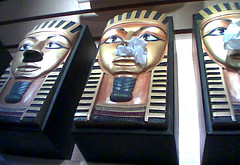
    king tut tissue
    Originally uploaded by suttonhoo.
    Disappointment presupposes high expectations. Knowing that, I’ve made a pact with myself not to care, not to want, and not to hope about anything having anything to do with Tut.

    Because the hype has been too big, and the run is going to be too long (through January 1 at the Field Museum), and too many people who don’t care about desiccation on an ordinary day care are going nuts over this kid’s canopic jars.

    As if.

    But the Anthropology Alliance generally puts on a good show, so I had high hopes for last night’s private viewing of the King Tut exhibit.

    The Anthro Alliance is a satellite group of Field Museum members who care about things anthropological. Recent past events have catered the geek in me: There was a viewing and lecture and book signing about some of the best remaining examples of Madagascar textiles (“remaining” because the museum housing the best burned down in Madagascar a few years ago, and took the textiles with it); and a presentation by Bob Martin regarding the paper he was getting ready to publish in Science on the Flores Man.

    Besides: The food's always good, and the bar's usually open.

    But last night was pretty tepid. Big crowd, meager spread, and a lecture that tried to cover way too much old ground (yep – thanks – picked up that bit about the cyclical flooding of the Nile in 5th grade world history – got anything fresh?).

    The exhibit, on the other hand – the thing I was prepared to be unimpressed by – was pretty dang cool. Of course the pieces that grabbed me the most didn't show up in the catalog (at least in the little mini-catalog that was the only one I was interested in forking over the cash for) and my darlin’ companion was hovering close by and pointing to the “no photography” sign, so I came away without any pictures to show.

    So you’ll have to believe me when I tell you that there are some pieces that really are worth seeing:

  • There’s a wonderful obsidian bust cracked down one side – the contrast of the glassy unfinished obsidian against the finished surface is alone worth the price of admission

  • A leather dog collar. Very cool. And very big. (For a big dog, apparently.)

  • A child’s seat with the woven reed seat still intact

  • The gold base of a fan that used to hold ostrich plumes (as a matter of fact ostrich are indigenous to Egypt, as we learned later that night [okay -- so the lecture wasn't a total wash]) – and if you peek into one of the holes where the plumes were mounted you can see where one busted off and left the nib behind

  • A beaten gold covered sarcophagus lid that on which bits of the linen shroud, soaked in resin, is still stuck to the gold (I love it when the organic stuff survives. I’ll take fibers and seeds over gold and silver any day.)

  • And the simple inlaid wreath that served Tut as a crown – the one he wore on his head under all those layers and layers and layers that they entombed him in

  • The crown is delicate and intricate and divine, and the expressiveness of the cobra and the vulture that peer out from the front of it had me ogling for much longer than was polite.

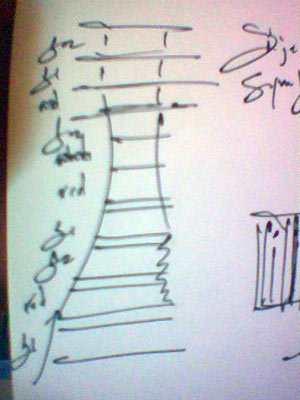
    One of my favorite pieces of the show was a wooden carving of a symbol that I learned about for the first time last night – cousin to the Ankh, it was a Djed, and there seemed not only to be an importance to the number of bars that crossed it at the crown, but also the way it was colored – and maybe even the sequence of that coloration. With the dc keeping me honest I had to resort to sketching (in a hurry) a rough outline of what I saw:


    In the same way the Ankh represents life, the Djed represents stability, and it appeared repeatedly in the pieces that peppered the show -- pulled, of course, from a period of turbulent history, emerging from the religious upheaval that Akhnaten wrought and trying desperately to set things right again.

    The symbol usually showed up as an object that was clutched and held aloft -- almost as if a wooden staff, were it beautiful enough and crafted out of enough precious metals and semi-precious stones -- could possess the power to settle the upsurges of a violent world.

    As if.

    (But wouldn’t that be something if it could?)

    time to eat

    I love Gaper’s Block for a lot of reasons –- their format is genius, and the daily weather report is every thing I need to get out the door in the morning (yesterday: Umbrella. One Layer. today: Muggy & Murky.).

    Their RSS Merge feed feeds me sweet little nuggets of local info in readily digestible morsels. They just served up this little piece about a Mickey-D's billboard that went up in Wrigleyville. Say what you will about McDonald's -- it's a pretty friggin' cool billboard (the round of applause goes to Leo Burnett for the concept):


    To turn the sundial concept into reality, Leo Burnett hired Christian Huff, a Chicago-based electrical engineer and technical advisor to Studio One East, a Chicago graphic design business that does work for Leo Burnett.

    Mr. Huff says he evaluated several available billboards before settling on the one west of Wrigley Field, where the sun hits at just the right angle to tell time between 6 a.m. and noon.

    He then designed an aluminum set of McDonald’s arches measuring four feet by three-and-a-half feet to serve as the “dial” mounted above the billboard. “The underlying concept is simple, but the application is messy,” Mr. Huff says, explaining that he had to tweak the positioning of the arches so it would cast an undistorted shadow on the billboard at noon, when the arches fall on a sandwich, signaling lunchtime.

    From «McD’s launches next strike in breakfast war – in Wrigleyville» in Crain's ChicagoBusiness

    olympic spirit


    All there is is this
    Originally uploaded by eyecatcher.
    I’ve held a deep distrust of the Olympics and the changes they bring to a city ever since I met a small business woman from Utah whose livelihood was threatened (and the quality of her neighborhood destroyed) almost immediately by the changes that came to Salt Lake City when they won the right to host the games in their city.

    This morning’s story on the changes that are coming to Beijing in anticipation of the 2008 Olympics only feeds that distrust.

    “Does this look like a scene from quaint Beijing or more like a war zone?” asked Pan Jinyu, 64, a local resident, as he stood on a narrow street pockmarked by flattened houses. Not far away, a red and white propaganda banner fluttered over a razed building: “Build a New Beijing and Welcome the Olympics.”
    ...

    “They are doing it in stages,” [Said Mike Meyer, an American who lives in the Old Beijing neighborhood and has written a book about it.] “It’s progressing like a wave cresting.” He said the gradual approach had left many residents elsewhere in the city unaware of the scope of the demolition. Comparing it to New York, he added, “It’s like one morning you woke up and Chelsea was gone.”

    From «Olympics Imperil Historic Beijing Neighborhood» in this morning’s New York Times
    My distrust stems from wildass theories about sustainability, I suppose.

    Isn’t it important, when building something, that the construction be appropriate to the native environment and can be put to good use for some future duration?

    I’m not convinced that the new construction demanded by an Olympic venue is enduring construction. Sure, it’ll always be put to some kind of use (infamously, there was the soccer stadium in Sarajevo, used during the war as a burial ground) – but it’s one-shot wonder construction that serves a single event in history and then can do no better than to be appropriated for something else that it wasn’t necessarily intended to serve.

    And to bulldoze a historic neighborhood – paying lifelong residents paltry sums before kicking them out on the street (one couple received $174K for property valued at $1.4 Million) to make way for crap construction, seems to me one of the worst kinds of property crimes you can commit.

    London is one of my favorite cities in the world. I wasn’t one of the ones cheering when they won the bid.

    The Gay Games are in Chicago this weekend – which is a good thing. But I heard someone mention on the news that this was the first step in proving that our city has the mettle to host the big shot Olympics. That we’re getting ourselves into position.

    Please. God. No.

    [Photo Credit: eyecatcher]

    Tuesday, July 11, 2006

    death becomes her


    ...red swan.
    Originally uploaded by underbunny.
    I'm the grandchild of an undertaker (and you thought my interest in graves and graveyards was just prurient). I also have a deep reverence for craftsmen and the tools that are the artifacts of their trade.

    Which may be why I'm so taken by the work of underbunny@flickr.

    Or it could be the way she gazes, unflinchingly and wonderously, on things that would make most of us turn away.

    (Regrettably, she's been inactive at Flickr since about November of last year.)

    A comment on one of her most impressive sets reads:
    There's no reason at all that we should be so shielded from the details surrounding death. It only makes it more terrifying, unsettling, disgusting, horrifying.

    Demystifying death and educating about it is so important. It takes some of the fear and revulsion out of it and makes it what it is, part of each person's existence.

    Thanks for sharing these, and helping me over that much more fear.

    Here's a link to a slideshow of that set, which is called ...undertaking »

    (Be forewarned: It's not for the weak of stomach. But it is astonishing -- and astonishingly beautiful.)

    as fine as face powder


    I spent the evening giving my grandmother's book a final going over -- one last proofread before it goes to the press where we'll have it self-published.

    My maternal grandmother is a very matter of fact woman who has laid down the story of her life -- as a child in Hoisington, Kansas who crossed the country with her family to McCloud, California during the Depression once the dust got so bad that the birds stopped flying, the sky went black, and the jack rabbits ran rampant down Main Street -- in a very matter of fact way.

    And yet it never fails to make my heart ache by the time I’m done giving it a read.

    Being her granddaughter probably has something to do with it: Her history is my history, so it matters just a little bit more.

    But she also pulls off some passages that leave me speechless.

    Speaking of a visit to the home of the landlord from whom the family leased their farmland in Kansas to pay the rent:

    One day it was my turn to go along and I was so impressed by a large glass cup just filled with sharpened pencils. I never forgot it. I only had one or two pencils to last me the entire school year. My idea of wealth was to be able to own plenty of pencils.

    Writing about the weather that would change the course of her life:
    Then in 1931 when I was 10 years old, the rains stopped.
    ...

    The dust storms began. The dust was as fine as face powder and almost black in appearance. It invaded every space.
    ...

    I remember my Dad driving on the way home in the afternoon and the wind was blowing so hard and the dust was so thick and black it was like driving in the middle of the night. It was difficult to stay on the road. My Dad had to follow the fence posts to find his way home. The dust filtered into our Model A Sedan. It was scary and difficult to breath.

    What she found in California was a mixed bag. Her family settled in McCloud where her father at first worked at a lumber mill, but her father, being a farmer, preferred to work out of doors, and so he took his family packing to pick fruit in the fields around Modesto.

    In high school she lived with a family in McCloud so that she could finish school; when summer came she joined her family in the trailer her father had made and worked the fields and in a cannery. She loved her life in McCloud and was deeply ashamed of the poverty of her family’s life in Modesto. She writes:

    Now is when it gets hard to write as this was a most difficult time in my life. If you can just imagine being fifteen years old, soon to turn sixteen on July 17, and no place to call home. All ten of us were traveling in one car pulling a homemade trailer with all our wordly possessions. We were planning to go from place to place to pick fruit on our way to our final destination of Modesto.
    ...

    It would be hard for anyone who has not lived through this difficult time in our history to understand the tremendous amount of unemployment, poverty and homeless people. Camps were set up everywhere. Laundry was always hanging from ropes or fences. Small children were playing in the dirt.

    The town people and fruit growers really didn’t want these “Oakies” (everyone was called the despised name of “Oakie” regardless of which state you were from). They only wanted cheap labor in their orchards to pick their fruit and now they didn’t know what to do with all the “Oakies” from the Dust Bowl.

    Excerpted from «My Story: A Memoir» by Elva Marie Rathbun Gooch, aka my Nini.

    Monday, July 10, 2006

    valley of the moon

    The last time I visited my mother in Sonoma we returned to the house where she grew up along Castle Road just to take a peek. The house is still there although the property around it, where my grandfather kept his workshop surrounded by a whole assortment of farm animals (the big scary bull is strongest in my memory, although there were horses and sheep and pigs and turkeys here, too) is now covered with Ravenswood vines. My grandparents sold the property in the early 80s.

    For some reason this image has been dancing around my mind all weekend. We’re driving along the railroad tracks that are hidden by those gloriously tall eucalyptus trees; their scent hangs heavy in the air. My mother tells me a story I’d never heard before: that her father, my grandfather, was in the habit of pulling over on his way home and here, by the tracks, he would dump out his ashtray, filled with cigarette butts.

    The litter-freak in me recoils spontaneously. And then she continues: Hobos used to live along this stretch of track – the shelter was particularly good here – and the butts were for them. He’d dump the ashes at the same spot every time; every time he returned it was picked clean.

    It’s the Sonoma summertime that’s been swimming through my head all weekend; that sweet scent and gentle breeze; lit by a moon that always seems larger here than anywhere else. And out of the corner of my eye a scene that story and castaway memory awakens for me, where glowing cigarettes hang like statellites around a fire in the dark.

    Sunday, July 09, 2006

    you must remember this

    I'm fascinated by memory -- by how a room full of people will almost certainly remember the same series of events as something quite different and distinct from everyone else in that room. Not necessarily the sequence of what occurred – but the whys behind it all.

    In 1964 my folks were married at St Frances Solano in my mother’s home town of Sonoma, California. A (silent) film was made of the ceremony and the reception at her parents' home afterwards. It's an extraordinary family artifact -- not only for the event that it captured, but for the foil it provides to everyone's memory of the event.

    It's also bittersweet because their marriage only lasted 7 years.

    Some time ago I taped interviews with many of my family members who were there, and planned to make a short video that would intercut their reminiscences with footage from the event. That project was interrupted by the end of my own marriage -- another experience where memories collided and failed to reconcile.

    Time has passed, life has settled, I gave marriage a go again, and I'm thinking about getting back to the video project too.

    In the meantime here's a snippet that never fails to make me smile, mostly because in the middle of this event -- where the two folks getting themselves married seem overwhelmed and out of their depth -- there's this brilliantly cool oasis of calm where a jazz trio from San Francisco does their thing.

    I’m also pretty sure it was the one thing in that whole damn wedding in which the groom, my father, was allowed any input at all.

    yes, there will be singing

    In the dark times, will there also be singing?
    Yes, there will be singing.
    About the dark times.

    — Bertolt Brecht

    what it is


    between meals
    Originally uploaded by suttonhoo.
    (Note to self -- pick up this guy's book:)
    That's what art is, he said, the story of a life in all its particularity. It's the only thing that really is particular and personal. It's the expression and, at the same time, the fabric of the particular.

    And what do you mean by the particular? I asked, supposing he would answer: Art. I was also thinking, indulgently, that we were pretty drunk already and that it was time to go home.

    But my friend said: What I mean is the secret story. ... The secret story is the one we'll never know, although we're living it from day to day, thinking we're alive, thinking we've got it all under control and the stuff we overlook doesn't matter. But every damn thing matters! It's just that we don't realize. We tell ourselves that art runs on one track and life, our lives, on another, we don't even realize that's a lie.

    Excerpted from Roberto Bolaño's «Last Evenings on Earth», which was so lovingly reviewed by Francine Prose in today's New York Times Book Review.

    Saturday, July 08, 2006

    mexican manga


    El Libro Vaquero: Odio en la Sangre is a roughly 5 inch square Mexican comic book that I picked up in Mérida on the Yucatan penninsula a few years back. It's jammed pack with passion, intrique, buxom beauties (like most comic books, there's a D-cup requirement for female participation), villians, and one blonde, blue-eyed, long-haired hero. Not to mention Spanish that I can understand, like ¡Te Amo! y ¡Maldita Bestia! and the occasional ¡Arrrggghhh!

    Thought it would be fun to take the macro to it. Enjoy.

    Mexican Manga slideshow »

    Friday, July 07, 2006

    forever in blue jeans


    I have an unnatural affection for a Levi’s denim jacket that I picked up in 1985. I wore it (too much) through the last part of high school and into college, and I realized I had something good going on when a girlfriend in college –- who had never asked to borrow any of my clothes before (or since) -- asked if she could borrow it for a date.

    It was faded and worn by its second year out.

    In the upper left hand pocket there’s a Michelob Light bottle cap from the night I shared a few 3.2 brews with C, the class Salutatorian who, it just so happened, I had nursed a crush on our senior year when our lockers were parked right next to each other.

    He hadn’t even noticed I was alive, he told me, “until that day you read that thing you wrote in AP English. What was that?” (It was an exegesis of the dream passage in Richard Wright’s Native Son, but I don’t think that’s what he meant.)

    We had a glorious(ly innocent) mash session a few nights after that but, alas, summer was at its end and he had MIT (and a girlfriend) to get back to, so that was the end of that.

    After I got out of college I retired the jacket to my closet along with the other clothes I no longer wear but can’t bear to throw out. Then near the tail-end of the 90s jean jackets came back around, so I pulled out the coat and gave it a good washing.

    Since then I’m back to wearing it too much.

    Recently I went to pull it off the hook where it was hanging at work, and saw that a huge hole had worn away in the yoke -- I could actually hook the hook through the jacket.

    Clearly it’s time to retire its raggedy old ass. The thought has only made me love it more, and wear it more, which the antique can hardly take.

    This afternoon, wearing the jacket, I stopped by a colleague's office. As we talked her eyes kept straying to the coat, and I felt them boring through every worn and torn spot, looking it over the way the popular girls look you over right before they whisper to their friends about how ridiculous you look and how terribly un-cool you are.

    Uh oh, I thought. I waited too long. Now it’s come to this: public embarrassment. I really need to take this old thing off and never wear it again.

    Just as I was about to slink away in shame she said (loudly): “What’s with the bad ass vintage jean jacket?!” – and went on from there, praising its virtues at some length.

    It seems the governor has just called in his pardon.

    bowie on tap

    This week's Chicago Reader's Critic's Choice (for dance):
    CHICAGO TAP THEATRE Mark Yonally's latest tap-dance narrative, Changes: A Science Fiction Tap Opera, is even more campy than last summer's "The Tell-Tale Tap: Stories of Edgar Allan Poe."

    Set entirely to songs by David Bowie, the evening-length Changes begins where "Space Oddity" leaves off: Major Tom gets lost, then crash-lands on a planet ruled by cruel dictator Altego (played by Yonally himself, "glammed the hell out," as he says). Eventually Major Tom frees the planet's citizens from slavery in what Yonally calls a "rousing space adventure" with a subtext: the sci-fi angle allows him to satirize egotistical leaders and state-sanctioned torture.

    The dancing itself is straightforwardly satisfying, underlining or playing off the music's rhythms while providing the story's details and emotion. And its thunderous reverberations, especially when all or most of the 11 cast members are performing, magnify the saga, giving it an operatic scope. Through 7/30: Fri-Sat 8 PM, Sun 3 PM, Athenaeum Theatre, Studio 3, 2936 N. Southport, 312-902-1500, $15-$25, discounts for groups of 15 or more.

    Laura Melzahn in the Chicago Reader

    What a strange and wonderful town.

    shake that blues booty

    ChicagoEye@Flickr posted some great shots of Vasti Jackson in action today along with a write up on the night:
    Vasti was singing a song about the “Blues Booty,” then asked if anyone indeed had a Blues Booty. This woman from Louisiana said she had one. Vasti invited her up for closer inspection.

    Vasti asked the woman to move her Blues Booty and she obliged. When she finished, he said “Boy, ya know times have changed when a white girl has all that @ss and knows how to move it.”

    — ChicagoEye
    Wanna see what he was talking about? »

    telling it true

    A year ago today I had been flickring for only a few months when the London bombing hit. (For those of you unfamiliar with the verb “flickring” think “mainlining” -- but with digital imagery instead of heroin. Flickring is communal in the same way an opium den is communal: I’m flickring, you’re flickring, we’re all flickring. Together. But that’s not the point I'm here to make.)

    I was brushing my teeth when the news hit that morning about the bombings in London; I got online, toothbrush still engaged, and started Googling like mad and emailing friends in London to make sure they were all right.

    The news couldn’t come quickly enough. Everyone was afraid to say anything incriminating, so they were saying nothing, and showing less. Then I tried Flickr. I searched on “London+bomb” -- and saw this:


    And this:


    And this:


    And this:


    I found a pipeline I could rely on.

    (To see any of these in their original context, just click on the pic.)

    Over the next weeks, by the hour, I watched the story unfold in images uploaded by Flickrites in London. Their storytelling added a humanity to the coverage that wasn’t present in the newsfeeds. It was a new way of telling a story that was immediate, unfiltered, and true.

    Here’s the photostream of the group that started up one year ago today – at this writing there are 1,228 images (starting with today and going back in time) so you might want to get comfortable.

    London Bomb Blasts Community -- Remembrance Day Slideshow »

    chicken vesuvio tonight!

    The first full weekend of every month is Chicken Vesuvio night at Clara's, an unbelievable great Italian joint in Lisle, midway (for me) between work and home.

    Be forewarned: it's the first FULL weekend -- that means if Friday night lands on the 31st, Nothing Doing. You'll have to WAIT for your Chicken Vesuvio until the following weekend.

    The gal at the to-go counter has more than once treated me with uncharitable exasperation when I've called up on a Friday the 31st asking for my sweetie's portion. NEXT weekend, she says. (Me? I usually get the eggplant. Not big on chicken in general. But I do like the red Vesuvio peppers that he leaves behind.)

    Never heard of Chicken Vesuvio? Well then, perhaps you haven't spent enough time in Chicago... read all about it here: http://www.eatchicago.net/archives/000044.html

    the silk road opens


    36970024
    Originally uploaded by Yu Kai.
    China and India have been friendly for thousands of years, and the unhappy episode lasted only a few decades, so the reopening of the Nathu La Pass will be a blessing that will lead to generations of friendship.

    Hao Peng, the deputy chairman of Tibet and the official responsible for trade in the the Himalayan region, commenting on the opening of the border between China and India that severed the Silk Road some 40 years ago.

    As reported in The Times »


    I've got a bee in my bonnet about traveling the Silk Road some day. This story means I'm that much closer.

    [Photo credit: Yu Kai]

    Thursday, July 06, 2006

    playing chess with duchamp

    a found poem

    scored by lines
    of laughter and loss

    [he] underwent
    a long and strange
    psychoanalysis

    in shorter and longer fictions
    sought to free himself
    to find his own voice

    soon infiltrated
    he fled Paris

    played chess with Marcel Duchamp
    (he beat Beckett badly)

    took up residence
    in a small village
    where no one spoke English

    and he had nothing in English to read


    Found in the Boston Globe »

    All the words shown here appear in the same sequence that they appeared in the Globe article; I took liberties and deleted select words in between. The one addition is shown in [brackets]. With apologies to Leland de la Durantaye, the author of the original piece.

    a lifetime of creative stumbling

    I was needing a hero this morning. Then this guy showed up.

    David Lewiston has been recording indigenous music (releasing most of it with Nonesuch) since he quit his job in the mid-1960s to travel and listen to what was out there. There's a piece about him in today's New York Times that describes him "not as an ethnomusicologist or any other kind of academic. His guideline, he said, is simply 'the pleasure principle'."

    His albums are documented with his photos and liner notes that he struggles to write but are filled with both historical fact and delight in the music. But his appreciation, he insists, is not intellectual but sensual.

    "The ethnoids", Mr. Lewistons said, using his joshing term for ethnomusicologists, "can't stand me. They'll review one of my records, picking every nit they possibly can. And then the final line will be 'The sounds on this album are superb.' They can't get away from that."

    From David Lewiston, a 'Musical Tourist' of the World in today's NYT

    I suppose if I was feeling introspective I'd sit back and try to figure out why that strikes me as an incredibly cool thing to do.

    Wednesday, July 05, 2006

    TD4.5


    There was nothing remarkable
    About the day we got the pu-erh
    Except maybe
    The drumming of your heart
    Your gentle breath

    Not long before we asked for
    Two pots steaming
    (Yours china white; mine green)
    Your fingers set bottle caps
    Buzzing
    Stroking the beaten spoons

    (“They’re not spoons”
    You had scolded me before
    Laughing)
    But still I made the mistake
    Picking up Chigamba’s
    Masterful M’bira

    The one you brought
    (A gift) with the others
    In your pack
    Where the music slept
    Until you woke it

    And it flowed
    Through you

    Knowing it was home

    There was nothing remarkable
    About the day we got the pu-erh
    A few loose ounces
    Purchased for a friend

    Except of course
    The reverence
    You gave me
    For the whiskered leaves
    Old souls
    Born of ancient trees
    Set to ripen into wisdom
    Over decades
    In the dark caves of China

    (It was so often this way)

    What you knew
    You offered
    Like a kind monk would water
    To a thirsty traveler
    Exhausted by the world
    Dusty from too much doing

    (I loved to drink from the deep stores of your mind)

    There was nothing remarkable
    About the day we got the pu-erh
    Except not knowing
    How soon
    These hours
    Would empty
    Like a teapot

    Fragrant leaves still clinging to the sides


    WTF »

    josh andrews appreciation day


    Josh Andrews is the nice guy and (imho) stellar photo editor at WBEZ who selects images for the public radio station's home page. Today's he running a shot that I took recently of an old abandoned Fire House in Chicago's River North that old school Gene & Georgetti's is using as a parking garage.

    Thanks, Josh.

    (If you'd like to see more from this same series you can spot them here »)

    too much wonderful wine


    Wonderful 4th with friends consuming a wine list selected in honor of the World Cup players (well, more or less):

  • Pio Cesare 1999 Barolo

  • Warre 1977 Vintage Port

  • Nicolas Feuillatte 1995 Champagne

  • Benzinger 1995 Zinfandel

  • And a German wine that we never managed to get to...

    Here's a slideshow of the whole party »

    on vinyl


    23
    Originally uploaded by Plastic Jesus.
    Shared by Plastic Jesus@Flickr on the subject of vinyl (his pic, too):

    I hope that with one or perhaps two more generations of sampling rates we will eventually get back to fucking vinyl! And it absolutely matters. Scientists have explained it to me in terms of digital frequencies being stairsteps and vinyl being more rounded. That's as good as any way to say it's not just the notes but the stuff in between them that counts.

    There's resonance and harmonics and all kinds of things that you don't hear but you do feel. They make it warmer and smoother and it communicates more effectively. They used to use music to communicate to autistic children but now it'll never work. I was in London when it was the 20th anniversary of Sgt Pepper and they had a listening session at Abbey Road. I went along and they played the original master tapes. I swear to you I was physically stoned for two days.

    The impact of hearing the raw master tapes had enormous impact on you, mentally, physically, emotionally. The difference between that and a fucking cd or download is you're only hearing 20% of what was recorded. That's why things are so disposable now. That's why nobody's really into it in the same way. That and the loss of the 12-inch cover.

    Steve Van Zandt in The Word Magazine

    Tuesday, July 04, 2006

    merit badge

    Why didn't they have this going on when I was in Girl Scouts? (I might not have been forced to resign in protest):
    Girl Scouts from troops in Chicago's near north suburbs recently helped test activities for [the Chicago Artichitecture Foundation's] new Architecture Badge program.

    The scouts earned the official Girl Scout Architecture Badge by sketching buildings, designing parks, using math skills to learn how to use an architectural scale and constructing scout-sized structures out of recycled newspapers.

    From the Summer issue of «Insights» the Quarterly Newsletter of the CAF

    Monday, July 03, 2006

    baby got back

    Messing around with a new macro lens »

    beckett on the lake

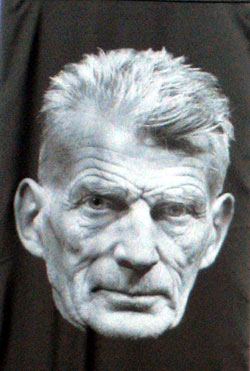
    The last time we met he said he wasn’t feeling the best – “crock”. Something was affecting his balance and he had fallen twice. I said I was sorry to hear that. “Cheer up”, he said, “I’ve written a poem for you”. “Where is it?” I’ll say it to you, only an Irishman would understand it. Then he smiled and said, ‘Ochón, ochón, dead but not gone’.

    At the end of our meeting he got up to say goodbye and somehow I sensed it would be our last meeting. “I’ll walk you to your door.” No, he wanted to leave quietly, without fuss. Take it easy, I said. He held my hand in both of his and said, “you sit there and finish your coffee”. When he was halfway across the café floor he turned and said: “Michael. If I fall, don’t bother to pick me up”. The smile, and then gone.

    Michael Colgan remembering Samuel Beckett in the Gate Theatre’s «Beckett on Stage | April 2006» program published during the Beckett Centenary Festival.


    It seems to be my lot, like some obedient Sisyphus, to return repeatedly, hot and tired and smelling badly after a day spent slugging about the city streets, to see selected Beckett shorts. I did it in Dublin in May and again last night in Chicago.

    The billing promised to be different from the shorts that we saw at the Gate as part of the Beckett Centenary celebration – there it was Play and Catastrophe (the latter written for Václav Havel and devastating) – last night, at the Theater on the Lake, it was expected to be Eh, Joe; Rough for Radio 1; and then Texts for Nothing Nos. 4, 7, and 12.

    Turns out Play was on the billing too, but I had missed it when I booked the tickets.

    Which wouldn’t be a bad thing if Play were not about three people in pots. Who are all sleeping together. And if it weren’t for the fact that (if you’ve seen it you know) they run through the script twice – the second time with slightly different intonations. All of this well and good if you’re a freak like me, but a bit tiresome if you just indulging a freak like me, which was the situation my husband found himself in.

    Earlier, in Dublin, on the day we slugged about the city and landed finally at the Gate where Dublin’s toniest were decked out in their best to the see the show in packed house, my darlin’ companion had been particularly grumpy about how things were going (I suspect the Writer’s Museum earlier that morning had put him over the edge – later he would confirm this to be true), and so as we took our seats I debated whether or not to explain to him that we were about to see three people up to their necks in pots, their faces encrusted with mud.

    I opted not to.

    All in all, after the curtain came up, he took it quite well.

    But that experience wasn’t enough to prevent the long look and a good humored rolling of the eyeballs when the curtains pulled apart last night to reveal, indeed, three people in pots.

    I enjoyed the contrast: an American company v. an Irish company, playing the same script. The staging was strikingly different: at the Gate they brought the players to the very edge of the stage. At that proximity an intimacy is reached that makes you almost forget these people are in pots. (Although I'm not convinced that Beckett wanted us to forget.)

    At the Theater on the Lake the pots were at the far rear of the stage, and they attempted to close the gap somewhat by adding a fourth player who ran the curtain and the lights and sat in the middle distance. But they were remote from us, and that remoteness was exacerbated by the lighting – the stage directions have each player being illuminated in their turn, as they speak, and last night that light came from within the pot. (The pots themselves were paper maché which made for a nice effect when illuminated from within.)

    Unfortunately to have the light come from below rather than above (did the players activate it themselves?) meant that their faces were obscured by severe shadows – made worse, of course, by all that mud. We never got to see who they were, which made it a bit more difficult to care for them. At the Gate the lighting was direct and from above: we could see their humanity through the crap that covered them. The outcome was quite different.

    But the most notable difference between the two performances was the delivery: at the Gate Play was a very funny show. Insightful and poignant, of course, as well – you can’t get away from a Beckett without catching a glance at the worst of ourselves, and walk away loving humanity anyway – but really very funny. And this would be an important attribute when the topic is adultery. Otherwise: Ouch.

    The Chicago show was played ponderously. Not quite the same thing.

    Worth the price of entry, anyway, and the sweltering conditions of the theatre (it’s a seasonal playhouse and has a summer camp feeling -- they hand out fans at the front door) meant that our stink, gleaned from an afternoon running around the Taste of Chicago, was scarcely noticed (the same, I’m sure, cannot be said about our attendance at the Gate).

    Eh, Joe, by the way, was brilliant. And there’s more goodness promised throughout the year – The Curious Theatre Branch is doing nothing but Beckett until they put the season to bed.

    The farther he goes the more good it does me. I don’t want philosophies, tracts, dogmas, creeds, ways out, truths, answers, nothing from the bargain basement.

    He is the most courageous, remorseless writer going and the more he grinds my nose in the shit the more I am grateful to him. He’s not fucking me about, he’s not leading me up any garden path, he’s not slipping me a wink, he’s not flogging me a remedy or a path or a revelation or a basinful of breadcrumbs. He’s not selling me anything I don’t want to buy – he doesn’t give a bullock whether I buy or not – he hasn’t got his hand over his heart.

    Well, I’ll buy his goods, hook, line and sinker, because he leaves no stone unturned and no maggot lonely. He brings forth a body of beauty. His work is beautiful.

    — Harold Pinter on Beckett

    Sunday, July 02, 2006

    more dead president’s wives

    No matter where I was, Nancy Reagan’s countenance seemed to drift unbidden into consciousness.

    From Guy Trebay’s wonderfully catty write up on men’s fashion in Milan in the Sunday Styles section of the paper. Later he goes on to say:

    Is this the place to note that the most inescapable, not to say oppressive, theme of the week was short pants? … There were tennis shorts and shorts worn as the bottom half of suits and shorts so abbreviated that they were little more than cummerbunds with a zipper and a seam up the crotch.

    If these presentations said anything about the larger culture, it could be that the West is being readied for a future in which China has conquered the planet and the rest of us have been hired to make UPS deliveries or mow the lawn.

    jack or jackie?

    You look like the Kennedys!

    The drunk woman who passed me and pointed yesterday in the swirling press of humanity that is the Taste of Chicago.

    She was gone before I could ask her which one.

    (Oh please let it be her and not him.)

    sextant

    Give me this:
    It’s summer.

    We step away
    from the heat and noise
    (you took my hand
    unexpectedly)

    And now we lie
    our backs in the grass
    feet extended to the far
    and opposite poles
    cheeks touching

    The constellations are so close
    they’re unseemly
    and I can feel
    your whole face change
    as you smile
    at something I’ve said

    Saturday, July 01, 2006

    your lens is a wonderland

    beckett @ the gatedonut sundaesafety stop
    brewpubcold soba with noodle sauceMamenchisaurus
    time for a (half) pintdelayed in detroitsidewalk detail

    A photograph is never all the photographer’s doing – there’s always a middle man.

    That would be the camera lens.

    I have a handful of lenses that I shoot with, and each one has a different personality. My first serious digital camera was a Minolta Dimage 7Hi with a fixed 49mm lens. It was open and receptive; generous in that it shot a little bit wide, which came in handy when I trekked it down South and started pointing it at pyramids.

    I have a little pocket Canon that is much the same – it shoots broad and without guile.

    Recently my darlin’ companion spoiled me good with a Nikon D70s outfitted with two lenses, each one packing its own attitude: one high and tight (and a bit standoffish – she’s my shy girl) and the other goes wide like a movie shot in letterbox – he’s game for anything (he’s my gangly teenager – ready to rumble).

    But the one that I cherish, curiously, with a warmth that exceeds the others, is my little Nokia cameraphone. I love the way he sees the world, the little imp. Frames it wide and magnifies it just a touch; takes the available light and then punches it up.

    And spontaneous? Baby’s always game.

    I picked him up almost 5 years ago and, really, it’s about time he was retired.

    But I can’t. I just can’t do it.

    tony the knife guy


    tony the knife guy
    Originally uploaded by suttonhoo.
    This is Tony the knife guy. He sets up shop every summer at the local farmer’s market. Once a year I make my pilgrimage, knives in hand, and he takes good care of me.

    Every year, as he’s handing them back to me, he says: “Those are good knives. You take care of them.” (And he’s right about that – they’re artisan knives and the first joint purchase I ever made with my sweetie – we split it down the middle. I cherish those knives.)

    One year I brought by a lawnmower blade and when I returned to pick it up he said: “It had a nick. I gave you another one.” And he had – a better one. For which he only charged me the price of the sharpening. (I gave him a big tip.)

    He’s also an incorrigible flirt, which makes me love him all the more.

    His grandfather built his whetstone many years ago, and he powers it by peddling it like a bike. Conversations with Tony have a lovely cadence, flowing on the melody of his Italian accent, and metered out by the pumping of his feet.

    I stop by just about every Saturday in the summertime to say hi.

    curiouser and curiouser

    I think of Flickr as a place apart – over time you get to know folks and their habits by what they shoot, post and how they comment -- but all of this happens somewhere besides the real world.

    So it was strange to see the New York Times pull the curtain back and give a nod to one of my (and 3,000 other people’s) Flickr contacts, Thomas Hawk from San Francisco, whose work I've gotten to know over the last year or so.

    Seems the Hawk has gotten into a bit of a scrape with photographer Jill Greenberg – accusing her of taking candy from babies in the worst kind of way.

    You can read all about it in this morning’s New York Times »

    (Scroll down a bit -- you'll find it mid-page. And while you're there you can read all about the new bike blender. See? All kinds of useful stuff.)

    And here's another one from Oz: my theatre-buddy litwit got herself blogrolled by Terry Teachout, the WSJ and Commentary critic.

    Time to change your underwear, Toto: it seems people are watching.
    Related Posts with Thumbnails