I wrote this story up for a friend who shared a great Wyoming fish story about leeches, and I’m of the opinion that it’s just not right to get a good story like that without sharing one in return. This one isn’t as good as the leech story, but it’s the only Wyoming story I had handy, so it’ll have to do.
This story is only interesting because it happened at all.
Seven years into my marriage to B., one year before he decided to go his own way, two years before I found out about his new direction, and three years before the divorce decree was final, we went to Yellowstone. The trip saved us for a little while, but it wasn’t enough to save us altogether.
I had been sick too much (and hadn't yet been diagnosed or received the treatment that would cure me good), he had been working too much, and we hadn’t seen much of each other at all for awhile. So we took three days off from work and drove the distance from Seattle to Gardiner, Montana in a day.
We didn’t tell anyone that we were going. We just left.
We listened to the audiotape of a River Runs Through It on the drive. I had seen the movie, but was unprepared for the whammy that the book packed. My grandfather had died a few years before this trip, and I was missing him fiercely. He was born in Gardiner, and approached fly fishing like the sacrament that it is to most folks around there. He had one of those holy tackle boxes that I suspect your grandfather had, and his reels were all stored lovingly in purple felt Crown Royal pouches. (Bompa liked to drink almost as much as he liked to fish.)
So Maclean’s book made me think of Bompa – the father character especially -- and it also made me think of my dad – the younger son character did that – the changes he goes through with his family and the conclusions that the brother comes to by the end of the book about his brother.
My dad is a brilliant guy – but it's the kind of brilliant that’s full of heartbreak. We’ve always been close – he's close to all his kids -- and we’re both given to long, rambling philosophical wanderings -- I’ve had more long conversations about crazy things that make perfect sense with my father than with anyone else I’ve known.
But from the time I was in high school to just a few years ago he was going through some hard times financially, and after all we kids moved out of the house he headed to the hills to hide out and figure out what to do next. He was living in Green River, Wyoming on very little at the time of this story, and I hadn’t seen him since my grandfather's funeral, about two years before. I wasn’t too concerned about it – it was normal by this point – and I didn’t feel estranged from him – but I missed him.
So I sobbed my way through the last chapter of the audio book, and was thinking long and hard on my father and my grandfather and the strange terroir of the place I was in and wondering why I felt more at home there than anywhere else in the world.
It was autumn when we went, heading into winter: The grasses were golden and the buffalo and the elk were seeking out the heat of the hot springs and the geysers in the belly of the caldera, where the steam rose into the icy air.
We stayed the first night at Mammoth Hot Springs – and learned when we got there that the road we expected to take straight down to Yellowstone Lodge had just been closed for the winter. We would have to take a longer road around the next day to get where we were going. Our route would take us by the big old grand hotel on Lake Yellowstone (built in the 1890s) – I had read about it, and wrote it off in favor of going straight to Yellowstone Lodge (largest log cabin structure in the world!) and staying there for a couple of nights in a row. But since we had to go by there anyway I thought it would be cool to stay the night. I asked B. if he would be open to that. He said “No.”
I then did something unusual: even though he said no, I said, “well, I would”, and then turned to the ranger behind the desk, who was explaining all this to me, and asked if he could help me shuffle our reservations around. This probably had something to do with the fact that I’m a sucker for National Park hotels and lodges and hope to visit every one of them before I die, and also with the fact that B. had been whining about something and I was feeling impatient with him, but I like to think it also had something to do with getting the stars into alignment for what would happen next.
So we set out on our drive for the Lake Yellowstone Hotel, with all kinds of plans to stop and do all kinds of things. The sun was intensely bright that whole day – especially amazing having just come out of the drizzle of Seattle – but the wind had blown all the clouds away and there was no cover to keep the heat in – the temperatures dropped and it was getting really cold really fast. Given the wind and the cold we canceled our plans to hike down to Yellowstone Falls, and cancelled a handful of other stops as well. We did pause to see a black bear that had wondered down to the road and attracted a crowd, and to see some buffalo along the way. But our timing was nothing like we had originally planned it to be.
When we pulled into the hotel parking lot and opened our car doors the wind threw them wide open, and then swept through the car and hurled our map out into the parking lot. We knew immediately that it would be impossible to chase it down, given the speed at which it was traveling. Even still we took a few seconds to discuss whether we were going to do the virtuous thing. We decided we wouldn’t, and headed instead into the hotel.
I only tell you that because if we had chased the map, this next thing wouldn't have happened.
It was eerily still in the hotel – we’d figure out in just a little while that this was because the wind storm had knocked the power out -- but this wasn’t immediately apparent because of all the windows and the natural light that poured into the hallways. We walked the long hall from the parking lot to the front desk, and then, for some reason, instead of approaching the desk to check in, I decided to take a look at the lake.
The wind was so fierce that white caps were kicking up on the surface. It was gorgeous. It was so still in hotel without the hum of electricity that every sound was in high relief. I think it's in large part because of this that, as I was crossing to the windows to see more of the waves, I heard the sound of my father’s voice.
I didn’t hear what he said – I heard just the music of his voice. A single note. Later I learned that he had just said “thanks” to someone who gave him the time. If he had been wearing a watch I would have missed him altogether.
He was standing halfway out the doors to my left when he said it, and paused only briefly before continuing on his way to his pickup, which was still running in the circular drive in front of the hotel.
He’d been traveling to see a client when he found that a tree felled in the wind storm was blocking the road. So he circled through Yellowstone to use the telephone and let his customer know what the hold up was. And now he was about to drive off again.
But I didn’t know any of that yet: I just turned and saw him walking away. So I said: “Dad?”
And he turned with a look of complete bafflement on his face – it probably looked just like mine – and said: “Daughter?”
So then of course there were hugs and laughter and stories and he stayed for a couple of hours and we hung out in the lobby and caught up and hugged and laughed some more.
And the whole time it seemed both extraordinary and absolutely ordinary that this was happening.
And after those couple of hours had passed he said goodbye and drove off, and we checked into our room.
Wednesday, September 13, 2006


Tuesday, September 12, 2006
your attention, please
If you're not outraged, you're not paying attention.
Bumpersticker seen tonight on the road home.
plutoed
Verb. to pluto someone or something is to downgrade, demote or remove altogether from a prestigious group or list, like what was done to the planet of the same name.
Running just now on the home page of the Urban Dictionary when I stopped by to look something up.
He was plutoed like an old pair of shoes.
Running just now on the home page of the Urban Dictionary when I stopped by to look something up.
More on words at detritus »
in accord
Six months after moving to Paris, I gave up on French school and decided to take the easy way out. All I ever said was "Could you repeat that?" And for what? I rarely understood things the second time around, and when I did it was usually something banal, the speaker wondering how I felt about toast, or telling me that the store would close in twenty minutes. All that work for something that didn't really matter, and so I began saying, "D'accord," which translates to "I am in agreement," and means, basically, "O.K." The word was a key to a magic door, and every time I said it I felt the thrill of possibility.
From In the Waiting Room: The Advantages of Speaking French by David Sedaris in this week's New Yorker
David Sedaris' piece in this week's New Yorker (which is a hundred times funnier than what you're about to read below – and really, you should probably go read that now instead) immediately made me think of traveling with my grandmother, who was raised in a Norwegian speaking household but had never been to Norway until she hit her mid-70s. In Norway she binged on the language like a kid on candy – engaging in long rambling conversations with every cab driver, waiter, and public official that we met.
I sat in silence for the duration of these interlocutions, wondering what she was saying, able to make out only brief phrases like "meine barne barne" (which meant me, I think -- her "child's child") (and, of course, is only a bare phonetic approximation of the actual spelling, because, as should now be evident, I don’t speak – or spell -- Norwegian).
Keep in mind, Norway seemed to be a quiet country – at least the public places were. Folks didn't chat much, idly or for any other reason, and exercised such social restraint that I really had to wonder how my grandmother or I, both given to loquaciousness when we get a good head of steam on, could be of that stock. So given that, my grandmother's voice was frequently the only one to be heard in the vast silences, filling the air with her Norwegian-American accent which just about everybody (when asked) commented was "good, but just a little gravely" – except, of course, for the folks down south around Stavanger, where her own grandmother was from, who thought her accent was exceptional.
As a survival mechanism I begged my grandmother to "teach me to say something agreeable" in Norwegian, and so she taught me to say (here again, spelled phonetically, not correctly): "Ja: da trög." Which she explained meant: "Yes: That's true." Or more true to the spirit: "That's what I think, too."
From there on out we made a most agreeable couple: My grandmother would take off on a ramble, and I would sit there in silence, nodding agreeably, until she came to what sounded like a conclusion. Generally, at that point she would turn to me and ask something with a slight inflection, to which I would answer: "Ja: da trög."
At which my grandmother would turn back to her audience and keep right on going.
the macbeth effect
Live Schereiber, who played Macbeth to critical acclaim this summer at the Delacorte Theater in Central Park, said the moral weight of the murder in the play was exhausting. And he said that cast members lined up to shower at the theater, rather than waiting until they got home.From « Lady Macbeth Not Alone in Her Quest for Spotlessness » in this morning’s New York Times, an article that reports on a Northwestern study that found students asked to contemplate an unethical act (one of their own) were twice as likely to accept the gift of an antiseptic wipe over a pencil at the conclusion of the study.
“That was unusual – usually no one uses those theater showers,” Mr. Schreiber said.
The article also states:
In another experiment, the researchers found that students who had been contemplating an unethical deed rated the value of cleaning products significantly higher than peers who had been thinking about an ethical act.People who washed their hands after contemplating an unethical act were less troubled by their thoughts than those who didn’t, the study found.
(…)
Monday, September 11, 2006
rosebud
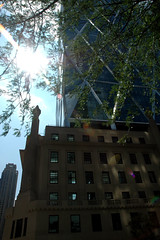
A friend in NYC who’s gigging for Hearst Publishing recommended that we stop by to see the new Hearst Tower just off Columbus Circle when we were in town.
It’s a towering glass skyscraper that sprouts from inside an original art deco six-story structure that went up back in the 1920s – and it's particularly interesting because it’s a green building that, among other things, extracts 60% of the water it needs to keep its bathrooms operational from collected rainwater. (I hope I’m remembering that right, because now that I’m quoting it, it seems awfully, well, dang virtuous.)
We stopped in on Sunday just before Labor Day, when it was locked up tight, and we could only step into the silent lobby to admire the soaring atrium in which the elevators, just beyond the security gates, ascend steeply through a tiered glass waterfall, to where the business gets done.
I was disappointed in my photos and had nothing more impressive to share here than “Wow. Cool.” so I didn’t expect that I would say anything at all – but then Blair Kamin went ahead and reviewed the building as part of a larger article this last Sunday in the Chicago Tribune called What Price Security? Architecture in an anxious age.
So with apologies to Blair, I thought I’d crib some of his comments here (with full attribution, of course) -- as well as throw in a few pics (because what kind of a Flickr whore would I be if I didn't get the pics in there?):
From Blair Kamin’s piece in the 10 September 2006 issue of the Chicago Tribune: « What Price Security? Architecture in an anxious age »
It’s a towering glass skyscraper that sprouts from inside an original art deco six-story structure that went up back in the 1920s – and it's particularly interesting because it’s a green building that, among other things, extracts 60% of the water it needs to keep its bathrooms operational from collected rainwater. (I hope I’m remembering that right, because now that I’m quoting it, it seems awfully, well, dang virtuous.)
We stopped in on Sunday just before Labor Day, when it was locked up tight, and we could only step into the silent lobby to admire the soaring atrium in which the elevators, just beyond the security gates, ascend steeply through a tiered glass waterfall, to where the business gets done.
I was disappointed in my photos and had nothing more impressive to share here than “Wow. Cool.” so I didn’t expect that I would say anything at all – but then Blair Kamin went ahead and reviewed the building as part of a larger article this last Sunday in the Chicago Tribune called What Price Security? Architecture in an anxious age.
So with apologies to Blair, I thought I’d crib some of his comments here (with full attribution, of course) -- as well as throw in a few pics (because what kind of a Flickr whore would I be if I didn't get the pics in there?):
Located near the southwest corner of Central Park and framed in a triangular steel structure known as a diagrid, the 46-story office building shoots out of an eclectic six-story base designed in the 1920s for press lord William Randolph Hearst by the architect and theater designer Joseph Urban.
The tower has a dazzling sculptural presence, flying above the old masonry building in a way that perfectly complements it.
It is at once a fresh take on the verticality of the classic New York setback sky scraper and a paragon of green architecture, the enlightened global movement that responds to the reality that big buildings are big energy guzzlers, consuming more than half of the energy used worldwide.
With the diagrid’s open fishnet letting waves of natural light flow into office floors, the skyscraper is projected to use 26 percent less electricity than a typical high-rise.
Yet neck-craners who take in this eye popper from the sidewalk are surely unaware that Foster and his associates re-examined every aspect of it after 9/11.
On the upper floors, they replaced conventional glass with blast-resistant laminated glass. And the upper floor of the building’s lobby – a nearly 100-foot-tall space with recycled water running down slanting walls of class – was closed to the public.
Here is a troubling sign that the grand public spaces within skyscrapers, whose chockablock concentrations of stores and restaurants make them cities in miniature, are increasingly private inner worlds, reserved for the sole use of their occupants.
From Blair Kamin’s piece in the 10 September 2006 issue of the Chicago Tribune: « What Price Security? Architecture in an anxious age »
dusk
I regret that dusk isn’t what it was
touch football turned to tackle
neighborhood kids -- heat-seekers all
chasing off the chill
charging loose limbed into a pile
eight kids deep
the Nerf ball buried at the bottom
is just a feint
we need this warm pyre
all of it
to chase off what we know
that the last of summer is spent
and so
raked like fallen leaves
these warm complicitous bodies
grunt, laugh and struggle
combustible
the streetlight sputters on
and we pretend not to hear the far cries
the grown up voices
dinner is ready
but we are not
Sunday, September 10, 2006
death or glory
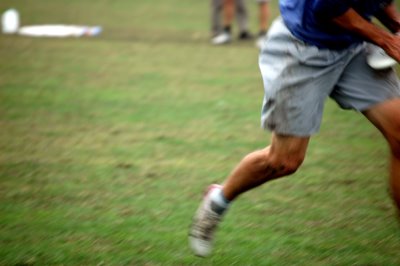
My godson was in Chicagoland over the weekend to play in an Ultimate Frisbee Tournament. His team -- Death or Glory (DoG) out of Boston -- successfully decimated the competition.
I got to watch -- which sent me into all kinds of fond reverie re high school crushes and Ultimate-playing boyfriends -- and take some pics, which was just what I needed to keep my mind off the plunging temperatures and the fact that I'm friggin' old enough now to have a 24-year old godson. (How did that happen?)
Here's a link to slideshow featuring some pics from the game »
free fall
a found poem
He departs from this earth like an arrow
relaxed
hurtling through the air
comfortable in the grip
of unimaginable motion
arms by his side
left leg bent
white shirt billowing free
perfectly vertical
in accord
with the lines of the buildings
behind him
he splits them
bisects them
North Tower; South.
he is the essential element
in the creation
of a new flag
steel bars
shining in the sun
something discordant
and therefore terrible:
Freedom.
This poem was found in Tom Juno’s article « The Falling Man » which appeared in Esquire in 2003
Saturday, September 09, 2006

meridians
The Chinese doctor
listens close
to the winds in my pulse
once strong licking flames of yang
(you should take to the sea,
she told me then,
more water, more yin,
to balance the fire.)
The pulses flutter now
beaten, weakened and tired.
“We will work on the lung meridian”
she tells me
“That’s where grief settles in.”
She knows this from listening
but I’ve told her no stories
I am quiet. Becalmed
on salty water.
She goes to work
Tracing my horizons. Mapping my meridians
calling the fire back.
Home again I'm met
by a thought
stamped and set to sail
across meridians
arriving
like a cat’s paw skittering across the surface of the sea
and I lift my head
like a sailor hungry for a breeze
This tender lick of flame
(really just a postcard)
reminds me
that never did my friend take his leave
(he whose leaving this last time
has taken my breath from me)
without leaving a gift behind.
And so he has.
(Dear friend.)
Friday, September 08, 2006
not so secret
Since July 1, when the campaign began, about 8,500 secrets have appeared, Ms. Yates said, on themes like "long-lost loves," forbidden passions and careers.
The secrets are also going up on giant digital signs on the Reuters Building in Times Square.
From a
So when does a secret stop being a secret and become a confession?
slacklining
A lot of sports is about domination. Allowing the slackline to be the slackline is the most important step for most people. Thoughts are too big to think that quickly.
Scott Balcom, author of Walk the Line, on slacklining in today's New York Times
Not so eloquent, but kind of intriguing.
Thursday, September 07, 2006
getting a leg up

"God is in the details," Mies van der Rohe is supposed to have said. He did not simply mean that building details are important; he meant that they are the very soul of architecture.
An easy way to appreciate this is to look at how different architects handle a very simple detail, such as a door handle, a baseboard—or a stair balustrade. The function of a balustrade is straightforward: It is both a guardrail and a climbing support. Yet the variety of designs that can perform these functions is vast.
From « Upstairs, Downstairs: How Small Details Make Great Architects », a photo essay on -- yep -- stairs, in today's Slate.
Wednesday, September 06, 2006
yo.
According to a study by British scientist Rupert Sheldrake, telephone telepathy does exist and now he wants to find out if the phenomenon extends to text messaging.Reported today in the British Globe and Mail
No word on whether the study participants were armed with Caller ID.
In other news (sorta): A girlfriend of mine who's a family practice physician told me once a long time ago that she had a patient come in for a pregnancy test -- the woman felt fine, but her boyfriend was experiencing something that resembled morning sickness, so he asked her to get the test.
Turned out she was pregnant.
full stop
Most of my hours behind the steering wheel have been logged west of the Mississippi, which I never thought meant much until I moved east of the Mississippi.
The North and the South have got nothing on the cultural differences between Westerners and Midwesterners.
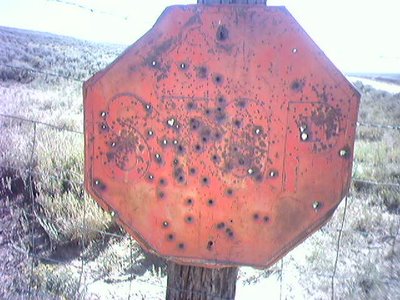
Stopping is one of those things that are done differently, depending upon which side of the mighty Miss you spend your time. Once you’re west of the river, if you happen to be driving within an area where traffic is sparse and people are few, you’re generally allowed what’s known as a “California stop” – that is, a gentle coast and glide up to the stop sign, a brief pause where you get a good look at the road to the left and the right of you, but never quite completely stop, before you move through the stop sign.
Maybe some westerners will disagree, but the California stop was so much a part of the driving culture of my family, that I was cautioned strongly to “come to a full and complete stop” by my father when I saddled up to take the driver’s license test. For his part, he never did. That I ever saw.
I married a careful Midwestern driver, and my lax western ways behind the wheel pretty much make him crazy. I do what I can to conform to keep the peace, but the habits of my ancestors run deep and are hard to shake.
Three years ago on Labor Day weekend we got a phone call that changed everything. It was one of those late night calls that you know are up to no good as soon as you hear the phone ring at 11.30. My father had collapsed during a hike through Utah’s Red Rock Canyon wilderness, had been airlifted to a trauma center in Grand Junction, Colorado, and wasn’t expected to live.
The nurses weren’t committing to that diagnoses, of course – all they would say was: “If you want to see your father again you should come right now.”
So we did. All four kids with family in tow, his mother, sister, girlfriend, ex-wife and ex-mother-in-law converged on Grand Junction within the next twelve hours.
He was barely alive, and stayed that way for a good week. By a stroke of good luck the physician assigned to my father was Dr. Honeycutt, an army doc who had left the military just the month before for an easy retirement at St. Mary’s, who knew trauma like nobody’s business, and saved my father’s life.
But it was a good week before we began to suspect that he might live, and a good month before we knew that things had a chance of being normal again – by then his kidneys and liver, which appeared to have given up the ghost earlier – had returned to him and started functioning again. And the infection that felled him on the hiking trail in the first place seemed to have abated (it would flare up again about a year later, but gratefully was beaten back into submission).
During those weeks I spent the days with my family just being there – which is really all you can do when someone you love is knocked flat like that. Just show up and be there, for as long as you need to be. I did my crying at night, in the dark, in the strong arms of my Midwestern boy, he of the full stops, who knows the value of good tight hug when you feel like your whole insides have exploded and spread across the heavens, and there’s no hope of getting them all back inside. Ever.
About three days into the worst of it, we needed to travel to Bluff, Utah, where my father had left his car at his buddy’s place before they headed out for the hike, because my dad’s girlfriend needed the car to get around. (She had been burying her mother in Michigan when the accident occurred, and arrived like us at the bedside, dazed and terrified, within the first twelve hours.)
The three of us – me, my sweetie, and my father’s sweetie, Cookie, a Michigan girl who has been thoroughly converted to Western ways – piled into our rental car and started the trek, covering the distance that my father had covered a few days earlier in a helicopter, counting down the miles through the far western edge of Colorado, through Moab, Utah and on to Bluff; feeling the remoteness of the surroundings, thinking of him lying there in the severe heat of the canyon area, unable to move, suffering from heat exhaustion and who knew what else (at this point they still didn’t know what laid him flat) while he waited two hours for help to come.
I spent most of that drive wondering if my father would ever wake up.
So it was a sober drive. Which is where the stop sign comes in.
After many hours we pulled into Bluff, Utah – a simmering caldera where very few people try to live. Cookie was the navigator – she knew where the house was -- “Straight to the end of this road and then left,” she said, as my darlin’ companion approached a stop sign. In the middle of nowhere. Not a soul in sight. Lacking only tumbleweed to make the scene complete. He slowed to a stop.
Cookie repeated herself: “Straight ahead. You need to go straight--- a--- head.” She turned and looked at our driver – utter confusion on her face -- trying to figure out what was happening. Why our forward progress had been frustrated. Why, for god’s sake, we were STOPPPING.
Then she looked up, and saw the stop sign; looked back to my sweetie, then to me, then back to the stop sign.
And laughed. Like cool water in the desert.
I laughed with her. And our good Midwestern boy shook his head, knowing that he had the situation under control, knowing there was no good reason to laugh at that: a stop sign is a stop sign is a stop sign.
And I knew that I could count on those steady ways in the dark when the laughter was gone and the tears had come again.
[Photo credit: b1-66er]
more ugly food

Celeriac is one of those words, like coccyx, that I hesitate to say in public for fear that I’m going to offend someone without even trying. Fortunately the need for the word doesn’t come up much. I recently came into some, via my Green Earth veggie hook up, so I was bound and determined to make something interesting out of it.
Enter Patricia Wells’ Double Celery Soup. Which requires not only the celery root but also the celery attached to the root, and the leeks that came as part of my CSA haul and were looking for a home.
Mission accomplished, and the soup wasn’t that bad. But that doesn’t mean I’m ever going back there again.
Well, maybe. Once autumn settles in and I’m needing me some more soup that tastes an awful lot like an awful lot of celery. ('Cause for this soup, you've gotta really like celery.)
Patricia Well’s Double Celery Soup1 medium celery root (about 1 lb) peeled and diced – a formidable challenge 10 celery ribs, cubed 3 leeks trimmed, well rinsed and cut into thin rounds Wells calls for a bouquet garni of thyme, bay leaves, and parsley tied together with a string. I was a bit sloppier than that and tossed in a handful of dried thyme, 2 bay leaves and some chopped parsley. Not quite as refined, but it got the job done. 2 quarts of stock – Wells calls for home made chicken stock; I used veggie bouillon cubes. (I usually do.)
In a large saucepan, combine the celery root, celery, leeks, and herbs. Add the stock and season gently with salt and pepper. Bring to a simmer over medium-high heat.
Simmer until the vegetables are soft, about 25 minutes. Adjust the seasoning. Pour into warmed shallow soup bowls and serve immediately.
Adapted from Patricia Wells’ Bistro Cooking
Tuesday, September 05, 2006
the thinking eye

For as Paul Klee wrote in The Thinking Eye, "Didn't Feuerbach say: For the understanding of a picture, a chair is needed? Why a chair? To prevent the legs, as they tire, from interfering with the mind."
Edward Tufte in Beautiful Evidence -- quoting Paul Klee quoting Feuerbach.
notflix
Netflix Inc. has launched Previews, a personalized section on its e-commerce site that enables subscribers to watch movie trailers.From « Netflix raises the curtain on new feature » in today's Internet Retailer
CUT TO: Loyal Netflixer keystroking Ctrl+T; opening new tab; entering "netflix.com"; browsing to Previews.
Watch online reader's excitement rapidly deflate when she discovers that Netflix insists on spoonfeeding her trailers. One. After another. After another.
No trailer index. No trailer landing page. No trailer search. Just that infernal "Next" button -- that allows the advertisers to decide what I need to see.
And that part where I can browse to the movie and watch the preview from the page? Sorry guys: doesn't cut it. I still want that list of new movies I've never heard of before -- not movies I already know about.
So no thanks, Netflix: I'll get mine from Apple.com. They let me choose.
Monday, September 04, 2006
momento mori

All photographs are momento mori. To take a photograph is to participate in another person's (thing's) mortality, vulnerability, mutability.
Susan Sontag, On Photography, In Plato's Cave, 1973
hip shots

New York City is about a lot of things: Most of all, it's about people.
Shot the majority of these pics from the hip, without ever raising the camera (thank god for auto-focus).
On our way out of Midtown on Sunday, we got caught in a press of people celebrating something Brazilian. A samba beat pulsated; Portuguese was the language of choice; the savory street food doubled as my lunch. Good stuff; great send off; lot of fun to shoot. Many of these hip shots are from there.
Here's the slideshow »
Sunday, September 03, 2006

Friday, September 01, 2006
Mies made this.
Ladie's Lounge; last stall; Mies Van der Rohe's Seagram Bldg (was that an ashtray once?)

MoMA around Noon
Architectural drawings by Mies & FLW; killer video installations by Bill Viola, Kota Ezawa & Douglas Gordon.

Thursday, August 31, 2006

travelin' goos
Gel filled bras? Yes.Permitted and Prohibited Items from the Transportation Security Administration's list of Permitted and Prohibited Items in carry-on luggage for air travel.
Hair styling gels? No.
Knitting needles? Yes.
Mouthwash? No.
Toothpaste? No.
Personal lubricants? Yes.
(Seems to me that if I'm not allowed to take mouthwash and toothpaste I'm really not going to find a use for that personal lubricant.)
barbarians at the gates
The old social networks in Silicon Valley run very deep, and this reminds us that Sillicon Valley has a common enemy to the north.Lee Sacenian, Dean of the School of Information at Cal Berkeley, commenting on the appointment of Google CEO Eric E. Schmidt to Apple’s board, as reported in today’s New York Times.


Wednesday, August 30, 2006
naguib mahfouz
I don’t read many contemporary novels: Mostly because I can’t be trusted to pick a good one out of a line up. So I wait for them to come to me, and they do, on the lips of friends whose hearts and judgment I trust.
Bel Canto came to me that way from litwit; The Sixteen Pleasures came from opiliones; each title now a fragrant, much-loved memory.
I have During the Reign of the Queen of Persia still waiting for me on my shelf where it took its seat when it was first recommended to me many years ago by a woman who my dear friend TD4 loved, and so of course I loved her too. But she broke his heart before I had a chance to crack it open, and since then it’s simply sat there, collecting dust, because I don’t trust it anymore.
The Bridge on the Drina was pressed into my hands, a gift from someone I’d only just met, when we shared a table in a café and our chat evolved into a passionate conversation about his home, which he missed bitterly, in Bosnia, which then was on the brink of war. (There was an earnestness in eyes as we spoke. When the conversation ended he went next door to the bookshop and returned. “A gift for you,” he said. I never saw him again.)
Midaq Alley came to me that way too, through friends with whom I shared an almost carnal fascination with alphabets and far away places. We read it together on a dare and talked long into the night, loving it and all the people who populated it.
So when I heard today that Naguib Mahfouz had passed away at 94, I was glad that it was 5 o’clock so that I could end the workday and return home, to pull the book off its shelf and visit with old friends.
From « Midaq Alley » by Nagub Mahfouz, who died today at 94. May he rest in peace.
Bel Canto came to me that way from litwit; The Sixteen Pleasures came from opiliones; each title now a fragrant, much-loved memory.
I have During the Reign of the Queen of Persia still waiting for me on my shelf where it took its seat when it was first recommended to me many years ago by a woman who my dear friend TD4 loved, and so of course I loved her too. But she broke his heart before I had a chance to crack it open, and since then it’s simply sat there, collecting dust, because I don’t trust it anymore.
The Bridge on the Drina was pressed into my hands, a gift from someone I’d only just met, when we shared a table in a café and our chat evolved into a passionate conversation about his home, which he missed bitterly, in Bosnia, which then was on the brink of war. (There was an earnestness in eyes as we spoke. When the conversation ended he went next door to the bookshop and returned. “A gift for you,” he said. I never saw him again.)
Midaq Alley came to me that way too, through friends with whom I shared an almost carnal fascination with alphabets and far away places. We read it together on a dare and talked long into the night, loving it and all the people who populated it.
So when I heard today that Naguib Mahfouz had passed away at 94, I was glad that it was 5 o’clock so that I could end the workday and return home, to pull the book off its shelf and visit with old friends.
Before they knew it they were at the end of the street and they laughed aloud in unison. Then they turned and he suddenly realized that their meeting was approaching its end. Thoughts of a dreaded farewell swam before him. Sadness enveloped him and halfway along the street he asked nervously:
“Where shall we say goodbye?”
She understood what he meant and her lips trembled. She asked half-heartedly:
“Here?”
However, he opposed the idea, explaining:
“We can’t just snatch this farewell hurriedly, like thieves.”
“Where do you suggest?”
“Go home a bit ahead of me and wait for me on the stairs.”
She hurried off and he followed slowly. When he reached the alley, all the shops were closed and he made his way dreamily towards Mrs. Saniya Afifi’s house. He moved cautiously up the pitch-black stairs, breathing as quietly as possible, walking with one hand on the banister and one groping into the shadows before him.
From « Midaq Alley » by Nagub Mahfouz, who died today at 94. May he rest in peace.
misinformation
Ms. Kloeris is determined to quash the rumor that NASA invented Tang, or freeze-drying, for that matter.
From « Taking Humdrum Astronaut Food, and Kicking It Up a Notch » in Tuesday's New York Times.
Somebody has to: this has gone on long enough.
syllogism
"'Terrorists lie' said Defense Secretary Donald Rumsfeld at a gathering of about 200 naval aviators in Nevada."
OpEdNews.com reported the "terrorists lie" line »
The New York Times also reported on the event »
Terrorists lieI know: We've all been taught not to rely on syllogisms. But isn't it fun?
Donald Rumsfeld lies
Therefore Donald Rumsfeld is a ...
OpEdNews.com reported the "terrorists lie" line »
The New York Times also reported on the event »
Tuesday, August 29, 2006
fig lover
 With figs you’re either all in or all out. There’s no half way.
You must bite right through the blue flesh that bleeds milky white when it’s just ripe; into the honey-colored fruit inside that glistens and aches to be eaten. There's no way around it.
Once I served a platter of figs and prosciutto to a guest who insisted on eating out the heart of the fruit and leaving the skins on his plate.
He wasn’t asked back.
Fresh Fig Salad
12 ripe Mission figs
2 tbsp olive oil
2 tbsp lemon juice
1 tbsp orange juice
1 tsp honey
a fistful of raw walnut halves
a clutch of fresh mint leaves
freshly ground black pepper
Cut the figs into quarters and place on a platter. Combine oil, juices and honey in a small bowl: beat lightly.
Drizzle dressing over the figs as they lie belly up on the platter; toss gently. Crush the walnuts, tear the mint; sprinkle on top with a crack of fresh pepper.
Serve to guests and politely field questions about the "little eggplants."
Freely interpreted from Viana LaPlace’s « Unplugged Kitchen »
[Photo credit: Figs for Lunch by Xerones]
this next
I spoke back in February at a conference where I posited something like thisnext.com – at least I intended to. As I kicked off my remarks a fever that would soon spike to 103 and eventually develop into pneumonia had just started to consume me – so hell if I know what I really said. The trades reported my opening remarks as the meat of the discussion, so I figure I must have blown it bad. (Thank god for the memory lapses that high fevers bring: they protect us from the pain.)
But to my point: We’re moving toward a new way to shop online, and for those of us who don’t shop recreationally (and maybe even those of us who do) but prefer to find our goods through the recommendations of folks we trust – thisnext.com holds a whole lot of promise for this brave new world of consumeristic-goodness.
The site relies on social networking, so it’ll take a while for it to get some meat on its bones and develop some soul, but it lays the ground work, and it’s extraordinarily cool.
Please pardon my anemic offering – these things take time to bloom; you might want to browse around to see what other folks have going on »
And of course Etsy.com was doing it first, at a more grass-roots level »
the difference a term limit can make
The United States just blew it in Rwanda.Former President Clinton in Rwanda this week as reported in this morning's paper.
When he was president, Clinton said it like this (in a 1998 visit to Rwanda): "Genocide can occur anywhere. It is not an African phenomenon. We must have global vigilance. And never again must we be shy in the face of the evidence."
Doesn't really pack the same punch. Refreshing, the difference the cloakings of power (or lack thereof) can make.
p.s. We'd like you back please, Mr. President. You can bone all the interns you like -- just please fix our country. Please.
Monday, August 28, 2006
new marine species discovered on ebay
No foolin'.
Here's the Guardian story »
Here the same story in New Scientist »
And by way of follow up: When the Guardian reported on the sea urchin Coelopleurus exquisitus on 17 August, bids were clocking in at $9.50; when the auction closed on 19 August bids had reached $138 -- which will most certainly ensure that there's a nice market for the many many little urchins that were hauled up from the ocean floor by a thoughtful drift net fishermen -- along with a metric ton of other diverse sealife that will never crawl along the murky bottom again.
Because what else are new species of sea urchins for if not to post to eBay to buy and sell for our amusement?
comfort food

I’ve been dreaming about this one since 5 o’clock: Grilled Muenster with fresh tomato and leftover roasted poblano peppers on Great Harvest white bread (Great Harvest made a white bread believer out of me – I never used to touch the stuff).
It was everything I wanted it to be.
Green Chile with Garlic and Oil
Roast 4 to 5 long healthy green chiles over burner (those little grill-like contraptions are great for this) until all sides are slightly blackened and the skin is bubbling and separating from the flesh.
Once it’s past hope, drop the peppers in a paper bag to cool.
When cool pull off their skins, pull out their seeds and remove their “threads” and stems.
Slice and stretch out languid and thin on that funky restaurant platter that you picked up for cheap when Opiliones came to town. Drizzle with oil and crushed garlic. Sprinkle with salt. Serve to company for dinner along with some other tasty stuff.
Rejoice when there’s a few left over to grill later with Muenster and that tomato.
Adapted from « A Painter’s Kitchen: Recipes from the kitchen of Georgia O’Keefe »
how cool is that?

Just arrived. Mine's figure 10.97; page 322.
A Global History of Architecture
Francis D. K. Ching, Mark M. Jarzombek, Vikramaditya Prakash
John Wiley & Sons, Inc.
ISBN: 0-471-26892-5
Hardcover
816 pages
August 2006

building on history

One last remark about Frank Lloyd Wright’s Dana-Thomas house, and then I’ll let it rest.
In addition to everything else that is going on in that house, Wright framed the cornices and baseline of the home with poured concrete finishes that strongly emulate the lines of Yucatec Maya pyramids. It’s all in the angle – and that angle is all Yucatec – you don’t see these same lines at the Mayan sites in the highlands of Mexico and Guatemala, but they’re all over the place in the Yucatan.
It was exciting to see that line (and mind-bending to see it teamed up with Pagoda-like pedimental details, but that’s another story) -- particularly once we got into the belly of the beast and discovered all those layers and platforms. Sixteen layers worth; overlapping, intersecting, all flowing seamlessly one to the next.
It’s known that Wright traveled in the Yucatan, although to my shame I don’t know the dates of his time there, but I suspect it was early, because the monstrosity that is the Nathan G. Moore house in Oak Park, built originally in 1905, has some styling Puuc-like roofcombs going on (god I hate that house). Just down the street the sweet little Laura Gale house also reflects the simple stucco-ed surfaces of the Mayan pyramid (I like her much better).
I had the good luck to travel to the Yucatan with an architect who apprenticed with Wright at Taliesin. I asked him about the influence of Mayan architecture on Wright and he (the architect’s name was Bob) said only: “It was profound.” Then he went off to sketch. He spent that whole trip sketching.
What I don’t know is what was known about the Maya when Wright traveled there – but here’s what’s known now, and what, so excitingly, seemed to be conveyed in the design of the Dana-Thomas house: the Maya built their new pyramids on top of their old pyramids, and did so reverently. See Rosalila at Copan for more on that reverence.
If you wander among these ruins you’re confronted by a crazy, delightful confluence of lines and steps that merge together to create new forms – new construction on old, building ever upward. Evidence, everywhere, of the Ancestors who had gone before – figures who are very important in the mythology and the daily lives of the Maya people, even today.
The Dana-Thomas house conveys something of the same thing, and the reason I got such a charge out of this idea was because the home itself was built on the foundations of a Victorian home that Sarah Lawrence Dana’s father had built there before for his family.
Most of the evidence of the original house was gone, with an important exception: In the heart of the home, surrounded by Wright’s stunningly appointed Prairie-style furnishings and details, Wright preserved the heart of the original home – with the original hearth still in place.
This is the only room in the house that is furnished in the Victorian-style. Stylized butterflies dot the hearth stone – Wright took that motif and extended it in his art glass throughout the house – a rare example of a crawling critter in his art glass designs (the Prairie Sumac is present here too, and that’s more Wright’s usual style – alluding to green, growing things).
For me, the deal was sealed on this little story that I was telling myself when I turned, and looked, and saw the portraits on the wall, just as the docent explained that “these are Sarah’s parents.”
The Ancestors.

Sunday, August 27, 2006
decisions and revisions
This is not the kind of news story I wanted to come home to right after dropping my sweetie off at the airport:
And please don’t tell me this is a case of someone being stupid and careless:
Only the co-pilot survived. Good luck living carefree with 49 ghosts on your back, buddy. Who was it who said "in a minute there is time for decisions and revision which a minute will reverse"*? Pardon my cynicism: but no. Not this time.
=============
* Full points to the little girl in the back who identified that correctly as T.S. Eliot -- and who also pointed out that he leads into that line by asking "Do I dare disturb the universe?"
Frankly, can any of us escape the fact that we do? (g*ddamit.)
And please don’t tell me this is a case of someone being stupid and careless:
People involved in the investigation said the lights might have been illuminated on the runway used by the plane, even though an airport notice had told pilots that the lights were off, and that discrepancy might have caused some confusion in the cockpit.
Only the co-pilot survived. Good luck living carefree with 49 ghosts on your back, buddy. Who was it who said "in a minute there is time for decisions and revision which a minute will reverse"*? Pardon my cynicism: but no. Not this time.
=============
* Full points to the little girl in the back who identified that correctly as T.S. Eliot -- and who also pointed out that he leads into that line by asking "Do I dare disturb the universe?"
Frankly, can any of us escape the fact that we do? (g*ddamit.)
sticky fingers

The Rolling Stones’ red pout was first used by the lipstick devotee Andy Warhol to design the album “Sticky Fingers.”From «The Red Army» in this Sunday’s New York Times, featuring random bits of trivia about the history of red lipstick.
the kindness of strangers
Flickr is like a neighborhood – you’re surrounded by folks, some of whom you know in passing only, and occasionally nod to, maybe say hello. Others you see every day, just briefly, at the dry cleaners or the grocery store, and as they become more familiar you linger a little longer in conversation, reveal a little more about yourself, as they do about themselves.
Yesterday I posted a pic called: "he promised to return; she waited", that captured comments from a couple of my close neighbors – entirely to be expected – I was thinking of them when I posted it, given the things they’ve responded to in the past, and was glad to see they took notice.
After that it didn’t generate a whole lot of comments, but it did generate a lot of “faves” – which is kind of like bookmarking an image for later, so you can come back to it easily and see it again. Most of the faves were from strangers – folks who live in the neighborhood who maybe I’ve only seen on the other side of the street before, if I’ve seen them at all.
That’s usually a good sign that the image wound up in Explore – which is the Top 500 “interesting” photos on Flickr for the day. “Interestingness” is determined by an algorithm that I don’t believe they’ve published anywhere, but I suspect has something to do with the volume of 1) views, 2) comments, 3) faves, and 4) the clout of the folks who view, comment and fave the pic. A quick Scout search uncovered the truth: baby hit 49/500. That’s a good day on Flickr.
And the pic -- called he promised to return; she waited -- generated something else -- something that makes me marvel and adore the crazy jazz scat mash up world that is Flickr – where a bunch of strangers get together and make stuff up and throw it out to the crowd to see if it sticks – it generated a poem from a someone I haven’t met before called *(+..+)*, who slipped this into my inbox without comment:
Emotional baggage
I waited up all night
For you again
And all I got was bags under my eyes
I gate check them, board the plane
And end up at your door
You told me where to go
But I had to find my way here
I stand on your porch like a kid whos missed the bus
And maybe the punch line to lifes joke
Cause Im not laughing
The airport lost my luggage
And Im left naked for you to discover
I said youd wait you told me I was right
Laughing as I sit here alone
Hope you make it before you room-mate get home
I couldnt ex-plane my self if I wanted too
I walk around back
To the sunny side of the house
Hoping to catch a break
And a glimpse of you in it
Sand in my toes and butterflies in my stomach
Fly me back to reality
Its four oclock in the morning
And I missed you again
*(+..+)*
Saturday, August 26, 2006
spit or swallow?

My sister scanned and uploaded this pic of three of us four kids to a family website. Through an accident of scanning she captured a ton of white space -- which is my favorite thing about it. (I'm the goof in the middle, with my front teeth only half grown in.)
haptics
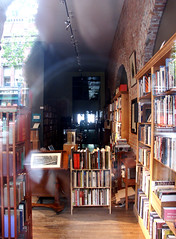
In a Screen Age, the eye is glutted and the sense of touch is starved. The electronic book robs us of the erotics of paper. Sure an audio clip could emulate the sound of turning pages, just as a screen could impersonate a specific copy of a book – J. Edgar Hoover’s Lolita, say, replete with obscene marginalia (I’m making this up) – but never its feel.
Smart as it is, electronic paper can’t learn, by which I mean it can’t wrinkle at the touch of wet fingers turning pages in the bathtub; can’t remember the stained ring of that glass of red wine you imprudently used to hold your place; can’t speak volumes, from its margins and endpapers, about everyone who has ever jotted a thought in it. “Implicit in the possession of a book is the history of a book’s previous readings – that is to say, every new reader is affected by what he or she imagines the book to have been in previous hands,” writes Alberto Manguel in his marvelous A History of Reading.…
The print medium’s saving grace, then, as any bibliophile knows who has ever caressed an onion skin page, inhaled the musk of old pages, run a satisfied finger along the serried ranks on her shelves. [Nicholson] Baker hints as much when he says, “I love the sound of turning pages. That’s one thing that paper does offer – that sound, as if you’re biting into an apple.”
Mark Dery reflecting on what he calls the “Gutenbook” in «Bound for Glory» in the July / August 2006 issue of Print.
Friday, August 25, 2006
to schmap or not to schmap
Okay. I owe Paul at locussolus some answers.
Q. So, will [Schmap] pay you for the use of the photo?
A. There was no offer of payment – but they did include a statement – which I’m cobbling together from memory because the page is no longer available – that said, in effect: we need your approval to use your photography because, even though you’ve allowed the use of your image under your Creative Commons license, Schmap does sell advertising. From that I inferred: Commercial Use.
Q: I'm curious, why the non-commercial restriction?
A: In the spirit of free play and filling the world with more-derivative-work goodness I choose to assign the Creative Commons Attribution-NonCommercial-ShareAlike 2.5 license to the work that I post here at detritus and at flickr. For folks who may be unfamiliar with Creative Commons, this flavor of licensing allows others to:
So long as they do so under the following conditions:
But I don’t think this next comparison is applicable to the current context:
Schmap is – or certainly will, at some point – be making money off of their product, which is a mash-up of royalty-free and copyrighted content. (It’s also, by the way, pretty cool – except for the fact that they require a client-side install rather than running it as a web app.)
What left me uneasy about accepting their terms was this: I compromised my right to collect royalties on creative property that I created that will, if the folks running the show at Schmap do their jobs right, make somebody some money. (I was director of an ecommerce operation for awhile – I can attest to the dollars that come through the door when these businesses are run right – even through advertising alone.)
A quick search on Technorati reveals that hundreds of people were contacted by Schmap in the last few days with a request to use their imagery. That’s a lot of shooters who aren’t going to share in the profits that will be generated by a product that relies on their work. And I suspect that’s only a sub-set.
My concern is that, as photographers, writers and musicians who share our work online, we have a responsibility to police ourselves -- Guild-like -- so that the power remains with the People – because if we don’t, the Man will be all over it and make it his.
The pop music allusion resonates strongly with me because my father is a musician and, as a result of signing a bad contract when he was young and trusting in the 60s, he was precluded from making much money from his own music – because the contract he agreed to ensured that the lion’s share of the profits from his work wound up in someone else’s pocket.
That hurt my father, and that hurt my family. And not just financially.
He went on, as a man with a hard won savvy about the music industry, to try another side of the business and wound up making Elektra and Windham Hill a ton of money -- and yeah, he got a good salary out of that for himself and for his family. But it was always someone else who was making the music at that point and, knowing what a brilliant musician he is and how much he loves to play for the people, that has always made me tremendously sad.
His story is part of our family database -- it shaped me and my outlook on what matters and it taught me this: Nothing’s more important than creating. Nothing’s more important than sharing what you create. And nothing’s more important than owning your story at the end of the day, so you can feed your family and feed your soul.
Q. So, will [Schmap] pay you for the use of the photo?
A. There was no offer of payment – but they did include a statement – which I’m cobbling together from memory because the page is no longer available – that said, in effect: we need your approval to use your photography because, even though you’ve allowed the use of your image under your Creative Commons license, Schmap does sell advertising. From that I inferred: Commercial Use.
Q: I'm curious, why the non-commercial restriction?
A: In the spirit of free play and filling the world with more-derivative-work goodness I choose to assign the Creative Commons Attribution-NonCommercial-ShareAlike 2.5 license to the work that I post here at detritus and at flickr. For folks who may be unfamiliar with Creative Commons, this flavor of licensing allows others to:
• Copy, distribute, display, and perform the work
• Make derivative works
So long as they do so under the following conditions:
• By Attribution. You must attribute the work in the manner specified by the author or licensor.Here’s the part where things got turned around when I gave Schmap my consent to use my image for commercial use:
• Noncommercial. You may not use this work for commercial purposes.
• Share Alike. If you alter, transform, or build upon this work, you may distribute the resulting work only under a license identical to this one.
• Any of these conditions can be waived if you get permission from the copyright holder.Now on to the meat of the discussion. I suspect we don't disagree all that much, Paul – but I do think I was sketchy about explaining what I meant in my original post. In response to my post you wrote:
But I also see a tremendous value in having the vast majority of that professional world go away. It's not inconceivable now to think about everyone in the entire world having the opportunity to photograph, write, create music, and publish all of it. Surely this possibility for unlimited human expression is more important than the interests of a few professionals whose services aren't valuable enough to really differentiate them in the first place. There will still be professionals; their numbers will just be limited to what the market can support (and yes, there will still be a market) or how much a government is willing to subsidize.I think we’re all agreed that the publishing Tsunami that’s sweeping across the Internet right now is on par with the changes Gutenberg brought to Medieval Europe. It’s power to the people and it’s all good.
But I don’t think this next comparison is applicable to the current context:
I mentioned pop music before because I seriously doubt that suttonhoo would be conflicted if she were a singer releasing pop songs on her blog for free. What if I posted a novel in this space tomorrow? Nobody would worry about the harm it might inflict on Jonathan Safron Foer's next offering.If I were promoting my own music or my own novel I’d be all over that – because I’m promoting my own work with the intention of gaining something through that promotion – either for myself, or for someone I designate.
Schmap is – or certainly will, at some point – be making money off of their product, which is a mash-up of royalty-free and copyrighted content. (It’s also, by the way, pretty cool – except for the fact that they require a client-side install rather than running it as a web app.)
What left me uneasy about accepting their terms was this: I compromised my right to collect royalties on creative property that I created that will, if the folks running the show at Schmap do their jobs right, make somebody some money. (I was director of an ecommerce operation for awhile – I can attest to the dollars that come through the door when these businesses are run right – even through advertising alone.)
A quick search on Technorati reveals that hundreds of people were contacted by Schmap in the last few days with a request to use their imagery. That’s a lot of shooters who aren’t going to share in the profits that will be generated by a product that relies on their work. And I suspect that’s only a sub-set.
My concern is that, as photographers, writers and musicians who share our work online, we have a responsibility to police ourselves -- Guild-like -- so that the power remains with the People – because if we don’t, the Man will be all over it and make it his.
The pop music allusion resonates strongly with me because my father is a musician and, as a result of signing a bad contract when he was young and trusting in the 60s, he was precluded from making much money from his own music – because the contract he agreed to ensured that the lion’s share of the profits from his work wound up in someone else’s pocket.
That hurt my father, and that hurt my family. And not just financially.
He went on, as a man with a hard won savvy about the music industry, to try another side of the business and wound up making Elektra and Windham Hill a ton of money -- and yeah, he got a good salary out of that for himself and for his family. But it was always someone else who was making the music at that point and, knowing what a brilliant musician he is and how much he loves to play for the people, that has always made me tremendously sad.
His story is part of our family database -- it shaped me and my outlook on what matters and it taught me this: Nothing’s more important than creating. Nothing’s more important than sharing what you create. And nothing’s more important than owning your story at the end of the day, so you can feed your family and feed your soul.
open wide
A man’s work is nothing but this slow trek to rediscover, through the detours of art, those two or three great and simple images in whose presence his heart first opened.
Albert Camus as quoted by Anna Deavere Smith
recall
a found poem
do not expose
do not disassemble
or mistreat
failure to follow
these instructions
may present risk
(explosion, fire,
high temperatures)
From the back of a Dell Battery Module Rechargeable Li-ion Battery Type C1295
Check out this comments thread for more background on this found poetry thing »
do not expose
do not di
or mistreat
failure to follow
these instructions
may present risk
(explosion, fire,
high temperatures)
From the back of a Dell Battery Module Rechargeable Li-ion Battery Type C1295
Check out this comments thread for more background on this found poetry thing »
harry callahan

This woman [who] was talking about my photographing grasses went into some big
philosophic thing. I told her that that particular spot was the only
place I could park my car. I didn't say that to be nasty to her, but to
show that those things are part of life too.
Harry Callahan, Photographer, quoted in 1994
Crushing hard on the work of Harry Callahan, which I saw for the first time ever while I was playing hookey yesterday at the Chicago Art Institute.
Am I the last person in the world to hear of "one of the most important American photographers of the 20th Century"? Sheesh. I gotta get out more.
short listed

I am writing to let you know that one of your photos with a creative commons license has been short-listed for inclusion in the second edition of our Schmap Dublin Guide, to be published mid-September 2006.
Clicking this link will take you to a page where you can:
i) See which of your photos has been short-listed.
ii) Submit or withdraw your photo from our final selection phase.
Best regards,
Ali Moss,
Managing Editor, Schmap Guides
I have unsettled feelings about Creative Commons licensing -- like an unpaid bill it nags at me – I’m sure there’s a hidden penalty in there somewhere, and the sooner I look at it the better my chance of doing something about it. But instead I just let it sit there.
I don't shoot for a living (or have any ambition to do so) so I'm flattered when someone wants to use my photography for something like this. But I know that the abundant availability of free imagery that sites like Flickr have made possible, will (and probably has) made it more difficult for working photographers to sell their imagery for purposes like these -- the bread and butter of folks who work in the trade.
I could have refused the short list option -- it steps outside the bounds of the Creative Commons license that I've assigned, actually, which precludes commercial use.
I probably should have. But I didn't.
Thursday, August 24, 2006
first day
Treat yourself to a great read by a master blogger »
(Limitless thanks to b1-66er for introducing me to Shädy Äcres: The fix like no other.)
(Limitless thanks to b1-66er for introducing me to Shädy Äcres: The fix like no other.)
killer carp
Dude, one time I was on my boat, and I had this Canadian dancer on there with me. So we were sitting there, and this carp jumped out of the water and hit this girl right in the face. Bam! It split her lip. There was blood everywhere. I had to take her to the emergency room, and she had eight stitches on her lip. It was horrible, man.
Chad Pregracke speaking of the scourge that is the Asian carp (now creeping up on the Great Lakes) in the September | October issue of «Orion»
My country ‘tis of thee: land of the invasive species. (Which, if I’ve got my family history right, would include me.)

if today is your birthday
This is for all you double-yod-venus-rising-leo-cusping-virgos out there with a birthday today:
I suspect my life would be very different if any of this were true.
Does this apply if my mother’s labor was induced? (It was.)
“Foreboding of loss”? Me? Miss Merry Sunshine?
“Pleasure in isolation” is a nice way of saying “no one wants to be near you, Virgo. You’re too picky and you're the only one who laughs at your jokes.”
Italy? Never been. Terracotta pots? Guilty. But the scarves don’t go on the walls: they’re for wearing.
Now you’ve lost me.
From some random astrolology site.
And did I mention that the weather's in the toilet and WBEZ kicked off their pledge drive today? All. The Stars. Have aligned.
This creature embodies all the alluring qualities which make so many of their admirers want to murmur 'Come live with me and be my love'. The best kind of cusp cocktail, there is fire in the heart, lightness in the wit, and a steadiness of concentration which can impress the cleverest people in the land.
I suspect my life would be very different if any of this were true.
In effect, August 24 catches Leo's last brilliant rays, twists them round a cocktail stick and slips the golden wand into the luscious dark velvet of their psychology. The women are much pursued, not least for their mystery. She doesn't try to be mysterious. On the contrary, she is bright, witty and can sometimes be the gorgeous focal attention of a party.
Does this apply if my mother’s labor was induced? (It was.)
But for all the friendliness, there's that feeling you just can't grasp her. Many give even their closest loved ones a prickly sensation, foreboding of loss, even when there's absolutely no indication of anything but happiness.
“Foreboding of loss”? Me? Miss Merry Sunshine?
You are always trying to hang on to August 24 and always glad you have a firm hold because somebody else is trying to lure them away. Many people pursue some kind of academic career, or at least research. They are clever, yes, but what takes them onwards is dedication to a subject and pleasure in isolation, which of course ain't easily accomplished in open plan offices.
“Pleasure in isolation” is a nice way of saying “no one wants to be near you, Virgo. You’re too picky and you're the only one who laughs at your jokes.”
She favours Italy, in particular the south with its stinging heat and the dusty white light. She brings back terracotta pots and bright scarves which she puts on shelves and hangs on walls.
Italy? Never been. Terracotta pots? Guilty. But the scarves don’t go on the walls: they’re for wearing.
She's a girl who is made for motherhood and can expect quite a few pregnancies, not all planned and very possibly either from different fathers, or a second batch of babies several years after the first.
Now you’ve lost me.
From some random astrolology site.
And did I mention that the weather's in the toilet and WBEZ kicked off their pledge drive today? All. The Stars. Have aligned.
Wednesday, August 23, 2006
compression and release
Unity Temple is the only building that’s ever made me cry.
It caught me by surprise -- but I suspect Frank Lloyd Wright knew exactly what he was doing when he designed it. He forces anyone who wishes to enter the sanctuary to first descend into a cloistered walkway (which runs in a tight, squared embrace, around the whole of the worship space – you could lap it in 2 or 3 minutes, easy) and then forces them again to ascend – single file -- into the sanctuary.
It’s that ascent up the steep narrow walkway, into a gorgeous angular space that is three stories high and shockingly intimate; that brought tears to my eyes.
Any FLW fan will tell you how he did it: with compression and release.
Wright was the master of lowering the lid – bringing the space in snug and tight around his occupants -- and then lifting it again into a soaring space that is both theatrical and habitable – to create a frame around domestic life.
I had a chance to see the Dana-Thomas house over the weekend and was reminded of Wright’s flair for the dramatic all over again. Built on 16 different levels, the house frames out multiple stages, platforms, barrel ceilings and performance spaces – all which live organically with myriad intimate nooks and conversation spaces. The massive home was built to be theatrical from day one: Sarah Lawrence Dana-Thomas, daughter of one of the richest men in Springfield (a mason and friend of Lincoln with government contracts) commissioned it after the death of her second husband (there would be one more before she was done) to entertain. She also opened her checkbook wide to Wright.
What more could a drama queen like FLW want?
Not much, it would seem. I have no shots of the interior to share – interior shots aren’t allowed, and the gift shop, for some unknown reason (but almost certainly because someone else owns the copyright) doesn’t sell a color catalog of the house (only one in black and white) – so please pardon my sputtering as I try to explain what happens there.
Through a beautiful accident of history when an attempt was made to auction the contents of the home in 1941 – all of which Wright designed and assigned to their appointed place – no one wanted them. As a result 90% of the furnishings and finishes remain intact. And – in one of those stories that docents love to tell – the State of Illinois (which owns the house now, having bought it back from a publishing company that had used it as offices for many years) re-acquired one lovely Wright designed stained-glass lamp that had gone missing at auction not too many years ago – for $750,000.
When it was built almost 100 years ago the entire house, with all of its furnishings, cost about $60,000. (To be fair: that’s equal to $4.5 million today.) (Interesting to compare what a dollar will buy you -- Mies’ Farnsworth House cost about the same sum, and was built about half a century later.)
The upshot is that the visitor has a chance to experience Wright at his most organic – surrounded not only by the striking modernity of his framed walls – but by the intimacy and elegance and harmony of his furnishings. The long, lean lines of oak; the jewel box details of art glass; and always the progression from stage to stage – up steps to the next level, tight little stairways and passageways which open into great big gorgeous barrel vaulted ceilings.
One of my favorite details was in the lower level – below ground, but it would be too pedestrian to call it a basement – Wright constructed a duck-pin bowling lane, framed by warm stucco walls under an arched ceiling. We encountered it on the tail-end of the tour – I thought for certain, after all our walking, that it was tucked into the back corner of the house – but it turned out to be tucked away right under the front door.
The Dana-Thomas House is unlike anything I’ve experienced before in a building. When folks talk about Wright’s desire to control the contents of the home – down to the dress of the woman of the house – the story is cited (generally with laughter) as an example of his overweening desire to control his clients.
But the space that he created with the Dana-Thomas house is not controlling – it doesn’t force conformity – it creates a stage for people to do what people do. To come together – in conversation and shared meals and experiences – in close, intimate compressions – that evolve into larger, theatrical expressions – whether in the performance spaces (Carl Sandburg read there; John Philip Sousa played there) or in the bedrooms (unfortunately the docent provided no details – but isn’t that where the best human dramas wind up?). And isn't it through human intercourse (conversational and otherwise) that we undergo transformation?
The Dana-Thomas House is a sociologist’s dream.
I have a little bit more to say but I’ll save it for later. In the meanwhile, here’s a slideshow of the home’s exterior »
Regrets that I can’t show you the real workings of the interior – you’re gonna have to roadtrip to Springfield to see it for yourself.
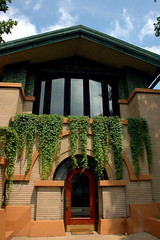
It caught me by surprise -- but I suspect Frank Lloyd Wright knew exactly what he was doing when he designed it. He forces anyone who wishes to enter the sanctuary to first descend into a cloistered walkway (which runs in a tight, squared embrace, around the whole of the worship space – you could lap it in 2 or 3 minutes, easy) and then forces them again to ascend – single file -- into the sanctuary.
It’s that ascent up the steep narrow walkway, into a gorgeous angular space that is three stories high and shockingly intimate; that brought tears to my eyes.
Any FLW fan will tell you how he did it: with compression and release.
Wright was the master of lowering the lid – bringing the space in snug and tight around his occupants -- and then lifting it again into a soaring space that is both theatrical and habitable – to create a frame around domestic life.
I had a chance to see the Dana-Thomas house over the weekend and was reminded of Wright’s flair for the dramatic all over again. Built on 16 different levels, the house frames out multiple stages, platforms, barrel ceilings and performance spaces – all which live organically with myriad intimate nooks and conversation spaces. The massive home was built to be theatrical from day one: Sarah Lawrence Dana-Thomas, daughter of one of the richest men in Springfield (a mason and friend of Lincoln with government contracts) commissioned it after the death of her second husband (there would be one more before she was done) to entertain. She also opened her checkbook wide to Wright.
What more could a drama queen like FLW want?
Not much, it would seem. I have no shots of the interior to share – interior shots aren’t allowed, and the gift shop, for some unknown reason (but almost certainly because someone else owns the copyright) doesn’t sell a color catalog of the house (only one in black and white) – so please pardon my sputtering as I try to explain what happens there.
Through a beautiful accident of history when an attempt was made to auction the contents of the home in 1941 – all of which Wright designed and assigned to their appointed place – no one wanted them. As a result 90% of the furnishings and finishes remain intact. And – in one of those stories that docents love to tell – the State of Illinois (which owns the house now, having bought it back from a publishing company that had used it as offices for many years) re-acquired one lovely Wright designed stained-glass lamp that had gone missing at auction not too many years ago – for $750,000.
When it was built almost 100 years ago the entire house, with all of its furnishings, cost about $60,000. (To be fair: that’s equal to $4.5 million today.) (Interesting to compare what a dollar will buy you -- Mies’ Farnsworth House cost about the same sum, and was built about half a century later.)
The upshot is that the visitor has a chance to experience Wright at his most organic – surrounded not only by the striking modernity of his framed walls – but by the intimacy and elegance and harmony of his furnishings. The long, lean lines of oak; the jewel box details of art glass; and always the progression from stage to stage – up steps to the next level, tight little stairways and passageways which open into great big gorgeous barrel vaulted ceilings.
One of my favorite details was in the lower level – below ground, but it would be too pedestrian to call it a basement – Wright constructed a duck-pin bowling lane, framed by warm stucco walls under an arched ceiling. We encountered it on the tail-end of the tour – I thought for certain, after all our walking, that it was tucked into the back corner of the house – but it turned out to be tucked away right under the front door.
The Dana-Thomas House is unlike anything I’ve experienced before in a building. When folks talk about Wright’s desire to control the contents of the home – down to the dress of the woman of the house – the story is cited (generally with laughter) as an example of his overweening desire to control his clients.
But the space that he created with the Dana-Thomas house is not controlling – it doesn’t force conformity – it creates a stage for people to do what people do. To come together – in conversation and shared meals and experiences – in close, intimate compressions – that evolve into larger, theatrical expressions – whether in the performance spaces (Carl Sandburg read there; John Philip Sousa played there) or in the bedrooms (unfortunately the docent provided no details – but isn’t that where the best human dramas wind up?). And isn't it through human intercourse (conversational and otherwise) that we undergo transformation?
The Dana-Thomas House is a sociologist’s dream.
I have a little bit more to say but I’ll save it for later. In the meanwhile, here’s a slideshow of the home’s exterior »
Regrets that I can’t show you the real workings of the interior – you’re gonna have to roadtrip to Springfield to see it for yourself.
Frank Lloyd Wright's Dana-Thomas House
301 East Lawrence Avenue
Springfield, Illinois 62703
Tuesday, August 22, 2006
a house divided

One of the most impressive presentations at a museum that strives to impress (that would be the Lincoln Museum in Springfield, IL – a multimedia spectacular that puts Disneyland’s robotronic Lincoln to shame) is a brief four minute movie -- an animated timeline, actually -- that plots the progress of the Civil War from the point of Lincoln’s election, through secession, his inauguration, and on to battle.
The Union and Confederacy are represented in blue and red (ya think they could have used blue and grey, but oh no -- had to be blue and red), and as the clock ticks -- with one second equal to one week -- the battlefront oscillates and morphs and serpentines, punctuated with the brief explosions of battles (Shilo, Antietam, Gettysburg), as the body count tallies in the corner (over 1 million before the war is done). Then Sherman marches to the sea and cuts the final gash that seals the surrender of the South.
The movie closes with Lincoln’s assassination.
Edward Tufte would be proud – it’s brilliant information design.
I, frankly, was a wreck.
[Image Credit: The flag graphic above is by Rolyn Barthelman of NYC who created it after the last presidential election.]
Monday, August 21, 2006
wholesomeness and pureness

I know a guy who married a girl from Springfield, Illinois. When I told him I was heading down to Springfield for the weekend he said: “I’m sorry.” And then he recommended the Maid-Rite – home of the famous “loose meat sandwich”.
The Maid Rite is a classic Midwestern success story: The kind of World Famous you’ve never heard of. Here’s the story from the Xeroxed hand-out that they keep behind the counter, right next to the matchbooks that look like they were typeset in 1932:
In the early 1920s, butcher Fred Angell created a special cut and grind of meat, then added selected spices, to create a new ground beef sandwich.
A delivery man, upon tasting the sandwich, remarked that the sandwich was ‘made right’. The name MAID-RITE, adapted to mean “wholesomeness and pureness,” has remained part of the Midwestern landscape ever since.
Making it perhaps the first – and last time -- in our American culture that “loose meat” has been associated with “wholesomeness and pureness”.

A Maid-Rite sandwich is -- as the man who married into Springfield described it to me -- like a sloppy joe without the sloppy -- no sauce, just spices. Dressed up just like a burger, with mustard, onion and pickles. And to add to the novelty, the Maid-Rite also has the distinction of having “one of the first” drive-through windows -- which may well be why it landed itself on the National Register of Historic places.
Whatever the reason, the good news is that because of the designation, the homemade root beer and loose meat of the Maid Rite – franchise-that-failed-to-flower though it may be – isn’t going anywhere anytime soon.
Which is good news for those of us whom, having done pretty much all there is to do in Springfield, won’t be passing through again anytime soon. (Unless it’s for another fix of Wright’s Dana Thomas House. Details to follow soon.)
Maid Rite Sandwich Shop
118 N. Pasfield Ave.
Springfield, IL
el hefe

We are a sports brand. We are making products for athletes, we are not making them for leaders.Travis Gonzales, head of public relations for Adidas, commenting on Castro’s jacket in the shot the Cuban government released of the leader during his convalescence, in this morning’s New York Times.
For what it’s worth, he added, Adidas also provides athletic shoes to President Bush.
Sunday, August 20, 2006
a. lincoln

Young America is very anxious to fight for the liberation of enslaved nations and colonies, provided, always, that they have land.
As to those who have no land and would be glad of help, he considers they can wait a few hundred years longer.
Abraham Lincoln on the Mexican-American War
opening franco's graves
There is no place where there are no graves.
Francisco Extxeberría, a forensic doctor who volunteers with ARMH (the Recovery of Historical Memory) quoted in Mike Elkin's piece «Opening Franco's Graves» in the September/October issue of «Archaeology» about the mass graves of Franco dead that are beginning to be disinterred in Spain.
Thursday, August 17, 2006
all food-on-a-stick; all weekend long

We’re trying to keep a dinosaur alive that’s probably outlived its purpose.
William M Napoli, a State Senator from South Dakota, commenting on the money that’s funneled into supporting state fairs – and how little of that is actually returned – in yesterday’s New York Times.
Seems like we’re considerably behind the curve on this one: Driving the old Route 66 down to the Springfield this weekend for a State Fair fix (the website of which is worth checking out for the cheese factor alone) and to spend a little quality time with my boy Abe.
I’ll be moblogging all the food-on-a-stick offerings I can scare up – and anything else worth shooting in scenic Southern Illinois. (Woo. Hoo.)
The road show begins Friday night »
whole lotta sweetness
Unlike some brave souls I passed on a full weekend of Patty doing the Rose at Ravinia -- fearing mostly that, after a night like Friday, I’d be left like Semele when she begged Zeus to give it to her full on – and was split in half by the force of what he had to give.
I opted instead to hang out in a dark cellar of a theatre with the playwright Jeffrey Sweet.
Not a bad trade.
I only knew a little bit about this guy going in – the Chicago Dramatists blurbed him as an influence behind Wicked, so I was ready to be disappointed. A succession of phone calls on Saturday morning that pushed back the start time by three and half hours only added to the dread. But that turned out to be Amtrak’s fault, and the workshop – which was billed as a Playwriting Nuts and Bolts Intensive -- delivered the goods.
Two days later I came out with moleskine packed with techniques for turning it on, and a head full of stories from a man who’s lived his life in the theatre.
Sweet is a fierce technician with a great sense for a good story. He's also a gorgeous gossip and a name dropper and I loved every minute of it: How can you not get excited about hearing someone tell a story they got straight from Jack Klugman -- about being there the day that Clifford Odets returned to NYC (to run Golden Boy through rehearsals) from D.C. -- where he had just named the names of half of his Golden Boy cast and crew to Joe McCarthy. (Talk about a rough day at the office.) (Rat fink.)
Also came away with a list things to read and watch and listen to – some for a second time:
The weekend also succeeded in splitting me down the middle (kinda like Semele) -- torn between the impulse to do nothing but write and the impulse to do anything else at all.
I opted instead to hang out in a dark cellar of a theatre with the playwright Jeffrey Sweet.
Not a bad trade.
I only knew a little bit about this guy going in – the Chicago Dramatists blurbed him as an influence behind Wicked, so I was ready to be disappointed. A succession of phone calls on Saturday morning that pushed back the start time by three and half hours only added to the dread. But that turned out to be Amtrak’s fault, and the workshop – which was billed as a Playwriting Nuts and Bolts Intensive -- delivered the goods.
Two days later I came out with moleskine packed with techniques for turning it on, and a head full of stories from a man who’s lived his life in the theatre.
Sweet is a fierce technician with a great sense for a good story. He's also a gorgeous gossip and a name dropper and I loved every minute of it: How can you not get excited about hearing someone tell a story they got straight from Jack Klugman -- about being there the day that Clifford Odets returned to NYC (to run Golden Boy through rehearsals) from D.C. -- where he had just named the names of half of his Golden Boy cast and crew to Joe McCarthy. (Talk about a rough day at the office.) (Rat fink.)
Also came away with a list things to read and watch and listen to – some for a second time:
The Apartment
Beyond Culture
Fires in the Mirror
Waiting for Lefty
Daughter of Time
The Collection
The Gin Game
The Cradle Will Rock
The Dramatist's Toolkit
The weekend also succeeded in splitting me down the middle (kinda like Semele) -- torn between the impulse to do nothing but write and the impulse to do anything else at all.
Subscribe to:
Posts (Atom)