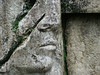
Some eyecandy for your evening, courtesy of Flickrite !esco&guilmon!
A Malleable Inconvenience »
If you clickthrough on the above link for the slideshow and then dial the timing way down so that a frame flashes every second or so, you might find (as I did) that it's curiously reminiscent of Dali and Buñuel's Un Chien Andalou.
Maybe it's the eyeball. Or maybe it's just me making freaky associations again, where no real affinity exists.
Friday, April 13, 2007



record of invention
So I leaned over to my Higgs Bosen buddy at a break during our committee meeting last night and asked him, what with all the news on the new Collider: “Have you been to Cern lately?” (don't I sound urbane? ;) Which of course resulted in some gossip (apparently Fermi Labs has embarrassed themselves badly with an exploding magnet), and delightful use of language (when particle physicists talk about ramping up a new particle accelerator, they say that they’re going to: “get some beam up” – slowly, so as not to compromise the equipment – and then, over time, they’ll “move up to top energy”) and then led into the most extraordinary napkin-sketch conversation.
He’s just filed a record of invention – predecessor to prototyping, forerunner to any possible patent – for a tremendously cool device that would provide energy efficiently and at practically no cost – if it works.
All this he sketched on a scrap of paper for my wondering eyes and made perfectly plain sense of for my fascinated-by-physics-but-not-entirely-savvy-to-it ears.
And of course I’d like to tell you all about it, but seeing how they still need to ramp up a prototype (at the Department of Energy’s expense) that would probably be breaching a trust and the what of it isn’t important anyway, is it?
What’s important is that people think these things up. Manufacture them out of nothing more than grey cells and coffee gone cold and the pure night air. (And oh, right, government funding.)
Wandering around Rodin’s bronze folk at Stanford the other night I got to wondering the thing I wonder a lot whenever I’m moved by a masterful artist’s art: Why do I need this? And why did you, my friend the artist, feel compelled to create it? To drop everything else and just do this? For me. For all of us.
The courage of that astonishes me. I have such a compulsion to be useful – even the way I make my livelihood grew out of that compulsion – much as I love it, it was more or less accidental. I saw an opportunity to do something, something that I did reasonably well, something that other people found to be of use, something they’d pay me to do so that I could eat.
And I like to eat. So I kept on doing it.
But to quit everything else and only create things because they’re beautiful?
M’s sketch last night – the invention – the whole thing was about harnessing energy. Spinning coils and magnetic fields and laser beams – all to harness this one thing and put it to beautiful use. Born of pure imagination, it may well find a useful end. But only because he dreamed the beautiful thing into being. Only because he allowed it to be.
He’s just filed a record of invention – predecessor to prototyping, forerunner to any possible patent – for a tremendously cool device that would provide energy efficiently and at practically no cost – if it works.
All this he sketched on a scrap of paper for my wondering eyes and made perfectly plain sense of for my fascinated-by-physics-but-not-entirely-savvy-to-it ears.
And of course I’d like to tell you all about it, but seeing how they still need to ramp up a prototype (at the Department of Energy’s expense) that would probably be breaching a trust and the what of it isn’t important anyway, is it?
What’s important is that people think these things up. Manufacture them out of nothing more than grey cells and coffee gone cold and the pure night air. (And oh, right, government funding.)
Wandering around Rodin’s bronze folk at Stanford the other night I got to wondering the thing I wonder a lot whenever I’m moved by a masterful artist’s art: Why do I need this? And why did you, my friend the artist, feel compelled to create it? To drop everything else and just do this? For me. For all of us.
The courage of that astonishes me. I have such a compulsion to be useful – even the way I make my livelihood grew out of that compulsion – much as I love it, it was more or less accidental. I saw an opportunity to do something, something that I did reasonably well, something that other people found to be of use, something they’d pay me to do so that I could eat.
And I like to eat. So I kept on doing it.
But to quit everything else and only create things because they’re beautiful?
M’s sketch last night – the invention – the whole thing was about harnessing energy. Spinning coils and magnetic fields and laser beams – all to harness this one thing and put it to beautiful use. Born of pure imagination, it may well find a useful end. But only because he dreamed the beautiful thing into being. Only because he allowed it to be.
Beauty is its own excuse for being. — Emerson
steely amanuensis
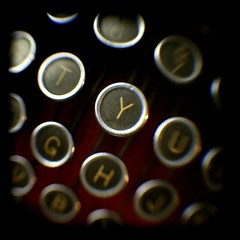
Why?
Originally uploaded by ReyGuy.
a found poem
It is strange and pleasing
That a machine famed
For its cold efficiency
Issued from the hands
Of this modest and distracted man [1]
He wore battered hats
One historian says.
His trousers were inches too short
[In later years]
He soon disowned the [typewriter]
Refused to use one
Or even
To recommend its use
[And yet]
Nietzsche used a typewriter
In the effort to stem his migraines
And incipient blindness
(Symptoms of syphilis)
Mark Twain was the first
To deliver a typewritten manuscript
To a publisher [2]
For many years after his death
[The] devoted typist [of Henry James] [3]
Claimed that she was still receiving
[His] dictation
(Indeed
Through her spirit medium
She was informed that
Thomas Hardy, George Meredith,
And John Galsworthy
All as dead as James
Also wanted to use
Her stenographic services.)
William S. Burroughs wrote
And may have believed
That a machine he called
The Soft Typewriter
Was writing our lives
And our books
Into existence
Found in The Typing Life: How writers used to write, Joan Acocella's review of Darren Wershler-Henry's new book The Iron Whim: A Fragmented History of Typewriting, in this week's New Yorker Magazine.
[1] Christopher Latham Sholes, from Milwaukee, was the inventor of the typewriter that was marketed to great success by Remington after the Civil War (when the market for guns dried up). The machine was the first to deploy the QWERTY keyboard, designed to be inefficient so that the typewriter’s keys wouldn’t jam together. According to Wershler-Henry: “Reportedly, Sholes’s partner delegated his son-in-law, the superintendent of schools for western Pennsylvania, to draw up a list of the most common two-letter sequences in the English language. Sholes then designed the keyboard so that these pairs were separated, thus introducing a tiny delay between the activation of one letter and the next.”
[2] The manuscript was Life on the Mississippi
[3] Theodora Bosanquet
Thursday, April 12, 2007

mmmmmmmm. bacon.
N = C + {fb (cm) • fb (tc)} + fb (Ts) + fc • ta
In which:
N = force in newtons
fb is the function of the bacon type
fc is the function of the condiment or filling effect
Ts is the serving temperature
tc is cooking time
ta is the time taken to insert the condiment or filling
cm is the cooking method
C represents the breaking strain in newtons of uncooked bacon
The formula that best describes the bacon sandwich, or "bacon butty", as devised by Researchers at Leeds University and reported in yesterday's New York Times.
According to the researchers, perfection of the bacon butty is realized through the attainment of the perfect crunch, which is understood as follows: "the amount of force in the bite, expressed in newtons, and the level of noise, expressed in decibels. … Ideally ... 0.4 newtons should be applied to crunch the sandwich, creating 0.5 decibels of noise."
Wednesday, April 11, 2007
goodnight, baby.

Photo: Fred R. Conrad/The New York Times
Hello, babies. Welcome to Earth. It’s hot in the summer and cold in the winter. It’s round and wet and crowded. At the outside, babies, you’ve got about a hundred years here. There’s only one rule that I know of, babies — ‘God damn it, you’ve got to be kind.’
From Kurt Vonnegut's 1965 novel God Bless You, Mr. Rosewater, as cited in the New York Times obituary for the writer, who passed away today at 84.
Even though on two different occasions two different friends (neither of whom knew the other) told me of encounters with the esteemed Mr. Vonnegut in his twilight years, sloshed at one literary after hours gathering or another, behaving badly and leering at the young women -- even still I love the man.
Love the way his words take shape on the page and play their music in the ear. Love, most of all, just to hear what he has to say.
Goodnight, Mr. Vonnegut. Safe home.
Tuesday, April 10, 2007
clothes make the man
We got spontaneous reports from the women that we never got from the males, comments like "I would have liked the photos better if the people didn't have those ridiculous '70s hairstyles."
Dr. Kim Wallen of Emory University as cited by Natalie Angier in Birds Do It. Bees Do It. People Seek the Keys to It. in today's New York Times.
Dr. Wallen comments on the fact that in a scientific study on sexual desire, conducted by Emory University, women showed a marked preference (over men) for images of men performing cunilingus on other women. They also noticed more fashion details.
(Which reminds me of a story that a friend once told me about a girl in her grade school whose name was Connie Lingus…)
the malady of the quotidian
a found poem
There is a peculiar intensity about some streets in Dublin
which becomes more gnarled and layered the longer you live
in the city
and the greater the stray memories
and associations you build up.
Sometimes this sense of the city
can be greatly added to by history and by books;
sometimes, however, the past
and the books
hardly matter
seem a strange irrelevance.
On a busy day it is easy to go
into the GPO in O’Connell Street
without a single thought
for MacDonagh and MacBride and Connolly and Pearse
or without remembering
for a second
that Samuel Beckett once asked his friend to
measure the height of the ground to Cúchulainn’s arse’
the ancient Irish hero
patron saint of pure ignorance and crass violence.
The need to buy a stamp
or a TV licence
or fill in a form
is often too pressing
the queues too long
the malady of the quotidian
too richly detailed to be bothered by heroes.
Found in Darlings: Colm Tóibín on Beckett’s Irish Actors in the 5 April issue of the London Review of Books.
It is a not insignificant artifact of my life that I am homeless. Meaning, that although I have more than sufficient shelter, I have no ancestral home to return to. The one that I might have claimed, my grandfather’s, was sold long ago, and my parents have long since moved elsewhere (each to a different destination) to places that have very little purchase in my heart, although they’re pleasant enough, all three (counting a step-parent in there).
For that reason, home for me means the company of the people I love. And, not insignificantly, the memory of their company is tied, concretely and discretely, to the places where we exchanged evidence of that mutual accord – through conversation, the squeeze of a hand, a shared look, a snug hug, a tumble beneath sheets.
I realized recently with a start that this specificity of geography in the landscape of my heart is also tied tightly to time. This occurred to me when, just this last week, I asked a colleague to let me off at the top of Taylor Street in San Francisco, with the intention of walking down to my hotel. I stepped out of the car and discovered that I was directly in front of my girlfriend M’s place – or at least where she was living when I visited her in the early 90s. She’s somewhere in Vermont now. I was just married at the time, to a man who would make me a chump, but I didn’t know that yet and thought myself luckier than most. It was a time bender, to stand there and remember a very different set of circumstances when I visited her back then; and to wonder how much of that Me is still left?
This is a question that comes to mind often lately: “Where have I gone?”
Or, more to the point: “Where am I?”
Traveling west of the Mississippi stirs it up the most, seeing friends that are tied, in my mind, to that landscape leaves me longing for a home that I’ve lost. Living in Chicagoland I feel sometimes that I’m a stranger to myself. This landscape doesn’t store up memories for me, and yet there’s something about the broad sweep and openness of this place that has become inhabited with parts of me that I’m still getting to know. Older. A bit more detached.
All of this came to mind as I read Colm Tóibín’s piece this morning in the London Review of Books, because it reminded me of crossing a street in Dublin just about a year ago now, and spotting a distinguished gentleman whose carriage emulated my Irish grandfather’s almost exactly. I embarrassed myself, without thinking, by stopping and staring with an impolite familiarity. Although I stood a distance from him my sudden stillness was enough to catch his attention and he turned to look, startled, at what I was up to. Our eyes locked. There was no smile, just puzzlement at the rude American. I wonder still how much I gave away. I wanted nothing so much at that moment in time than to sob and reach out to the ghosts that are my home and bring them close to me.
But of course, there’s no holding a ghost.
The moment passed, and we moved on.
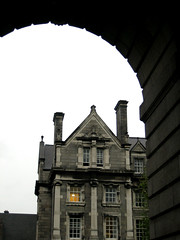
There is a peculiar intensity about some streets in Dublin
which becomes more gnarled and layered the longer you live
in the city
and the greater the stray memories
and associations you build up.
Sometimes this sense of the city
can be greatly added to by history and by books;
sometimes, however, the past
and the books
hardly matter
seem a strange irrelevance.
On a busy day it is easy to go
into the GPO in O’Connell Street
without a single thought
for MacDonagh and MacBride and Connolly and Pearse
or without remembering
for a second
that Samuel Beckett once asked his friend to
measure the height of the ground to Cúchulainn’s arse’
the ancient Irish hero
patron saint of pure ignorance and crass violence.
The need to buy a stamp
or a TV licence
or fill in a form
is often too pressing
the queues too long
the malady of the quotidian
too richly detailed to be bothered by heroes.
Found in Darlings: Colm Tóibín on Beckett’s Irish Actors in the 5 April issue of the London Review of Books.
It is a not insignificant artifact of my life that I am homeless. Meaning, that although I have more than sufficient shelter, I have no ancestral home to return to. The one that I might have claimed, my grandfather’s, was sold long ago, and my parents have long since moved elsewhere (each to a different destination) to places that have very little purchase in my heart, although they’re pleasant enough, all three (counting a step-parent in there).
For that reason, home for me means the company of the people I love. And, not insignificantly, the memory of their company is tied, concretely and discretely, to the places where we exchanged evidence of that mutual accord – through conversation, the squeeze of a hand, a shared look, a snug hug, a tumble beneath sheets.
I realized recently with a start that this specificity of geography in the landscape of my heart is also tied tightly to time. This occurred to me when, just this last week, I asked a colleague to let me off at the top of Taylor Street in San Francisco, with the intention of walking down to my hotel. I stepped out of the car and discovered that I was directly in front of my girlfriend M’s place – or at least where she was living when I visited her in the early 90s. She’s somewhere in Vermont now. I was just married at the time, to a man who would make me a chump, but I didn’t know that yet and thought myself luckier than most. It was a time bender, to stand there and remember a very different set of circumstances when I visited her back then; and to wonder how much of that Me is still left?
This is a question that comes to mind often lately: “Where have I gone?”
Or, more to the point: “Where am I?”
Traveling west of the Mississippi stirs it up the most, seeing friends that are tied, in my mind, to that landscape leaves me longing for a home that I’ve lost. Living in Chicagoland I feel sometimes that I’m a stranger to myself. This landscape doesn’t store up memories for me, and yet there’s something about the broad sweep and openness of this place that has become inhabited with parts of me that I’m still getting to know. Older. A bit more detached.
All of this came to mind as I read Colm Tóibín’s piece this morning in the London Review of Books, because it reminded me of crossing a street in Dublin just about a year ago now, and spotting a distinguished gentleman whose carriage emulated my Irish grandfather’s almost exactly. I embarrassed myself, without thinking, by stopping and staring with an impolite familiarity. Although I stood a distance from him my sudden stillness was enough to catch his attention and he turned to look, startled, at what I was up to. Our eyes locked. There was no smile, just puzzlement at the rude American. I wonder still how much I gave away. I wanted nothing so much at that moment in time than to sob and reach out to the ghosts that are my home and bring them close to me.
But of course, there’s no holding a ghost.
The moment passed, and we moved on.
Monday, April 09, 2007
isn't that special?
In digital you can be so much more special.
Richard Prenderville, head of global brand marketing at Reebok, Canton, MA, as quoted in last Thursday's DM News.
with malice aforethought
Do you think this is the first 6-year-old we've arrested?
Chief of Police Frank Mercurio, commenting on the arrest of Desre'e Watson on 28 March. Desre'e is a 6-year old who threw a tantrum in her Avon Park, Florida, kindergarten class.
Cited in Bob Herbert's column: 6-Year-Olds Under Arrest in this morning's New York Times.
Sweet mother of god: We've gone completely round the bend.
Sunday, April 08, 2007
xela

Shot last December. It's been a while since I've been out with my camera and I was moping around today (for that and other reasons) so I dug through some old files for a little medicine.
remembering rodin
Had a chance to see this fellow and his compadres by moonlight when I passed through Palo Alto a few days ago. I expect to make it back in the daylight with a camera before the month is out, but I'm doubtful that it'll be possible to capture the impact that this place had on me.
Some moments -- and everything they contain -- just don't shoot well.
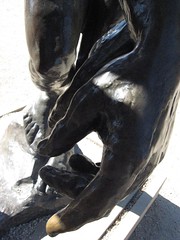
Some moments -- and everything they contain -- just don't shoot well.
reading light
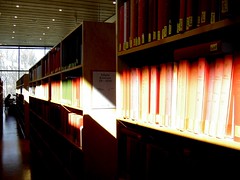
This is one of the defining sorrows of books: that we cannot see one another.
From John Hodgman's Areas of My Expertise
Saturday, April 07, 2007
skin deep
façade-ectomy
The practice, gaining in popularity in Chicago, of preserving only the facade of historic buildings in the belief that this qualifies as historic preservation.
Architecture critic Blair Kamin laments the situation in The Danger of Becoming Skin Deep, in this Sunday's edition of the Chicago Tribune.
Here's a slideshow of some of the sites he mentions in the piece »
The practice, gaining in popularity in Chicago, of preserving only the facade of historic buildings in the belief that this qualifies as historic preservation.
Architecture critic Blair Kamin laments the situation in The Danger of Becoming Skin Deep, in this Sunday's edition of the Chicago Tribune.
Here's a slideshow of some of the sites he mentions in the piece »
hurry up and wait
Or: How to survive a 3 hour pre-dawn layover in Detroit while trying to get home to Chicago after catching the redeye out of SFO.
• Walk the length of the terminal with luggage in tow.
• Walk it again.
• Purchase a bottle of water from one of the few open shops and slurp it down while walking the length of the terminal.
• Wonder at all the sleeping people.
• Wonder if you could just nap a little bit without almost missing your flight like that time in Amsterdam.
• Keep walking.
• Watch the sunrise come up over Gate A9.
• Replay the golden moments of the last few days through your brain. Wonder at why it hurts so much to say goodbye to friends. Realize you know why. Wish there was a workaround.
• Long for bed. Long for dreams. Long to brush your teeth.
• Cave and get some coffee.
• Realize you're past that -- coffee can't help you now.
• Keep on walking.
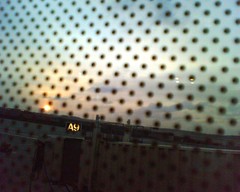
• Walk the length of the terminal with luggage in tow.
• Walk it again.
• Purchase a bottle of water from one of the few open shops and slurp it down while walking the length of the terminal.
• Wonder at all the sleeping people.
• Wonder if you could just nap a little bit without almost missing your flight like that time in Amsterdam.
• Keep walking.
• Watch the sunrise come up over Gate A9.
• Replay the golden moments of the last few days through your brain. Wonder at why it hurts so much to say goodbye to friends. Realize you know why. Wish there was a workaround.
• Long for bed. Long for dreams. Long to brush your teeth.
• Cave and get some coffee.
• Realize you're past that -- coffee can't help you now.
• Keep on walking.
Friday, April 06, 2007
long lonely thoughts
Posting by cameraphone from the Airtrain Station at SFO.
Heading home on the redeye.
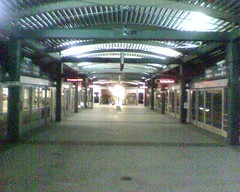
Heading home on the redeye.

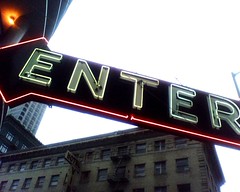
walk this way
Oh do not ask what is it
Let us go and make our visit.
-- T.S. Eliot
Posting by cameraphone from San Francisco.
Let us go and make our visit.
-- T.S. Eliot
Posting by cameraphone from San Francisco.
Thursday, April 05, 2007
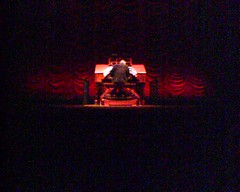
gee ma, it's a wurlitzer! [1]
Intermission at the Stanford Theatre
Palo Alto, CA
[1] Google Ian Whitcomb for this one (posting by cameraphone from the Bay Area)
Palo Alto, CA
[1] Google Ian Whitcomb for this one (posting by cameraphone from the Bay Area)
Wednesday, April 04, 2007
the eye's camera
This was the shot I missed just now, cabbing
camera-less through San Francisco's Tenderloin
district on the way to my hotel:
camera-less through San Francisco's Tenderloin
district on the way to my hotel:
A long, lanky derelict man sucking on a rainbow
popsicle while seated against a brilliantly colored
street mural. The sun was shining and he wore
a scowl as he looked to one side.
minnesota nice
Mauling victim has deep wounds but no ill will.
Headline in today's Minneapolis Star Tribune
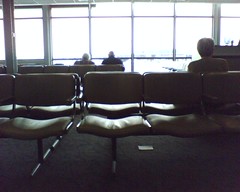
picniking at the gate
Transferring in the Twin Cities -- home of the Mall of America and Target too, I think. The airport certainly doesn't disappoint -- shopping abounds.
These far Northerners really have merchandising down.
These far Northerners really have merchandising down.
Tuesday, April 03, 2007
table manners
Sharing a meal, sometimes sitting face to face with strangers, is a curious act that sets humans apart from all other animals on the planet. So strange is this behaviour, yet so important to the development of society and communication, that plenty of scientists and philosophers have tried to decode the origins and history of the human meal.
Kate Colquhoun reviews Feast: Why Humans Share Food by Martin Jones in the 27 March issue of the Telegraph.
I want to know if Jones touches on when we decided it was rude to put our elbows on the table. I'm increasingly struck by how this taboo limits engagement when you're sharing a meal with someone; pulling you back and away from the place of exchange and engagement; calming your body language, hands in your lap, so that animation is stilled, the body is made passive, and conversations evolve in much different directions than they might have otherwise.
I have elected to break this taboo repeatedly, and without compunction. Particularly after the last plate has been cleared and there is still some wine left to drink.
Monday, April 02, 2007
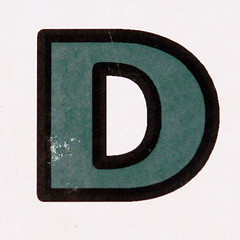
brought to you by the letter "D"
D
Originally uploaded by Leo Reynolds.
found, but not really a poem
D is for
daleth, or door
an ancient Assyrian symbol
for the "gate of heaven"
Mystics say it symbolizes
the breast or the bosom
even the vulva
The Greeks considered
their delta
the letter of Demeter
In its triangular form
resides all three aspects of the goddess:
Demeter, Persephone, Kore
The Pythagoreans preferred it
for its geometry
D is for
the waxing of the year
twin to the letter T
sacred to the druids
who call it duir
and associate it with the oak
the planet Jupiter
and Thursday
The ruinic sign
was named daeg
meaning "day"
and was equated with light
The first and least tangible
yet most desired gift
More or less found and cobbled together from The Alphabet Abecedarium, which I'm picking through instead of working, because I'm tired of working, even though I still have much work to do.

Sunday, April 01, 2007
more leftovers


Like dew that vanishes
like a phantom that disappears
or the light cast
by a flash of lightening—
so should one think of oneself.
Ikkyu Sojun
Trans. Steven Carter
Saturday, March 31, 2007
leftover

A few years back I bought a wonderful free-form steel trellis from my girlfriend enyasi's garden shop in West Seattle. I had it shipped home to Chicago, and hesitated for only a moment about whether or not I should rust-proof it, before deciding to install it as is and let the weather have its way with it.
It's now a wonderful rust-covered free-form trellis, and this is the last of last year's clematis which clung to it through the harsh winds and cold and snow of the Chicago winter and is just starting to bud.
Yay, Spring.
coda

From page A3 of today's New York Times (read: beaucoup bucks to run this puppy): A Saks Fifth Avenue ad for a "Printed Led-Zeppelin zip-front hoodie, $145"
so. wrong.
chi
chi -- when pronounced "chee", Ch'i is an idea prevalent in China; it is: "the natural force of the universe [that] encompasses all things" (quoting equusigns, who is also the originator of these lovely letterforms and this image); I see an acupuncturist frequently and am always amazed at how I feel physically after those sessions, when she's stirred up the Chi and it dances through my bones and veins.
chi -- when pronounced "shy", Chi is a nickname for Chicago, "Chi-town", my adopted hometown
chi -- when pronounced "Ki" (long "i") Chi is the Greek letter "X"; Greece is the first foreign land I fell head over heels in love with for its archaeology and its mythology and its climate and its history and its people; it is the 22nd letter of the alphabet that I set myself to memorize in high school just because I thought it would be cool (such. a. freak.)
chi -- when sounded out as an anagram, CHI stands for "Computer Human Interaction" design, the thing I do for a living
chi -- when rolled into something entirely new, chi pom pom pom is the enigmatic name of lolabola's blog, the beautiful bailaora whom I have never met, but who seems like an old friend because her blog has become a regular fix (maybe, if she spots this, she'll tell us where the name came from :)
No moral to this story. Just spotted equusigns' lovely letterforms this morning and got to thinking about the ways that these three letters touch my life.

chi -- when pronounced "shy", Chi is a nickname for Chicago, "Chi-town", my adopted hometown
chi -- when pronounced "Ki" (long "i") Chi is the Greek letter "X"; Greece is the first foreign land I fell head over heels in love with for its archaeology and its mythology and its climate and its history and its people; it is the 22nd letter of the alphabet that I set myself to memorize in high school just because I thought it would be cool (such. a. freak.)
chi -- when sounded out as an anagram, CHI stands for "Computer Human Interaction" design, the thing I do for a living
chi -- when rolled into something entirely new, chi pom pom pom is the enigmatic name of lolabola's blog, the beautiful bailaora whom I have never met, but who seems like an old friend because her blog has become a regular fix (maybe, if she spots this, she'll tell us where the name came from :)
No moral to this story. Just spotted equusigns' lovely letterforms this morning and got to thinking about the ways that these three letters touch my life.
Friday, March 30, 2007
i've got a crush on you
Mr. John Hodgman was kind enough to post this image, which I originally posted to the h in sunrays Flickr group, to his blog, good evening.
Remember that feeling you'd get when you passed that cute boy you had a crush on, and just maybe he'd say hi in a way that made it clear it was no big deal to him -- but it definitely was to you?
Yeah. Feels something like that.
That is all.
Remember that feeling you'd get when you passed that cute boy you had a crush on, and just maybe he'd say hi in a way that made it clear it was no big deal to him -- but it definitely was to you?
Yeah. Feels something like that.
That is all.
an open letter to David Plouffe, Campaign Manager, Obama for America
Finally got fed up and sent the good folks at Obama for America an email:
Hi David:
I'm an online marketing specialist[1] and a Barack Obama supporter, and I'm concerned that you're making a misstep in the way you've chosen to use email in the early days of this campaign.
Too much fund raising; too little substance.
You're going to lose your audience in a hurry as they tune out to your appeals for more money.
Your base needs to hear about the issues that matter -- updates on what Obama's doing, where he's been, who he's talking to -- and include tips on how they can help spread Obama's message -- and the money will follow. Please trust me on this. (A "donate now" button is fine at the tail end of the message -- but the messages need more substance and emotional appeal than the ones you've been mailing.)
Jakob Nielsen did a great job of summing up how Bush outperformed Kerry in the email space in the 2004 election -- here's a snippet:
here's a link to his analysis:
http://www.useit.com/alertbox/20040920_lastweek.html
and here's another piece that Nielson did that you might find useful:
http://www.useit.com/alertbox/20040920.html
Please don't make the same mistakes that Kerry did -- use email to mobilize your base, not turn them off -- we've gotta bring this one home.
thanks for your time. let's put Mr. Obama in the White House.
[1] I didn't footnote this in the actual letter, but in the interest of full disclosure, online marketing is only one of the things I do. but it was the most relevant to the conversation, doncha think?
Hi David:
I'm an online marketing specialist[1] and a Barack Obama supporter, and I'm concerned that you're making a misstep in the way you've chosen to use email in the early days of this campaign.
Too much fund raising; too little substance.
You're going to lose your audience in a hurry as they tune out to your appeals for more money.
Your base needs to hear about the issues that matter -- updates on what Obama's doing, where he's been, who he's talking to -- and include tips on how they can help spread Obama's message -- and the money will follow. Please trust me on this. (A "donate now" button is fine at the tail end of the message -- but the messages need more substance and emotional appeal than the ones you've been mailing.)
Jakob Nielsen did a great job of summing up how Bush outperformed Kerry in the email space in the 2004 election -- here's a snippet:
As this analysis shows, Kerry supporters were bombarded by repeated fundraising requests, to the extent that many of them probably tuned out the newsletter in the final critical days. Although the Internet is great for collecting money from the masses, there is a limit. Kerry exceeded it. ... In summary, Kerry used his newsletter to collect money during the final week. Bush used his to increase voter turnout, and he won because he was better at turning out his base. Understanding the strength of email newsletters thus directly contributed to Bush's victory, so his Internet team can claim some credit for the outcome.
here's a link to his analysis:
http://www.useit.com/alertbox/20040920_lastweek.html
and here's another piece that Nielson did that you might find useful:
http://www.useit.com/alertbox/20040920.html
Please don't make the same mistakes that Kerry did -- use email to mobilize your base, not turn them off -- we've gotta bring this one home.
thanks for your time. let's put Mr. Obama in the White House.
[1] I didn't footnote this in the actual letter, but in the interest of full disclosure, online marketing is only one of the things I do. but it was the most relevant to the conversation, doncha think?
semiotics

Dairy Queen just unveiled a new logo. Following the pattern of UPS, Burger King, and other high-profile "rebranding initiatives," it's basically the old logo with a swoosh attached. DQ took it a step further, though, stating that the "gold and blue curved swishes [signify] food and treats."
No, it signifies an expensive hour of graphic design.
From Mark Hurst's Good Experience Newsletter. (Also posted online here »)
bring the nickel
a found poem
I can't say
how
every
time
I ever put my arms around you
I felt that I was home
Found in Racy Letters from Hemingway to Dietrich to Be Unsealed in this morning's New York Times.
Ernest Hemingway's letters to Marlene Deitrich have just been released -- they reveal a passionate, unconsummated affection between the two. Hemingway is on record as saying, in A.E. Hotchner's biography of the writer: "The thing about the Kraut and me is that we've been in love since 1934, since we first met on the Île de France, but we've never been to bed. Amazing but true. Victims of unsychronized passion."
Another sweet excerpt from Hemingway's letters:
I can't say
how
every
time
I ever put my arms around you
I felt that I was home
Found in Racy Letters from Hemingway to Dietrich to Be Unsealed in this morning's New York Times.
Ernest Hemingway's letters to Marlene Deitrich have just been released -- they reveal a passionate, unconsummated affection between the two. Hemingway is on record as saying, in A.E. Hotchner's biography of the writer: "The thing about the Kraut and me is that we've been in love since 1934, since we first met on the Île de France, but we've never been to bed. Amazing but true. Victims of unsychronized passion."
Another sweet excerpt from Hemingway's letters:
What do you really want to do for a life work? Break everybody's heart for a dime? You could always break mine for a nickel, and I'd bring the nickel.
Thursday, March 29, 2007
née (a quiz)
Which prominent consumer sites were originally born into the world as:
(Clickthrough for the answers.)
Source: How Consumers Find Web Sites in 2006 by Charlene Li for Forrester
• Jerry and David's Guide to the World Wide Web
• BackRub
(Clickthrough for the answers.)
Source: How Consumers Find Web Sites in 2006 by Charlene Li for Forrester
lady vervaine's reflections
Lady Vervaine is a particularly cinematic photographer -- she captures that fleeting feeling of time passing that is pervasive in motion pictures, but is difficult to capture in still frames. She pulls it off brilliantly, time and time again.
She writes for Vertigo, an independent film magazine, and introduced me (and many others) to the concept of shooting location stills of classic movies -- I still have it in my mind to hit all the scenes where Vertigo was shot the next time I'm in San Francisco (my sister was actually married, the first time, in that creepy church in the closing scenes -- although there is no bell tower, if I remember correctly). And I'm afraid to get started on Chicago locations, for fear that I'll wind up quitting my job to have time to shoot them all.
This morning I pulled up her stream and found a wonderful, reflective series (and you know how much I dig reflections) -- of people's portraits -- shot as their reflections in the bus windows of London.
Lovely stuff. Here's the tagged slide show »
She writes for Vertigo, an independent film magazine, and introduced me (and many others) to the concept of shooting location stills of classic movies -- I still have it in my mind to hit all the scenes where Vertigo was shot the next time I'm in San Francisco (my sister was actually married, the first time, in that creepy church in the closing scenes -- although there is no bell tower, if I remember correctly). And I'm afraid to get started on Chicago locations, for fear that I'll wind up quitting my job to have time to shoot them all.
This morning I pulled up her stream and found a wonderful, reflective series (and you know how much I dig reflections) -- of people's portraits -- shot as their reflections in the bus windows of London.
Lovely stuff. Here's the tagged slide show »
Wednesday, March 28, 2007

shadow on the wall
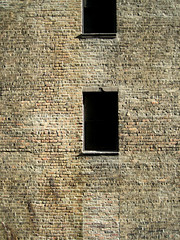
brick for barrett
Originally uploaded by suttonhoo.
a found poem
He would photograph a flower
Make a large painting of the photograph
Photograph the painting
Then
Destroy the painting
Once something was over, it was over
He felt no need to revisit it
It never really belonged to anybody
[He] long ago grew tired
Of leaving his shadow in the world
And had to let it go
Found in The Madness and Majesty of Pink Floyd in the 5 April 2007 issue of Rolling Stone, referring to Syd Barrett.
Also found, and no new news for folks who know these guys inside and out: the band’s name came from a mashup of “the first names of two obscure blues musicians, Pink Anderson and Floyd Council (and from the names of [Syd’s] cats)”.
(Tip for Hugh Laurie fans: He’s looking like a doll on page 66, same issue.)
Tuesday, March 27, 2007
transit
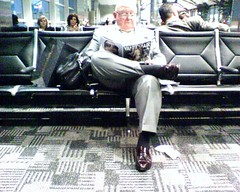
This image -- taken months ago with my cameraphone and forgotten in the cameraphone graveyard -- perfectly captures my mood right now, traveling back from Vermont after a friendly round of meetings with folks who were strangers only 48 hours ago.
They have things that need fixing. We told them a little bit how we can make things better. They want to hear more.
I feel useful. Needed. Adequate to the task. Content to be in the company of colleagues who make things like this easy.
And now I'm heading home -- airbound actually, but this pic -- the motion of the tracks, the flare of the sun -- captures the mood of this transit perfectly.
There's something about journeying that lives apart from the things that happen when you get there. Something liminal and in-between; thoughts are sometimes rareified, sometimes dulled, but the hours logged in the air or on the rails or the road are more like the hours logged when you dream than those that populate your waking life.
As long as these rails keep laying down beneath me, and the sun keeps flaring in my eyes, I'm on autopilot for a little while, and can live in these other thoughts that are far from the fears that have been nagging at me since I got the news of my grandmother's hospitalization, the whispered concerns that this might be Alzheimer's, the deep yawning hole of terror that we won't recap our memories anymore, that we won't laugh together, remembering, all that we've done, seen, and shared.
Contrary to all laws of nature my grandmother might forget us more and more as time goes by instead of learning and loving more, as family and dear friends do, as an artifact of that wonderful trick of the mind called memory.
But not yet. I don't have to think about that yet. Because I'm in transit. The rules are different here, and they save me from the knowledge that I cannot be useful in my grandmother's new world. The realization that it's likely that I'm not adequate to this task.
They have things that need fixing. We told them a little bit how we can make things better. They want to hear more.
I feel useful. Needed. Adequate to the task. Content to be in the company of colleagues who make things like this easy.
And now I'm heading home -- airbound actually, but this pic -- the motion of the tracks, the flare of the sun -- captures the mood of this transit perfectly.
There's something about journeying that lives apart from the things that happen when you get there. Something liminal and in-between; thoughts are sometimes rareified, sometimes dulled, but the hours logged in the air or on the rails or the road are more like the hours logged when you dream than those that populate your waking life.
As long as these rails keep laying down beneath me, and the sun keeps flaring in my eyes, I'm on autopilot for a little while, and can live in these other thoughts that are far from the fears that have been nagging at me since I got the news of my grandmother's hospitalization, the whispered concerns that this might be Alzheimer's, the deep yawning hole of terror that we won't recap our memories anymore, that we won't laugh together, remembering, all that we've done, seen, and shared.
Contrary to all laws of nature my grandmother might forget us more and more as time goes by instead of learning and loving more, as family and dear friends do, as an artifact of that wonderful trick of the mind called memory.
But not yet. I don't have to think about that yet. Because I'm in transit. The rules are different here, and they save me from the knowledge that I cannot be useful in my grandmother's new world. The realization that it's likely that I'm not adequate to this task.
Monday, March 26, 2007
Sunday, March 25, 2007
the motor city's hub(cap)
For what it's worth, you can pick up take out at the little sushi joint called Sora, somewhere around the 20-something gates at Detroit International's Northwest Terminal, in less time than it will take you to grab something at the McDonald's, Chili's or Starbucks just a few feet away.
Sora is always good and fresh (although their rolls demonstrate a lack of discipline and are a little looser than I like them) and while counter service is also quick, grabbing it to go to eat later while you wait (because there's always await -- this is an airport) gives you a few spare minutes to pick up a little vintage Stevie Wonder at the Motown shop (because there's always Motown -- this is Detroit) -- or to just stop and marvel at Michael's original nose. (Where have you gone, Jackson 5? We miss you.)
And if you're needing a quick shot of coffee after the first leg of your flight out of O'Hare, and your gate number's greater than 50, bypass the Starbucks in the center of the terminal and hold out for Carribou Coffee around gate 63. The service is just as glacial (is this a Detroit thing?) but the line is bound to be shorter, so you'll still make your flight in time.
All of this only applies, of course, if you're passing through the Northwest Terminal.
God help you if you're flying United -- because I certainly can't (see: "dumpy terminal", earlier in this stream).
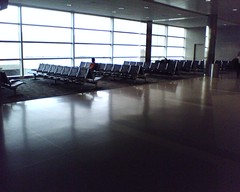
Sora is always good and fresh (although their rolls demonstrate a lack of discipline and are a little looser than I like them) and while counter service is also quick, grabbing it to go to eat later while you wait (because there's always await -- this is an airport) gives you a few spare minutes to pick up a little vintage Stevie Wonder at the Motown shop (because there's always Motown -- this is Detroit) -- or to just stop and marvel at Michael's original nose. (Where have you gone, Jackson 5? We miss you.)
And if you're needing a quick shot of coffee after the first leg of your flight out of O'Hare, and your gate number's greater than 50, bypass the Starbucks in the center of the terminal and hold out for Carribou Coffee around gate 63. The service is just as glacial (is this a Detroit thing?) but the line is bound to be shorter, so you'll still make your flight in time.
All of this only applies, of course, if you're passing through the Northwest Terminal.
God help you if you're flying United -- because I certainly can't (see: "dumpy terminal", earlier in this stream).
on the road again
I can sleep when I'm dead.
Grady Leno, CEO of Phone Sherpa, quoting his hardworking grandfather.
I'm sure other folks have said it, but I heard it first from Grady when we worked together, and I think of it every time I go on one of these work benders.
Off to Vermont. Updates from the road.
Saturday, March 24, 2007

to infinity and beyond
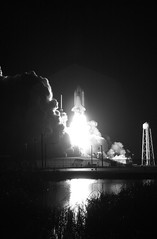
Space Shuttle Discovery
Originally uploaded by pingnews.com.
People stay here on full nights and say: "That's the weirdest room I've ever stayed in."
Cindy Schellenberg, desk agent at the Best Western Space Shuttle Inn near the Kennedy Space Center, commenting on the Inn's "Space Shuttle Fantasy Room" in this morning's New York Times.
The Space Shuttle Fantasy Room includes:
- Room for two in a "Space Shuttle bed" surrounded by the stars and planets
- The ability to "soak in the jetted tub as a Space Shuttle lands overhead"
- Complimentary champagne and scented soaps
- A mini-fridge
But it'll cost ya an extra $60/night.
I worked a gig for Reuters News Pictures during APEC in '93, coordinating photo-ops with Asia Pacific Rim leaders and their lackeys -- and learning the hard way that in Asia the surname takes the lead (humiliation was my teacher).
After a week's worth of excitement (which included making eye contact with Wolf Blitzer while he scarfed a quick lunch over a trash can) I went out for a meal with the photographers, and asked one old timer -- a real sweetheart who sported an uber-security clearance badge -- out of everything that he'd done and seen in his work, traveling the world as a photographer, what was the most amazing thing of all?
His answer surprised me.
"Any Space Shuttle launch."
He said to be up close, and feel the force and power of liftoff shake your whole body and drench you (with what? rocket fuel, I would imagine. or something very like it.) was unbeatably the most amazing thing he had ever experienced.
And this guy had seen a lot.
The Space Shuttle will be launching no more after 2010. Today's piece in the NYT -- The Shuttle May Go, But the Stories Will Linger -- talks about how that decision will impact the town surrounding the Space Center.
So if you're eager to book that Space Shuttle Fantasy room while there's still a space shuttle to fantasize about, here's the contact info (but don't try to book it online: the website throws a disconcerting error that reads: "This website is no longer able to accept online reservations. If you are the owner of this website please contact accounts receievable [sic] immediately." You might want to bring cash.):
BEST WESTERN
Space Shuttle Inn Kennedy Space Center
3455 Cheney Highway (Route 50)
Titusville, Florida 32780
(321) 269-9100
Rooms@SpaceShuttleInn.com
Friday, March 23, 2007
under the banyon tree
My Bompa took a long time to die, which meant a lot of time bedside or chairside, listening to stories, hearing him spin out the memories of his days like a skein of wool that needed knitting so we’d have something to keep us warm and remember him by after he left us.
One afternoon we sat in his room at the rehab center where he had been transferred after a brief hospitalization. We were listening to Glen Miller and waiting for my grandmother. He was hopeful that we’d all go out for lunch when she arrived, and suggested that we could go to that lovely place by the water under the Banyon tree. He named the place but I didn’t recognize it – I was even more curious about the Banyon. It was a tree I was unfamiliar with.
In our family, trees are our familiars. I can’t tell you how many times I’ve had a conversation with someone in my family about the loveliness of one tree or another (“I think that I shall never see…”); how many times we’ve debated the name of this species or that, and my grandmother always came up with the right answer. Always. So it was unusual to hear of one in my neighborhood that I had never met.
Bompa saw the puzzlement on my face and said: “Do you know about the Banyon tree?” No. I didn’t. “Oh!” he said – and took off, describing to me all of its wonderful qualities, and the joy of sitting beneath it. His eyes danced with light. I was getting hungry for the lunch we would have at this little restaurant that he loved, beneath the huge sheltering Banyon tree. We smiled together, I asked him more about the beautiful overarching tree, and he was happy to tell me all that he could. He. was. happy.
When Grama arrived I told her about our plans. Her smile fell suddenly and she said: “Arthur, you’re thinking of Hawai’i.”
My Bompa’s face fell as flat as hers. He looked disoriented, confused, chastised, uncertain.
She explained to him: You are in Seattle. You are not in Hawai’i. You are here. With us. In Seattle. There are no Banyon trees. You’re thinking of that place we loved in Hawai’i.
He looked miserable, and clearly he didn’t entirely believe her, but my grandfather, the brilliant litigator, couldn’t find the language or the logic or the evidence to argue his way out of this one.
I was thinking: Let up already, Grama. Let him be in Hawai’i if he wants to be in Hawai’i, goddammit. It makes him happy. Can’t you see how happy he is?
But, obedient granddaughter, I said nothing and looked at my hands in my lap. Embarrassed. Angry.
I don’t remember if we made it out the door for lunch that day. I don’t remember where we went. My memory stops at the look of pain that crossed my Bompa’s face, and at wondering why it was so important, so necessary, for my grandmother to bring him back, for her to be sure that he was HERE. With HER. Not lost somewhere in the depths of his memory.
I think I understand that desperation a little bit more now. For the last few weeks I’ve been receiving updates about my grandmother’s mental state from my aunt, and as the days pass they grow worse. Last night she wrote of my grandmother’s paranoid delusions – of bulging walls and intruders with murderous intent – and of her panicked wanderings through the halls of her assisted living community.
She’ll be hospitalized while we try to figure out if there’s any way to tame these anxieties.
And I find myself wishing that her aging brain would take her to that Banyon tree instead. Take her somewhere where her friends and family surround her, comfort her with memories. Not this strange and hostile territory where she knows no one and doesn’t belong.
Not this place where she’s all alone.

One afternoon we sat in his room at the rehab center where he had been transferred after a brief hospitalization. We were listening to Glen Miller and waiting for my grandmother. He was hopeful that we’d all go out for lunch when she arrived, and suggested that we could go to that lovely place by the water under the Banyon tree. He named the place but I didn’t recognize it – I was even more curious about the Banyon. It was a tree I was unfamiliar with.
In our family, trees are our familiars. I can’t tell you how many times I’ve had a conversation with someone in my family about the loveliness of one tree or another (“I think that I shall never see…”); how many times we’ve debated the name of this species or that, and my grandmother always came up with the right answer. Always. So it was unusual to hear of one in my neighborhood that I had never met.
Bompa saw the puzzlement on my face and said: “Do you know about the Banyon tree?” No. I didn’t. “Oh!” he said – and took off, describing to me all of its wonderful qualities, and the joy of sitting beneath it. His eyes danced with light. I was getting hungry for the lunch we would have at this little restaurant that he loved, beneath the huge sheltering Banyon tree. We smiled together, I asked him more about the beautiful overarching tree, and he was happy to tell me all that he could. He. was. happy.
When Grama arrived I told her about our plans. Her smile fell suddenly and she said: “Arthur, you’re thinking of Hawai’i.”
My Bompa’s face fell as flat as hers. He looked disoriented, confused, chastised, uncertain.
She explained to him: You are in Seattle. You are not in Hawai’i. You are here. With us. In Seattle. There are no Banyon trees. You’re thinking of that place we loved in Hawai’i.
He looked miserable, and clearly he didn’t entirely believe her, but my grandfather, the brilliant litigator, couldn’t find the language or the logic or the evidence to argue his way out of this one.
I was thinking: Let up already, Grama. Let him be in Hawai’i if he wants to be in Hawai’i, goddammit. It makes him happy. Can’t you see how happy he is?
But, obedient granddaughter, I said nothing and looked at my hands in my lap. Embarrassed. Angry.
I don’t remember if we made it out the door for lunch that day. I don’t remember where we went. My memory stops at the look of pain that crossed my Bompa’s face, and at wondering why it was so important, so necessary, for my grandmother to bring him back, for her to be sure that he was HERE. With HER. Not lost somewhere in the depths of his memory.
I think I understand that desperation a little bit more now. For the last few weeks I’ve been receiving updates about my grandmother’s mental state from my aunt, and as the days pass they grow worse. Last night she wrote of my grandmother’s paranoid delusions – of bulging walls and intruders with murderous intent – and of her panicked wanderings through the halls of her assisted living community.
She’ll be hospitalized while we try to figure out if there’s any way to tame these anxieties.
And I find myself wishing that her aging brain would take her to that Banyon tree instead. Take her somewhere where her friends and family surround her, comfort her with memories. Not this strange and hostile territory where she knows no one and doesn’t belong.
Not this place where she’s all alone.
Thursday, March 22, 2007
essentials
Earplugs and traffic cones: Two essentials for making it through the night and into the morning at the homeless shelter.
Earplugs are to shut out the snoring of strangers in close proximity; the traffic cone sits on the floor at the end of your sleeping pad -- the number correlates to the sign-in sheet upstairs where I or somebody like me (the volunteers who say, when you walk in the door and present your ID card: "hi -- how you doing -- overnight and a hot meal? bag lunch for tomorrow? and would you like an early wake up too?") the folks who write down your call time when you asked for 4.30 -- because "early" around here is any time before 6.30, when the lights come on and everybody else has to get up and out the door within the hour.
It's usually the folks with jobs who ask for the early wake up. They're the ones whose cones we find in the dark and then gently shake awake so they can head out into the pre-dawn and start the long peregrination by bus or train or foot to the minimum wage job that's not even barely keeping them fed or else we wouldn't see them back here tomorrow night.
Another essential, and harder to come by, as I learned when I scoured the office looking for one for a dear woman my mother's age, neatly dressed, whose poverty shows most acutely in the teeth that went missing long ago -- is a phone book.
Handy for tracking down businesses, handy for planning your next step, if you're not one of the ones lucky enough to need that early wake up call, and you're just trying to find yourself a job, so you can get out of this place and get yourself a home of your own -- where the only thing to shatter the snore free blissful silence is an alarm clock that you set your own damn self.
Phone books have the advantage of not requiring electricity, not requiring hardware and software, not requiring an Internet connection. And phonebooks, increasingly, are getting tossed in the trash bin because folks with all of the above can get the listings they need online.
While my friend on the other side of the desk, with none of the above, cannot.
Full disclosure: In my day job I'm one of the people who build those sites, so and I'm not advocating against them. It's just that I'm reminded every month when I work here that the digital divide is no myth. And it keeps getting wider.
Posting from the shelter.
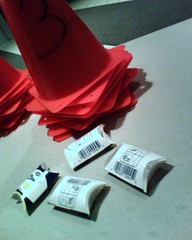
Earplugs are to shut out the snoring of strangers in close proximity; the traffic cone sits on the floor at the end of your sleeping pad -- the number correlates to the sign-in sheet upstairs where I or somebody like me (the volunteers who say, when you walk in the door and present your ID card: "hi -- how you doing -- overnight and a hot meal? bag lunch for tomorrow? and would you like an early wake up too?") the folks who write down your call time when you asked for 4.30 -- because "early" around here is any time before 6.30, when the lights come on and everybody else has to get up and out the door within the hour.
It's usually the folks with jobs who ask for the early wake up. They're the ones whose cones we find in the dark and then gently shake awake so they can head out into the pre-dawn and start the long peregrination by bus or train or foot to the minimum wage job that's not even barely keeping them fed or else we wouldn't see them back here tomorrow night.
Another essential, and harder to come by, as I learned when I scoured the office looking for one for a dear woman my mother's age, neatly dressed, whose poverty shows most acutely in the teeth that went missing long ago -- is a phone book.
Handy for tracking down businesses, handy for planning your next step, if you're not one of the ones lucky enough to need that early wake up call, and you're just trying to find yourself a job, so you can get out of this place and get yourself a home of your own -- where the only thing to shatter the snore free blissful silence is an alarm clock that you set your own damn self.
Phone books have the advantage of not requiring electricity, not requiring hardware and software, not requiring an Internet connection. And phonebooks, increasingly, are getting tossed in the trash bin because folks with all of the above can get the listings they need online.
While my friend on the other side of the desk, with none of the above, cannot.
Full disclosure: In my day job I'm one of the people who build those sites, so and I'm not advocating against them. It's just that I'm reminded every month when I work here that the digital divide is no myth. And it keeps getting wider.
Posting from the shelter.
Wednesday, March 21, 2007
stolen moments
If I'd know every plane that I might hope to hop out of LaGuardia was stacked one on top of another in the wake of severe electrical storms in Chicago, I probably would have taken more time this afternoon than the brief interlude I was able to steal (between a meeting that wrapped early and a cab that was destined to take me --jolting and revolting in one of those gotta accelerate full speed and then slam on my brakes even if I'm only inching forward a couple of feet rides) -- I probably would have lingered a little bit longer at the International Center for Photography.
Louise Brooks was there -- that's her up above in a shot swiped from the brochure for the "'New Woman' in Weimar Cinema" exhibit. Lovely stuff -- luminous, powerful, polyamorous -- but she was just the gravy.
I was there to see Henri Cartier-Bresson, in an exhibition of the "Scrapbook" photographs that he compiled for MoMA after he emerged from the grave -- literally -- escaping a German concentration camp after everyone thought he was dead.
And I was pleased and startled to see Martin Munkacsi, an Austrian photographer whose photography (one shot in particular -- that of three boys running into the sea) Bresson would later remark made him say "Damn!" and grab his camera and run into the street -- because he didn't know photography could look like that.
It was, to use Mr. Cartier-Bresson's phrase, a brief moment de graĉe -- a moment of extreme pleasure -- in a day that was otherwise nasty and brutish and, apparently, interminable.
Update from the desk -- another storm just hit Chicago. I may be here all night.
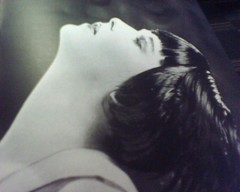
Louise Brooks was there -- that's her up above in a shot swiped from the brochure for the "'New Woman' in Weimar Cinema" exhibit. Lovely stuff -- luminous, powerful, polyamorous -- but she was just the gravy.
I was there to see Henri Cartier-Bresson, in an exhibition of the "Scrapbook" photographs that he compiled for MoMA after he emerged from the grave -- literally -- escaping a German concentration camp after everyone thought he was dead.
And I was pleased and startled to see Martin Munkacsi, an Austrian photographer whose photography (one shot in particular -- that of three boys running into the sea) Bresson would later remark made him say "Damn!" and grab his camera and run into the street -- because he didn't know photography could look like that.
It was, to use Mr. Cartier-Bresson's phrase, a brief moment de graĉe -- a moment of extreme pleasure -- in a day that was otherwise nasty and brutish and, apparently, interminable.
Update from the desk -- another storm just hit Chicago. I may be here all night.
the empire state wakes up
Staying in a postage stamp sized room where the A/C unit is positioned right next to my head -- correction: the A/C VENT is right next to my head.
But this was a nice perk -- woke up to discover the sun rising on the Empire State Building.
Posting by cameraphone from NYC.
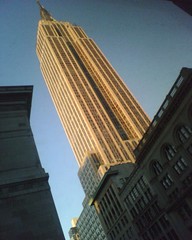
But this was a nice perk -- woke up to discover the sun rising on the Empire State Building.
Posting by cameraphone from NYC.
Tuesday, March 20, 2007
Lincoln slept here.
The bed from the boarding house where President Lincoln was taken and laid after Booth did his drama queen thing at the Ford Theatre.
He would be moved to the White House before he passed away.
Why do they always get the good ones?
Shot at the Chicago History Museum.
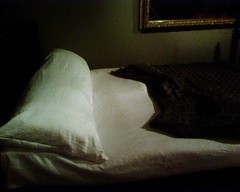
He would be moved to the White House before he passed away.
Why do they always get the good ones?
Shot at the Chicago History Museum.
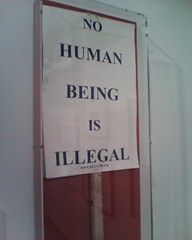
no human being is illegal
From last year's protests. Shot a little while back at the Chicago History Museum.
(Still circling.)
(Still circling.)
girls make media
Yeah, baby!
Leftover from Austin: Shot at Intellectual Property. Flickr'ng by cameraphone and trying not to go out of my &^%$# mind somewhere over Ohio. (Yes: wireless is turned off.)

Leftover from Austin: Shot at Intellectual Property. Flickr'ng by cameraphone and trying not to go out of my &^%$# mind somewhere over Ohio. (Yes: wireless is turned off.)
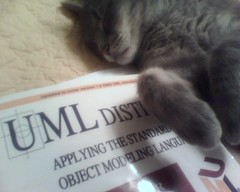
Charlie the UML Ubercat
Charlie's a Unified Modeling Language Zen Master. He's just taking a little break.
Killing time on my flight with "Airplane Mode" on -- queuing crap to upload that probably doesn't deserve to be uploaded.
We just entered a holding pattern -- and we're over an hour out from NYC. Could be a long night.
I really can't be held responsible for what you might see next.
(Can I just say that the gossiping gal with the shrill voice behind me is DRIVING ME NUTS?!?!)
Killing time on my flight with "Airplane Mode" on -- queuing crap to upload that probably doesn't deserve to be uploaded.
We just entered a holding pattern -- and we're over an hour out from NYC. Could be a long night.
I really can't be held responsible for what you might see next.
(Can I just say that the gossiping gal with the shrill voice behind me is DRIVING ME NUTS?!?!)
exposed
I was incredibly startled. The prize might be a stage for mockery — I might make a fool of myself on a grand scale. I imagined a scene out of a Brian De Palm movie. I felt like Carrie, covered in pig's blood.
It took me a week to accept the nomination. I had to think hard about the joys and threats of exposure.
Video artist Phil Collins commenting on his reaction to hearing the news that he had been nominated for the Turner Prize, as quoted in the 19 March issue of the New Yorker.
My kind of guy. Not so much the dripping in blood kind; more the fear of exposure kind.
unfortunate
Today's shard of memory is brought to you by Martin, who posted the liar's paradox ("A man says that he always lies. Is what he says true or false?"), which prompted the following comment from me, which I suspect was far too self-confessional, so I thought I would do the reasonable thing and convert it into a blog post because, really, isn't that where we oughta be getting all self-confessional anyway?
A long time ago I had dinner with my soon-to-be-ex- at a cheap sushi joint just as things were winding down between us -- we had filed the paperwork, all that remained was to appear before the judge.
He was making one last tearful appeal to me and I explained to him that I didn't believe him -- that he had lied for so long and so persistently and so well that he had lost all credibility.
It wasn't a bitter conversation. There wasn't a whole lot of rancor at the table. We had spent that long before. But a dull cloud of sadness hung over everything.
When it became clear that nothing more could be said he opened his fortune cookie and it read:
(Admittedly, it wasn't one of those belly laugh kind of laughs...)
A long time ago I had dinner with my soon-to-be-ex- at a cheap sushi joint just as things were winding down between us -- we had filed the paperwork, all that remained was to appear before the judge.
He was making one last tearful appeal to me and I explained to him that I didn't believe him -- that he had lied for so long and so persistently and so well that he had lost all credibility.
It wasn't a bitter conversation. There wasn't a whole lot of rancor at the table. We had spent that long before. But a dull cloud of sadness hung over everything.
When it became clear that nothing more could be said he opened his fortune cookie and it read:
A liar is never believed, even when he is telling the truth.It was one of the last laughs we shared together.
(Admittedly, it wasn't one of those belly laugh kind of laughs...)
Monday, March 19, 2007
three new things that I learned about eadweard muybridge today

Good evening, Major, my name is Muybridge and here is the answer to the letter you sent my wife.
What Eadweard Muybridge said to Major Harry Larkyns, who was sleeping with his wife, just before he shot and killed him. (Muybridge was acquitted on the grounds of "justifiable homicide". No word on how the wife took the news.)
Also learned that Muybridge did the same tricky thing with a buffalo as he did with that racehorse.
I've always liked the racehorse clip -- but for some reason the buffalo clip makes me go all melty inside.
Thanks, Wikipedia.
p.s. Wait -- one more: Phillip Glass wrote an opera based on the incident (the shooting, not the buffalo). And no, it's not available at Amazon. So that makes four. Four things.

Subscribe to:
Posts (Atom)